Research highlights

Nanoparticle coating eliminates reflection from glass

Reflection of light off glass surfaces is a problem occurring in everyday life, and hinders the performance of solar panels, smart phone and tablet displays. Researchers from FOM institute AMOLF have found a new and simple method to eliminate this reflection, by printing a silica nanopatterned antireflection coating onto the device.

The reflection of light from a material is determined by the refractive index. Glass, a material commonly used in solar panels and displays, has a refractive index of 1.5 and reflects 4% of incident light at its surface. The reflectivity can be reduced applying an anti-reflection coating, which must have a refractive index of 1.2 to eliminate the reflection completely. However, materials with such a low index do not exist in nature.

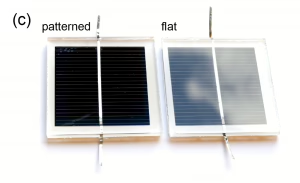
The AMOLF team used soft-imprint technology to fabricate an array of nanoscale glass cylinders onto a glass substrate. The effective index of this coating is determined by the density of the glass cylinders and was made to match exactly 1.2. By doing so, the combined reflectivity of the two sides of the glass substrate was reduced from 7.4% to 0.6%. The low reflectivity is maintained over a large range of angle of incidence, up to 50 degrees.

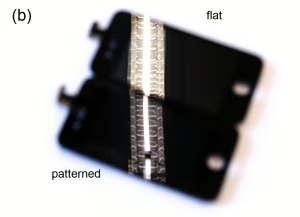
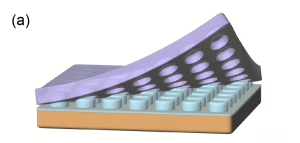
Soft-imprint lithography uses a flexible rubber stamp that transfers a nanoscale pattern into a liquid silica solgel layer that is first spin-coated on the glass substrate. After drying, the nanocoating is robust and water repellant. The researchers applied the nanocoating on miniature solar panels and showed that their efficiency increases by 2.8%. They also show how the glare from a nano-coated smartphone screen is effectively eliminated.

Albert Polman: “These experiments are the proof-of-principle. The next step is to exploit the fact that nanoimprint lithography can be expanded to an industrial scale, and work with manufacturers of solar panels and displays to apply our new, patented technology.”

Reference
Jorik van de Groep, Pierpaolo Spinelli, and Albert Polman, Single-step soft-imprinted large-area nanopatterned anti-reflection coating Nano Letters (2015) | DOI: 10.1021/acs.nanolett.5b01623
photonic materials albert polman jorik van de groep a
photonic materials albert polman jorik van de groep b
photonic materials albert polman jorik van de groep c

(a) Sketch of the fabrication process: the glass substrate is coated with a thin film of liquid silica solgel, which is patterned into nanocylinders by a single imprint step using a flexible stamp. (b) Photograph of reflection of fluorescent lighting off a smartphone screen with (bottom) and without (top) the nanopattern AR coating. A strong reduction in the brightness of the reflection is clearly visible. (c) Photograph of glass-encapsulated solar cells with (left) and without (right) nanopattern AR coating. The reflection of the clouded sky is clearly visible in the flat cell, whereas the patterned cell is completely dark.

Share article
What's happening

Most recent news items

All news items
Joining forces to study perovskite interfaces
People and recognition

Joining forces to study perovskite interfaces

AMOLF group leaders Professor Wiebke Albrecht and Professor Bruno Ehrler have received an NWO ENW-M2 grant for their joint research project, The Dynamic Atomic Interface between Halide Perovskites and Metals. The insights gained will pave the way for sustainable, high-performance solar energy and information technology. Wiebke and Bruno will each hire a PhD student for this project. The grant amounts to €800.000.

Read news item
Wim Noorduin and Arian van Asten presenting their scientific journey
People and recognition

Wim Noorduin and Arian van Asten presenting their scientific journey

On October 8, Professor Wim Noorduin and his collaborator Professor Arian van Asten (University of Amsterdam) presented their scientific journey in a video to the audience at the ‘Avond van Wetenschap en Maatschappij’. They did so alongside the other nominees for the Huibregtsen Prize.

Read news item
Natural phenomena ‘hyperuniform disorder’ enables highly efficient, thin silicon solar cells
Research highlights

Natural phenomena ‘hyperuniform disorder’ enables highly efficient, thin silicon solar cells

Silicon solar panels are rigid and heavy, and many rooftops cannot support them. This creates a need for thin, flexible solar cells that can be integrated into building materials. However, making silicon solar cells thinner makes it harder to trap light inside the material. Researchers in the 3D Photovoltaics group found a fascinating way to overcome this challenge using a phenomenon called hyperuniform disorder. They publish their findings in the journal ACS Photonics.

The researchers were able to make highly efficient silicon solar cell materials that are 30 times thinner than conventional ones. They managed to do this by integrating a layer of nanometer sized structures on top of the material. Up close, this pattern looks random, but it is remarkably when you step back: no clumps, no gaps, and no repeating pattern. This is called hyperuniform disorder (or HUD).

Read news item
Stay informed

Get the latest research highlights, events, and news from our institute delivered to your inbox