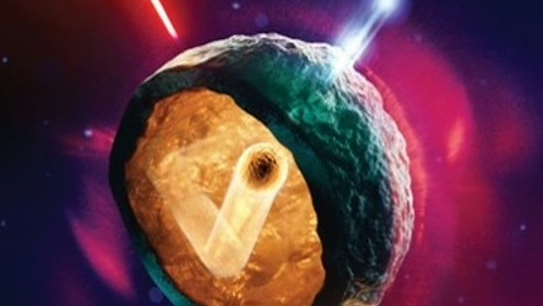
Together with researchers from the United Kingdom AMOLF group leader Bruno Ehrler studied a highly promising group of materials known as hybrid lead halide perovskites that can recycle light. The study builds on an established collaboration on the use of these materials not only in solar cells but also in light-emitting diodes, and was carried out by an international team led by the group of Richard Friend of the University of Cambridge.
Perovskite solar cells
Hybrid lead halide perovskites are a particular group of synthetic materials, which have been the subject of intensive scientific research, as they appear to promise a revolution in the field of solar energy. As well as being cheap and easy to produce, perovskite solar cells have, in the space of a few years, become almost as energy-efficient as silicon – the material currently used in most household solar panels.
Photon recycling
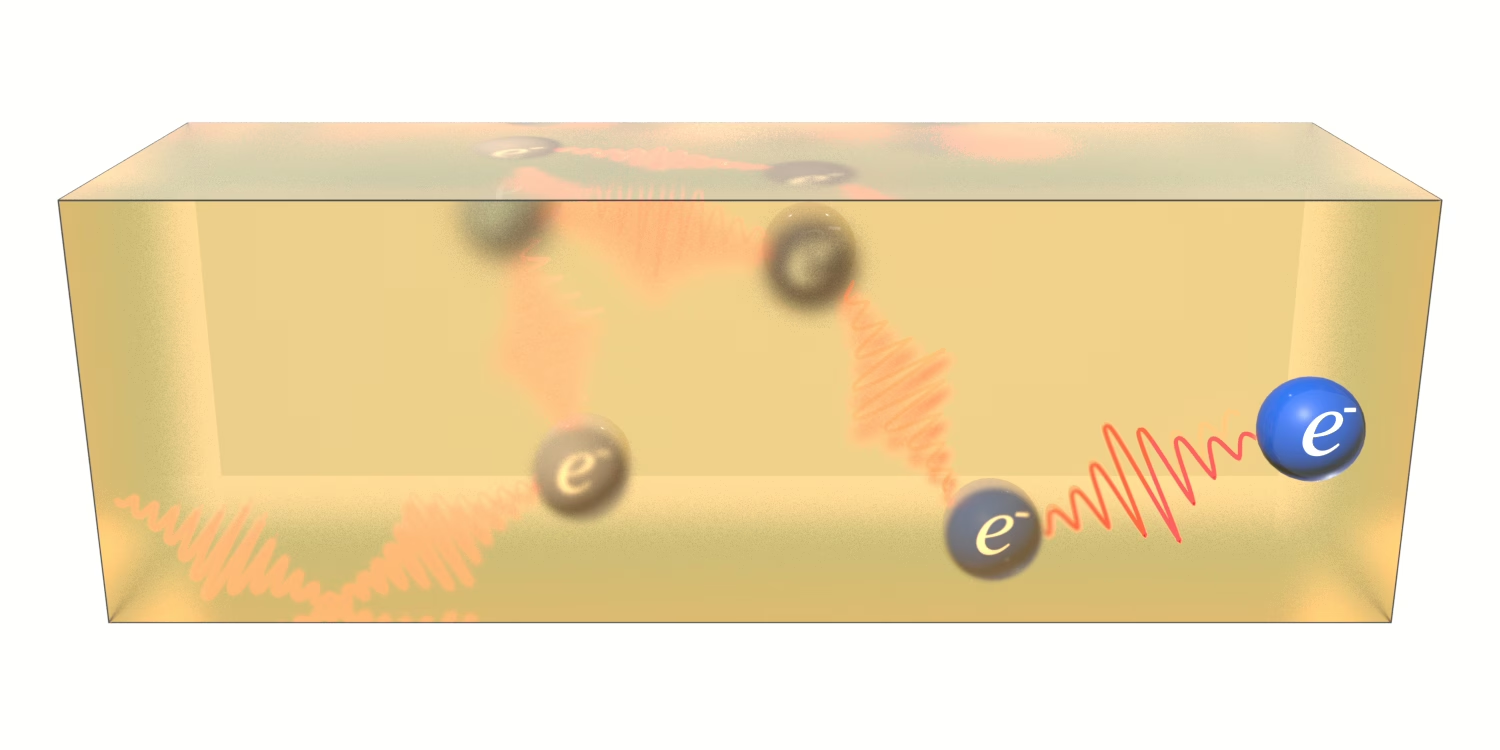
The new study, however, suggests that this could just be the beginning. Solar cells work by absorbing photons from the sun to create electrical charges, but the process also works in reverse, because when the electrical charges recombine, they can create a photon. The research shows that perovskite cells have the extra ability to re-absorb these regenerated photons – a process known as “photon recycling”. This creates a concentration effect inside the cell, as if a lens has been used to focus lots of light in a single spot. According to the researchers, this ability to recycle photons could be exploited with relative ease to create cells capable of pushing the limits of energy efficiency in solar panels.
Perovskite-based solar cells were first tested in 2012, and were so successful that in 2013, Science Magazine rated them one of the breakthroughs of the year. Since then, researchers have made rapid progress in improving the efficiency with which these cells convert light into electrical energy. Recent experiments have produced power conversion efficiencies of around 20% – a figure already comparable with silicon cells. By showing that perovskite-based cells can also recycle photons, the new research suggests that they could reach efficiencies well beyond this.
Infrared light reveals the effect
The study, which is reported in Science , involved shining a laser on to one part of a 500 nanometre-thick sample of lead-iodide perovskite. Perovskites emit light when they come into contact with it, so the team was able to measure photon activity inside the sample based on the light it emitted.
Close to where the laser light had shone on to the film, the researchers detected a near-infrared light emission. Crucially, however, this emission was also detected further away from the point where the laser hit the sample, together with a second emission composed of lower-energy photons. The low-energy component enables charges to be transported over a long distance, but the high-energy component could not exist unless photons were being recycled. The effect concentrates a lot of charges within a very small volume. These are produced by a combination of incoming photons and those being made within the material itself, and that is what enhances its energy efficiency.
As part of the study, the first author Pazos Outón (University of Cambridge) also manufactured the first demonstration of a perovskite-based back-contact solar cell with selective contacts. This single cell proved capable of transporting an electrical current more than 50 micrometres away from the contact point with the laser; a distance far greater than the researchers had predicted, and a direct result of multiple photon recycling events taking place within the sample. “This surprisingly large distance puzzled us at first and could only be explained by the photon-recycling effect”, remarked Bruno Ehrler from AMOLF.
The researchers believe that perovskite solar cells may be able to reach considerably higher efficiencies. The fact that they were able to show photon recycling happening in their own cell, which had not been optimised to produce energy, is extremely promising.
Reference:
Photon recycling in lead iodide perovskite solar cells, Luis M. Pazos-Outón, Monika Szumilo, Robin Lamboll, Johannes M. Richter, Micaela Crespo-Quesada, Mojtaba Abdi-Jalebi, Harry J. Beeson, Milan Vrućinić, Mejd Alsari, Henry J. Snaith, Bruno Ehrler, Richard H. Friend, Felix Deschler, Science Vol. 351, Issue 6280, pp. 1430-1433, DOI: 10.1126/science.aaf1168
Read the press release of the University of Cambridge