People and recognition

Marie Sklodowska-Curie fellowship for antifreeze protein research

AMOLF postdoc Konrad Meister from the research group of Huib Bakker was honoured with a Marie Sklodowska-Curie Individual Fellowship amounting 165 k€ for his proposal Hydration Dynamics of Antifreeze Proteins.

The fellowship allows Meister to continue his research at AMOLF on antifreeze proteins that enable various organisms to survive in freezing or subfreezing habitats. Despite their importance in nature and their industrial and medical relevance, the exact mechanism by which these proteins function is still poorly understood. Meister and Bakker intend to unravel these mysteries by studying the water surrounding antifreeze proteins using ultrafast spectroscopic techniques. In this research they cooperate with the group of Ilja Voets of the Technical University Eindhoven and with the group of Art DeVries of the University of Illinois at Urbana–Champaign.

In a recent study Meister and Bakker demonstrated the presence of a highly-ordered ice-like layer of water molecules at the surface of antifreeze proteins found in Antarctic fish. This organized water provides the protein with a high binding affinity to an ice crystallite, thus preventing its further growth. The latest research results on the antifreeze protein in the fire-colored beetle Dendroides Canadensis underline the importance of the molecular-scale structure of the protein and the nearby water molecules in the anti-freeze capacity.

References
Konrad Meister, Simona Strazdaite, Arthur L. DeVries, Stephan Lotze, Luuk L. C. Olijve, Ilja K. Voets, and Huib J. Bakker, Observation of ice-like water layers at an aqueous protein surface PNAS 111, 17732–17736 (2014) | DOI: 10.1073/pnas.1414188111

Konrad Meister, Stephan Lotze, Luuk L. C. Olijve, Arthur L. DeVries, John G. Duman, Ilja K. Voets, and Huib J. Bakker, Investigation of the Ice-Binding-Site of an Insect Antifreeze Protein using Sum-Frequency Generation Spectroscopy JPCL (2015) | DOI: 10.1021/acs.jpclett.5b00281
ultrafast spectroscopy huib bakker marie curie larve hydration shell

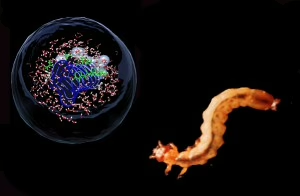
Larvae of the fire colored beetle dendroides canadensis and its hydrated antifreeze protein.

Share article
What's happening

Most recent news items

All news items
Collaboration

Successful outcomes of international EBEAM program led by AMOLF

The EU Pathfinder project Electron Beams Enhancing Analytical Microscopy (EBEAM) that was recently completed has received a highly positive review of the European Innovation Council (EIC). EBEAM brought together eight European research institutions and companies, including AMOLF, that develop new concepts and instruments combining spectroscopic analysis with electron microscopy.

Read news item
Research highlights

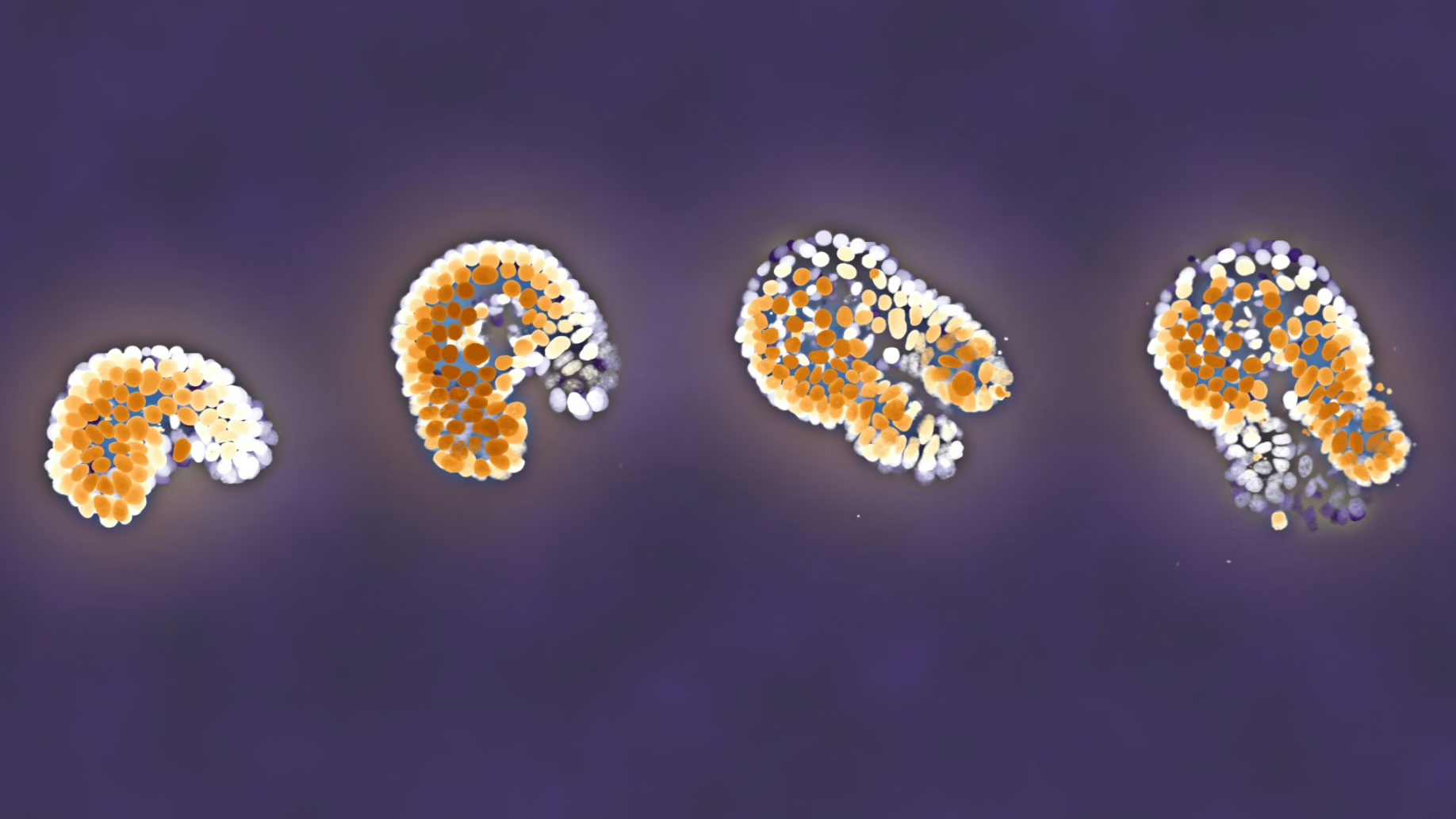
Everything you need to know about organoids

Organoids are instrumental in improving our understanding of processes that are otherwise hidden inside the body. For instance, these small 3D organs can be used to test medicines on tissue grown from a patient’s own cells. AMOLF researchers carry out unique and complex experiments to follow organoids in time. In order to enable other researchers to benefit from their experiences, they now publish their methods in the prestigious journal Nature Protocols.

Read news item
Events and outreach

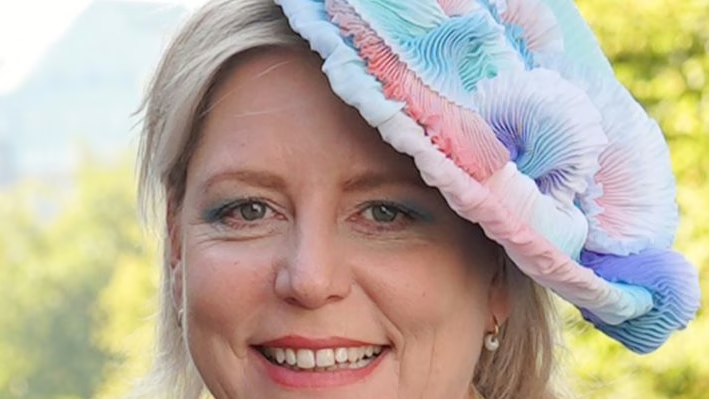
Minister Rianne Letschert wears hat and shoulder ornament inspired by Wim Noorduin’s research

This year at the opening of the parliamentary year (Prinsjesdag) Minister of Education, Culture and Science Rianne Letschert wears a spectacular hat and shoulder ornament. Both of them are inspired by the microscopic structures studied by group leader Wim Noorduin (AMOLF/UvA), which look remarkably like tiny flowers under a microscope. Artist and designer Malou Beemer translated these shapes, normally invisible to the naked eye, into wearable art.

Read news item
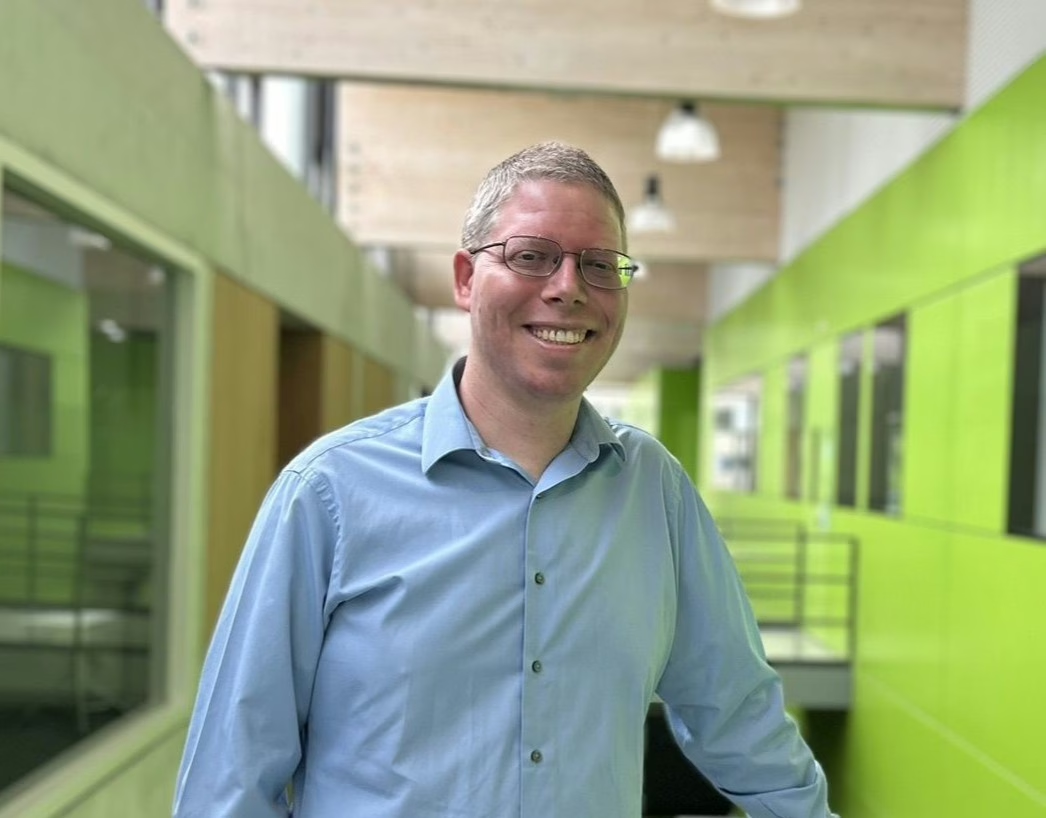
Nachi Stern, Group Leader Learning Machines at AMOLF
People and recognition

Nachi Stern awarded ERC Starting Grant to explore how matter learns

Why do brains learn, but rocks do not? Could a material one day adapt to its environment the way a living organism does? AMOLF group leader Dr. Nachi Stern has been awarded an ERC Starting Grant to investigate the physical laws of learning, in a project called, “Physical Learning in Dynamical Systems.”

Read news item
Stay informed

Get the latest research highlights, events, and news from our institute delivered to your inbox