Collaboration

FOM, NWO-ALW and Unilever jointly investigate the physical behaviour of everyday products

On the 1st of June, the Foundation for Fundamental Research on Matter (FOM), NWO Earth and Life Sciences (ALW) and Unilever will start a strategic joint research programme into understanding hybrid soft materials. The three parties agreed to commit to the new five year agreement on May 12, 2015. FOM and NWO-ALW will invest 400,000 euros per year in the programme. Unilever will invest the same amount. The goal of the collaboration is fundamental research and industrial valorisation, organised in each of the partners’ locations (Vlaardingen, Amsterdam (AMOLF, UvA) and Wageningen).

The collaboration will form the latest FOM Industrial Partnership Programme (IPP), with which FOM and NWO-ALW aim to link academic knowledge to industrial ambitions. In this case, this will be achieved by undertaking cutting-edge physics research on soft matter in collaboration with Unilever industrial scientists. FOM and Unilever have been working together since 2001 in various consortia-based research programmes. The success of these collaborations inspired the launch of the new IPP, a concerted effort with Unilever as sole industrial partner. Professor Vinod Subramaniam, director of the FOM Institute AMOLF, will lead the research programme.

Subramaniam: “Many food and consumer products, such as mayonnaise and personal care items, are composed of complex mixtures of different materials. The formulation of such products to achieve the desired properties that enhance the user experience, such as nutritional value, ‘feel’, or product stability and sustainability is still largely an empirical endeavour. AMOLF is delighted to be able to contribute its theoretical and experimental expertise in soft condensed matter to help gain a deep understanding of the physical and material properties of these complex systems. Together with our academic colleagues and Unilever scientists we anticipate gaining fundamental knowledge about these complex materials that will enable us eventually to design new materials and products with desired properties.”

Physical und
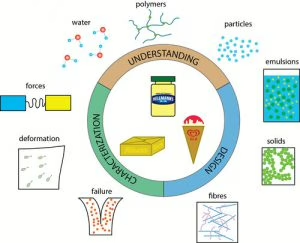
Schematic overview of proposal structure and specific challengens_IPP Unilever

erstanding inspired by nature
The aim of this programme is thus to understand and predict the stability and in-use behaviour of everyday consumer products. The main focus is to build a detailed physical understanding of the relation between the molecular, microscopic and mechanical properties of complex product matrices. In addition to this, the team will look for inspiration and will study structures made by nature, and will try to translate these lessons into the design of better, healthier and more sustainable materials and products.

About Industrial Partnership Programmes
Industrial Partnership Programmes are research programmes from FOM aimed at fundamental research over a period of several years. IPPs bring FOM staff into close contact with industrial researchers in areas with good potential for innovation and challenging scientific questions. With this they bridge the gap between fundamental and industrial research.

Top Sector Agri & Food
The research ties in with the Top Sector Agri & Food. For this programme a so-called TKI allowance has been applied for, which is part of the programme budget. The Ministry of Economic Affairs encourages collaboration between companies and knowledge institutions such as universities, NWO, FOM, Technology Foundation STW, TNO and ECN by awarding TKI allowances. These amount to 25 percent of the in-cash private contributions and a smaller allowance for in-kind contributions.

Share article
What's happening

Most recent news items

All news items
Collaboration

Successful outcomes of international EBEAM program led by AMOLF

The EU Pathfinder project Electron Beams Enhancing Analytical Microscopy (EBEAM) that was recently completed has received a highly positive review of the European Innovation Council (EIC). EBEAM brought together eight European research institutions and companies, including AMOLF, that develop new concepts and instruments combining spectroscopic analysis with electron microscopy.

Read news item
Research highlights

Everything you need to know about organoids

Organoids are instrumental in improving our understanding of processes that are otherwise hidden inside the body. For instance, these small 3D organs can be used to test medicines on tissue grown from a patient’s own cells. AMOLF researchers carry out unique and complex experiments to follow organoids in time. In order to enable other researchers to benefit from their experiences, they now publish their methods in the prestigious journal Nature Protocols.

Read news item
Events and outreach

Minister Rianne Letschert wears hat and shoulder ornament inspired by Wim Noorduin’s research

This year at the opening of the parliamentary year (Prinsjesdag) Minister of Education, Culture and Science Rianne Letschert wears a spectacular hat and shoulder ornament. Both of them are inspired by the microscopic structures studied by group leader Wim Noorduin (AMOLF/UvA), which look remarkably like tiny flowers under a microscope. Artist and designer Malou Beemer translated these shapes, normally invisible to the naked eye, into wearable art.

Read news item
Nachi Stern, Group Leader Learning Machines at AMOLF
People and recognition

Nachi Stern awarded ERC Starting Grant to explore how matter learns

Why do brains learn, but rocks do not? Could a material one day adapt to its environment the way a living organism does? AMOLF group leader Dr. Nachi Stern has been awarded an ERC Starting Grant to investigate the physical laws of learning, in a project called, “Physical Learning in Dynamical Systems.”

Read news item
Stay informed

Get the latest research highlights, events, and news from our institute delivered to your inbox