Research highlights

Observation of quantum molecular motions at work in next-generation solar cells

Researchers from AMOLF, Cambridge, Lund and Kiel have revealed that molecular vibrations drive the process known as singlet fission.

Singlet fission potentially allows to double the charge carrier generation in organic materials and therefore may drive the development of highly efficient solar cells. The results are published in Nature Chemistry on October 26, 2015.

In molecular solar cells, excitons are generally used to generate electrical charges, but a single particle of light, known as a photon, will normally only generate a single exciton. A process known as singlet fission can be used to convert a single photon into two energetically excited particles, known as spin-triplet excitons. If the process of singlet fission could be applied in devices and controlled, it may enable solar cells to double the amount of electrical current that can be extracted every time a cell is illuminated.

The researchers verified that this ‘two-for-one’ transformation involves a highly elusive intermediate state in which the two triplet excitons are “entangled”, a non-classical feature of quantum theory that causes the properties of each exciton to be linked, or correlated, to its partner’s. These kinds of quantum “super positions”, are the basis of Schrödinger’s famous thought experiment in which a hapless cat is – according to quantum theory – in a state of being both alive and dead at the same time.

By shining ultrafast laser pulses – just a few quadrillionths of a second – on a sample of pentacene, an organic material which undergoes singlet fission, the researchers were able to directly observe this entangled state for the first time, and showed how excited molecular ( vibrations make it both detectable and drive its creation through quantum dynamics.
The research was supported by the European LaserLab Consortium, Royal Society, and the Netherlands Organization for Scientific Research.

Reference
Bakulin, Artem et. al., Real-time observation of multiexcitonic states in ultrafast singlet fission using coherent 2D electronic spectroscopy Nature Chemistry (2015) | DOI: 10.1038/nchem.2371

For more information, contact former AMOLF researcher Dr. Artem Bakulin who is currently working at University of Cambridge, aab58ATcam.ac.uk
ultrafast spectroscopy 160316_bakulin_setup

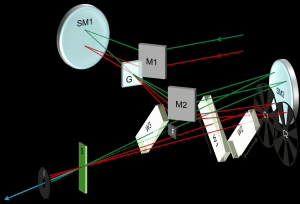
Ultrafast optical interferometry setup used by researchers to observe quantum dynamics in organic crystals.
ultrafast spectroscopuy 151027 bakulin state diagram

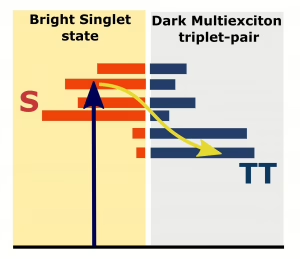
State diagram showing the transition between the initially excited exciton (S) and intermediate ‘entangled’ state (TT).

Share article
What's happening

Most recent news items

All news items
Joining forces to study perovskite interfaces
People and recognition

Joining forces to study perovskite interfaces

AMOLF group leaders Professor Wiebke Albrecht and Professor Bruno Ehrler have received an NWO ENW-M2 grant for their joint research project, The Dynamic Atomic Interface between Halide Perovskites and Metals. The insights gained will pave the way for sustainable, high-performance solar energy and information technology. Wiebke and Bruno will each hire a PhD student for this project. The grant amounts to €800.000.

Read news item
Wim Noorduin and Arian van Asten presenting their scientific journey
People and recognition

Wim Noorduin and Arian van Asten presenting their scientific journey

On October 8, Professor Wim Noorduin and his collaborator Professor Arian van Asten (University of Amsterdam) presented their scientific journey in a video to the audience at the ‘Avond van Wetenschap en Maatschappij’. They did so alongside the other nominees for the Huibregtsen Prize.

Read news item
Natural phenomena ‘hyperuniform disorder’ enables highly efficient, thin silicon solar cells
Research highlights

Natural phenomena ‘hyperuniform disorder’ enables highly efficient, thin silicon solar cells

Silicon solar panels are rigid and heavy, and many rooftops cannot support them. This creates a need for thin, flexible solar cells that can be integrated into building materials. However, making silicon solar cells thinner makes it harder to trap light inside the material. Researchers in the 3D Photovoltaics group found a fascinating way to overcome this challenge using a phenomenon called hyperuniform disorder. They publish their findings in the journal ACS Photonics.

The researchers were able to make highly efficient silicon solar cell materials that are 30 times thinner than conventional ones. They managed to do this by integrating a layer of nanometer sized structures on top of the material. Up close, this pattern looks random, but it is remarkably when you step back: no clumps, no gaps, and no repeating pattern. This is called hyperuniform disorder (or HUD).

Read news item
Stay informed

Get the latest research highlights, events, and news from our institute delivered to your inbox