Information in Matter
Ultrafast Spectroscopy

The group studies how water interacts at the nanoscale with molecules and surfaces. Using powerful ultrafast laser techniques, we capture molecular motions that occur in less than a trillionth of a second. By revealing how water behaves at the molecular level, we help pave the way toward cleaner technologies and more sustainable energy solutions.
Research focus
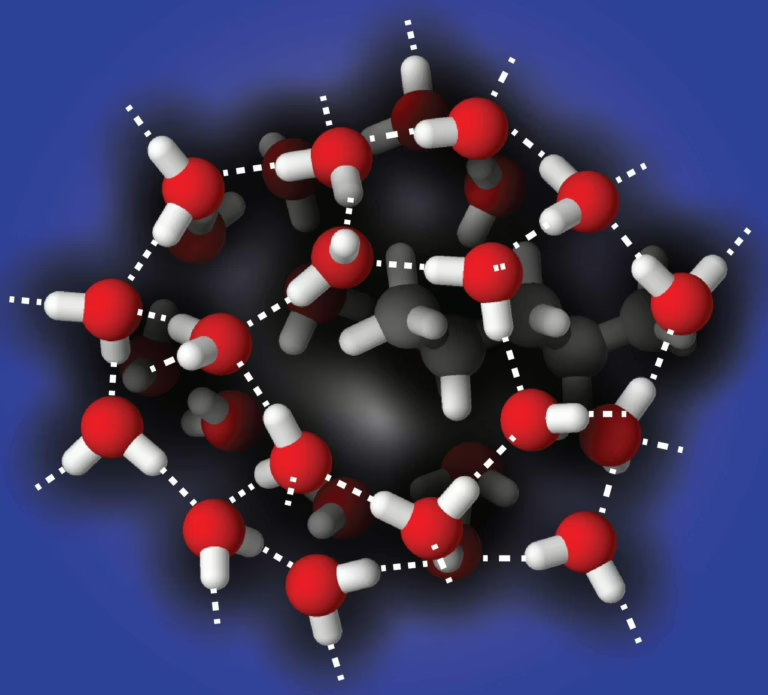
We investigate how water interacts at the nanoscale with ions, (bio)molecules, and surfaces. Our research focuses on systems where molecules organize themselves in water, such as molecular cages and hydrogels, electrochemical interfaces, and the boundaries between water and surfactants (soaps).
To study the nanoscale interactions of water molecules in complex systems, we use advanced laser-based techniques that allow us to follow molecular motions at extremely short timescales – down to femtoseconds (one millionth of a billionth of a second).
With our research we aim to contribute to the improvement of energy storage technologies and to support cleaner, more sustainable industrial processes.
Our methods include femtosecond nonlinear vibrational spectroscopy, surface sum-frequency generation spectroscopy, and GHz–THz dielectric relaxation spectroscopy (see below in ‘our methods’ for an explanation).
Our methods
We use the following techniques:
- Femtosecond nonlinear vibrational spectroscopy: advanced techniques such as laser-based methods to track vibrations at the molecular level.
- Surface sum-frequency generation spectroscopy: technique to examine surfaces at the interface between materials.
- GHz–THz dielectric relaxation spectroscopy: method to observe how molecules respond to electric fields across a wide range of frequencies.
Pure water exhibits a high surface tension at interfaces with air or hydrophobic substances such as oil and fat. Consequently, water has a strong tendency to phase-separate from materials with poor hydrophilic character. However, in many systems – such as living cells and numerous chemical applications – it is highly advantageous to mix aqueous and hydrophobic phases. This mixing becomes possible through the addition of molecules that strongly reduce the interfacial surface tension. These molecules are known as surfactants. Aqueous surfactants are ubiquitous and serve essential roles as cleaning agents, emulsifiers, foaming agents, and wetting agents.
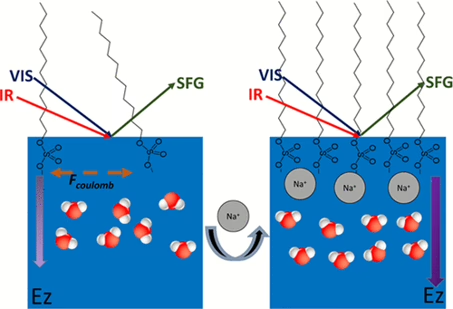
Surfactant molecules accumulate at the water surface, where their hydrophilic head groups interact with the aqueous solvent while their hydrophobic tails extend into the air or hydrophobic phase. Although the macroscopic and mesoscopic properties of surfactant solutions, such as their ability to reduce surface tension or form emulsions with controlled droplet size, are well understood, their microscopic behavior remains far less clear. At the molecular scale, surfactants display highly complex behavior. This complexity famously inspired Wolfgang Pauli to remark that “God made the bulk; the devil made the surface.”
The properties of aqueous surfactant solutions are strongly influenced by the presence of additional components, such as salts or other surfactants. For example, the addition of electrolytes significantly affects the efficiency of the widely used surfactant sodium dodecyl sulfate (SDS), also known as sodium lauryl sulfate (SLS), in protein denaturation. It has also been shown that added salts can drastically reduce the critical micelle concentration (CMC); in the case of SLS, the CMC can decrease from approximately 8 mM to about 1 mM.
In this project, we aim to develop a molecular-scale understanding of the interactions between surfactant molecules and adjacent water layers, as well as the influence of added ions and co-surfactants on interfacial properties. We investigate how the properties of surfactant solutions can be tuned and controlled. A central objective is to determine the conditions under which a substantial reduction in surface tension can be achieved at minimal bulk surfactant concentration. Lowering the required surfactant content for cleaning or emulsification would yield significant environmental benefits.
This project is part of the Nationale Groeifonds program “Big Chemistry.” In collaboration with Wilhelm Huck (Radboud University Nijmegen) and Hogeschool Fontys Eindhoven, we will develop an automated platform that systematically varies parameters such as salt concentration, surfactant combinations, and temperature to identify optimal conditions for reducing surface tension and forming emulsions.
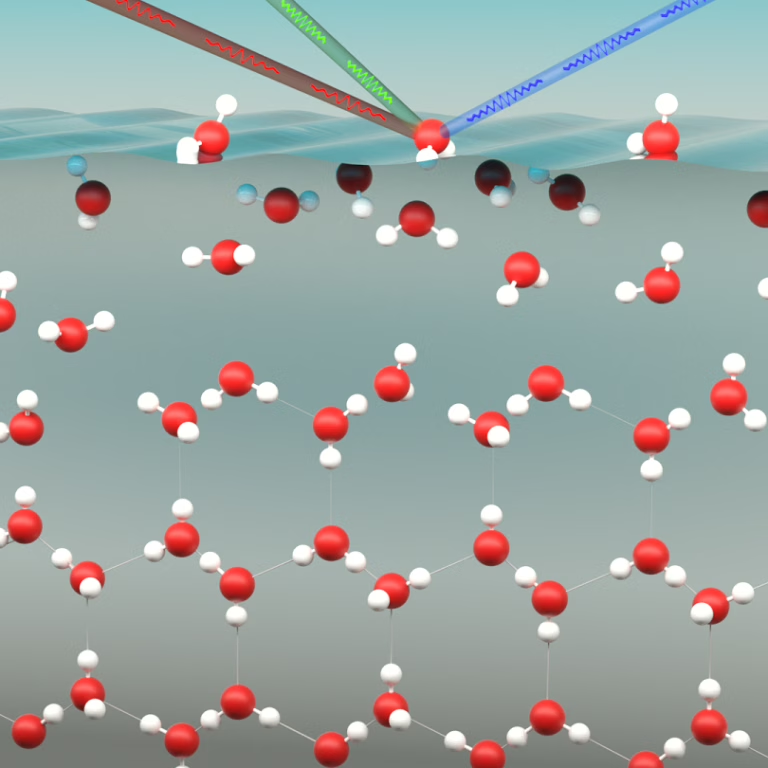
To probe the molecular properties of the interface, we employ heterodyne-detected vibrational surface sum-frequency generation (HD-VSFG) spectroscopy. This technique provides detailed molecular-scale information about the surface density and orientation of surfactant molecules, as well as the structure of water and dissolved ions in the near-surface region. HD-VSFG is non-invasive, highly surface-specific, and does not require molecular labeling.
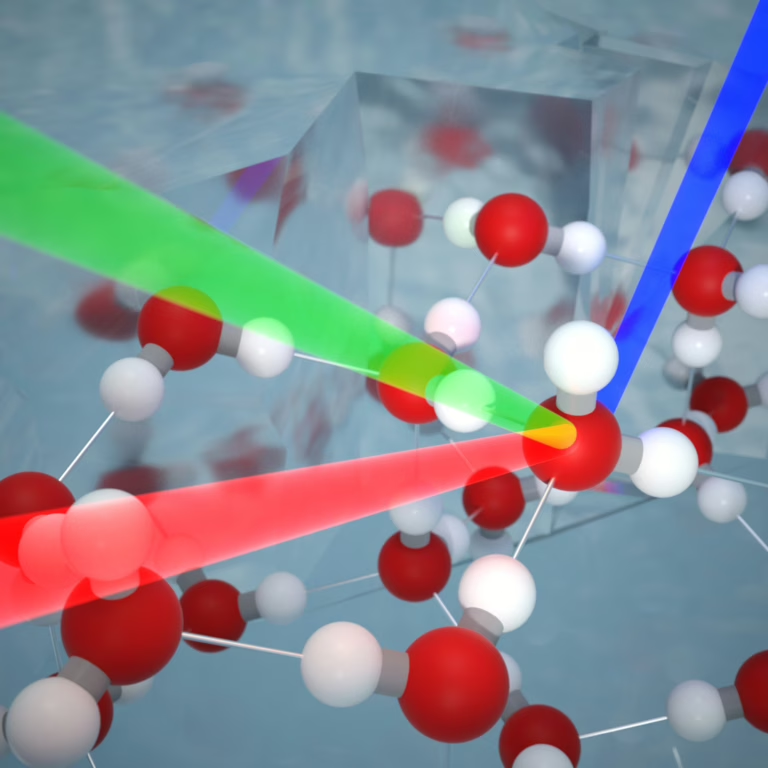
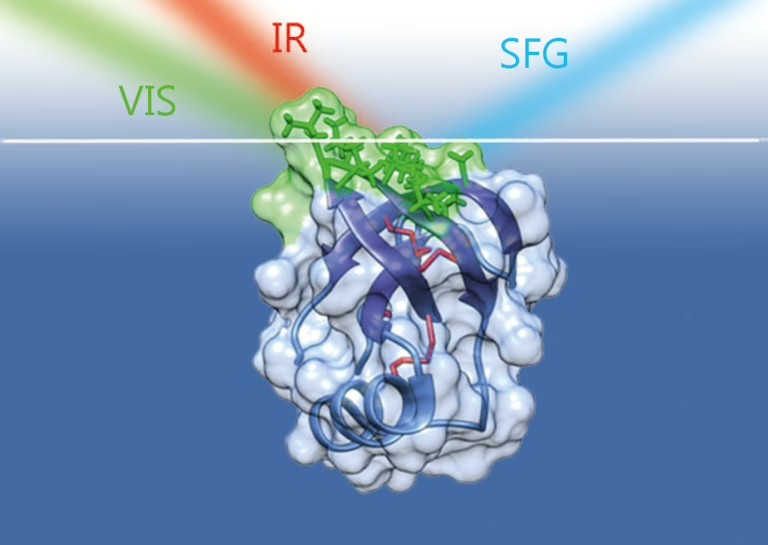
In HD-VSFG spectroscopy, a mid-infrared (mid-IR) pulse with frequency ωIR and a visible pulse with frequency ωVIS overlap in time and space at the interface, generating light at the sum frequency ωSFG = ωIR + ωVIS. Vibrational sum-frequency generation is a second-order nonlinear optical process that, within the electric dipole approximation, occurs only in non-centrosymmetric media. In isotropic bulk media, the second-order susceptibility vanishes due to inversion symmetry; at surfaces, however, symmetry is broken, allowing SFG light generation.
The infrared pulse is broadband and contains a range of ωIR frequencies. The SFG signal is resonantly enhanced when ωIR matches vibrational modes of molecules at the interface. Consequently, the spectrum of the generated ωVIS light provides a highly surface-specific vibrational spectrum.
The generated light electric field at ωSFG is phase-sensitively detected by interfering the electric field generated by the sample with that of a local oscillator. The direct measurement of the generated electric field avoids interference effects with non-resonant contributions to the signal that usually complicate conventional SFG measurements in which the intensity of the generated light at ωSFG is measured.
An additional advantage of the phase-resolved technique over conventional intensity measurements is that it provides direct information on the orientation of the transition dipole moments of the vibrations at the surface and thereby on the orientation of the molecular groups carrying the vibrations.
Hydrogels constitute a distinctive class of materials composed of a (polymer) network swollen with a large amount of water. In recent years, a new generation of hydrogels has emerged in which relatively small molecular building blocks stack into well-ordered supramolecular structures that subsequently bundle into nanofibers. Remarkably, these supramolecular hydrogels can be mechanically stable and elastic while containing an exceptionally high water content (>99.98%). Because their networks are held together by non-covalent interactions, supramolecular hydrogels are highly responsive to external stimuli such as temperature changes, pH variations, and light exposure, enabling straightforward control over their viscoelastic properties.
Despite these striking characteristics, the molecular origins of the exceptional properties of supramolecular hydrogels remain poorly understood. In particular, the nature of the non-covalent cross-links within the supramolecular polymer network, as well as the role of water molecules in the assembly and elasticity of the hydrogel, are still unclear. To address these questions, we employ advanced nonlinear spectroscopic techniques, including femtosecond two-dimensional vibrational spectroscopy, to unravel the structure and dynamics of both the supramolecular polymer network and the confined water molecules.
This approach reveals how the macroscopic viscoelastic and stimuli-responsive behavior of supramolecular hydrogels emerges from their molecular-scale organization and dynamics—specifically, how materials composed of more than 99.9% water can nevertheless be form-stable and elastic. The insights gained will guide the design and synthesis of new responsive supramolecular hydrogels with tunable viscoelastic and adaptive properties.
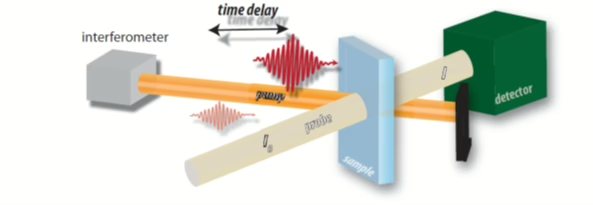
In femtosecond two-dimensional infrared (2D-IR) spectroscopy, the sample is excited by three ultrashort infrared pulses: a pair of excitation pulses followed, after a (sub)picosecond delay, by a detection pulse. The excitation pulse pair is generated by passing an intense femtosecond infrared pulse through an interferometer, producing two pulses with a precisely controlled time delay and relative phase. Fourier transformation of the signal as a function of this delay yields the excitation-frequency axis. The detection pulse is dispersed in a spectrometer and recorded with a multichannel infrared detector array, providing the detection-frequency axis.
When two vibrational modes are spatially close, excitation of one mode can induce a response in the other. In a 2D spectrum, such coupling appears as a cross-peak. These cross-peaks contain detailed conformational information. First, analyzing how the cross-peak intensity depends on the polarization directions of the pump and probe pulses allows determination of the relative orientation of the two vibrational transition dipoles. Second, the cross-peak anharmonicity, that is, the frequency separation between its positive and negative features, provides a measure of the distance between the coupled vibrations.
In a collaborative project with Profs. Joost Reek and Sander Woutersen at the Van ‘t Hoff Institute for Molecular Sciences of the University of Amsterdam, we investigate the molecular structure and dynamics of self-assembling nanocages and photoactive molecular complexes in water using femtosecond two-dimensional infrared (2D-IR) spectroscopy. In these experiments, we probe the vibrational modes of the cage-forming molecules, the ligands of the molecular complexes, and both internal and external solvating water molecules. The resulting 2D-IR spectra reveal the relative positions and orientations of the ligands and surrounding water, providing detailed insight into the nanoscale molecular structure.
We also perform polarization-resolved femtosecond mid-infrared spectroscopy on ligand and water vibrations to determine the rate of resonant vibrational Förster energy transfer. This transfer rate is highly sensitive to the distance and relative orientation of donor and acceptor groups. As a result, these measurements yield complementary structural information about the systems, including the arrangement of solvation water.
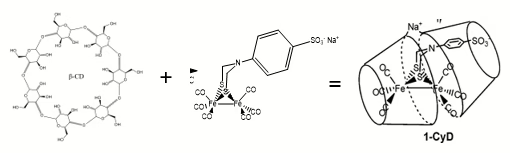
Beyond structural characterization, we study the ultrafast dynamics that follow excitation of photoactive molecules attached to or embedded within the nanocages, using femtosecond visible/UV pump–infrared probe spectroscopy. These photoactive species include photosensitizers and photocatalysts, such as hydrogenase catalysts that reduce protons to hydrogen gas. Although several hydrogenase systems are currently known, they generally suffer from limited stability and low efficiency. We investigate whether embedding a hydrogenase photocatalyst within a molecular cage enhances its stability (by providing protection) and improves the efficiency of hydrogen production.
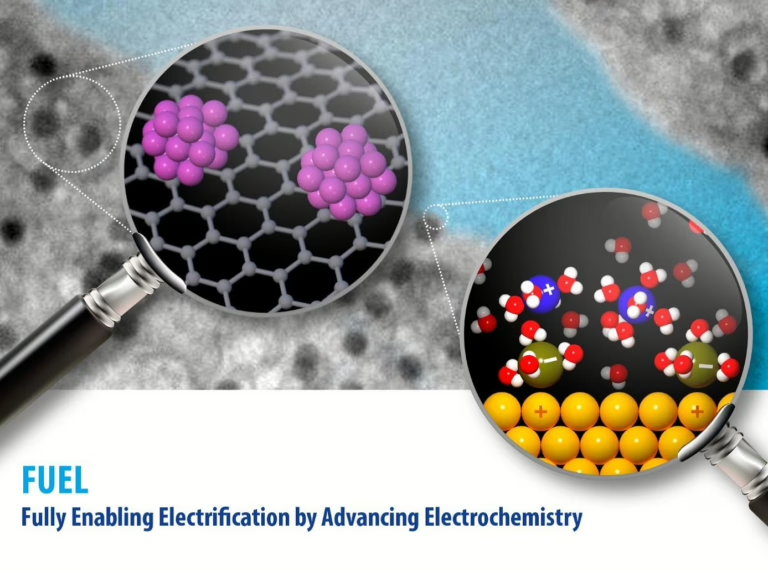
One of the major challenges in realizing the energy transition is the efficient storage of renewable energy. A highly promising strategy is the electrochemical conversion of water and CO₂ into energy-rich compounds such as hydrogen, hydrocarbons, and alcohols. However, these processes currently suffer from low efficiency and remain difficult to implement on a large scale.
A key limitation in improving electrochemical conversion lies in our incomplete understanding of how these reactions proceed at the nanoscale. It is well established that an electrolyte solution in contact with a charged electrode reorganizes into a so-called electrical double layer. This structure forms because ions with opposite charge are attracted to the surface, while like-charged ions are repelled. Water molecules in and around this ionic environment also reorganize in response to charge separation. Their net dipole moment, in turn, influences the distribution of ions.
In addition to the formation of the diffuse double layer, certain ions may specifically adsorb onto the electrode surface, further modifying the interfacial structure. As a result, electrochemical reactions occur within a highly structured environment of ions and water molecules near the electrode surface. This interfacial structure strongly affects reaction rates and overall efficiency.
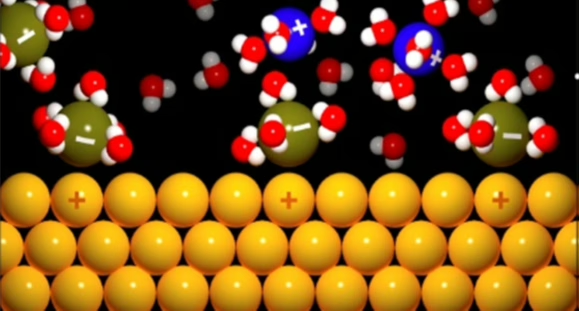
In collaboration with the 3D Photovoltaics group of Esther Alarcón-Lladó, we investigate the relative positions and orientations of water molecules and ions near electrode surfaces to gain insight into the structure of the electrical double layer under applied bias.
We study the aqueous electro-chemical interface with heterodyne-detected surface sum-frequency generation (HD-SFG) spectroscopy with femtosecond mid-infrared laser pulses. This interface-specific method measures the vibrational spectra of molecules at surfaces and enables determination of the absolute orientation of molecular groups. We apply HD-SFG to study the orientation and hydrogen-bond structure of water molecules in the electrical double layer near platinum and gold electrodes, graphene electrodes, and transparent oxide electrodes such as indium tin oxide.
In addition, we probe the distribution of ions near the electrode surface by measuring the vibrational response of multi-atomic ions, including HCO₃⁻, CO₃²⁻, NO₃⁻, and SO₃²⁻, using HD-VSFG spectroscopy. We systematically investigate how the interfacial water structure and ion distribution depend on electrode material, applied potential, and electrolyte properties such as concentration, pH, and temperature. We will correlate the obtained nanoscale structural information with the electrochemical performance of the electrode.





Ultrafast Spectroscopy Latest news



Most recent publications