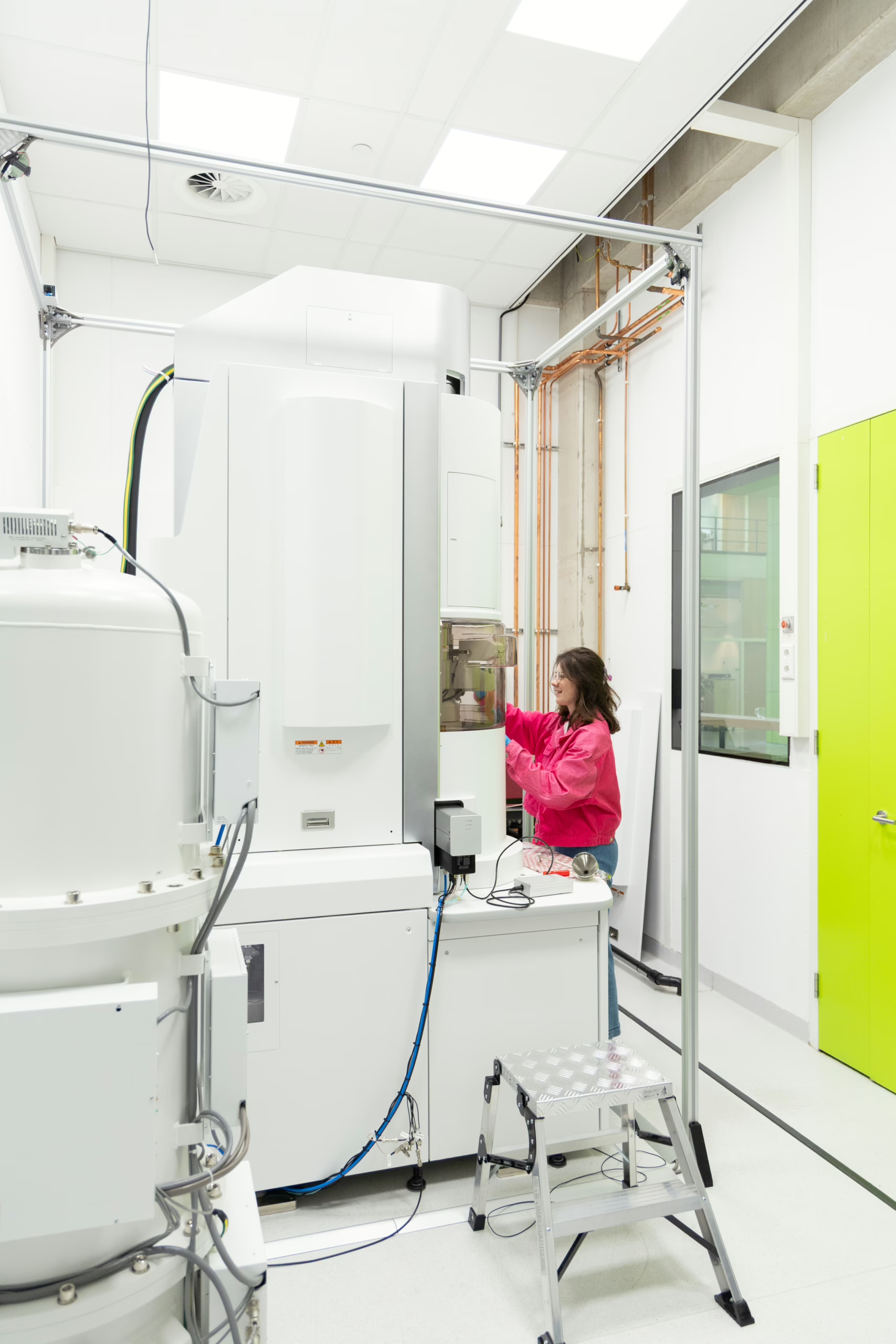
The discovery was made possible by AMOLF’s advanced transmission electron microscope (TEM). What makes this facility particularly special is that researchers can illuminate samples with laser light while observing them through the microscope. By combining images with measurements of the particles’ structure and chemical composition, the researchers could follow the transformation of individual nanoparticles as it happened.
Changing the composition with light
The researchers studied tiny gold rods coated with a thin layer of titanium dioxide. When they illuminated the samples with laser light, copper from the surrounding support material moved toward the gold particles and mixed with them, forming an alloy of gold and copper.
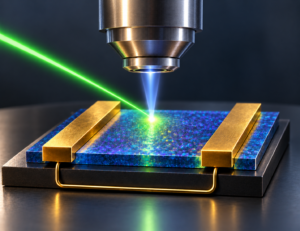
By adjusting the intensity of the laser light, the researchers could control how much copper was incorporated into the particles. They achieved copper concentrations of more than 80%. Increasing the laser intensity further caused copper to leave the particles, reversing the process. Once the laser was switched off, the particles retained their new composition.
“This means that light can be used not only to change the composition of individual nanoparticles but also to control and preserve the resulting material properties. Such precise control is difficult to achieve using conventional methods of producing nanoparticles.”
Toward more energy-efficient catalysis
The discovery is particularly promising for catalysis, a process in which a substance called a catalyst accelerates a chemical reaction without being consumed. Catalysts are widely used in the chemical industry, where many reactions require high temperatures and therefore large amounts of energy.
The properties of a catalyst depend strongly on its chemical composition. By changing the ratio of gold and copper in nanoparticles, researchers may be able to influence how effectively they catalyze particular chemical reactions.
The ability to control this composition using light could eventually help scientists develop catalysts whose properties can be adjusted during operation.
Wiebke explains: “Imagine a chemical reaction, in which one step works best with a catalyst containing 30% copper and 70% gold, while another step benefits from a different ratio. With our discovery, light could potentially be used to adjust this ratio, allowing researchers to tailor the catalyst dynamically during a particular chemical reaction.”
Although further research is needed to demonstrate these applications, the findings provide a new way to explore and control materials for future catalytic processes.
Learn more
- If you have any questions about this research, contact group leader Wiebke Albrecht by e-mail at: w.albrecht@amolf.nl
- The scientific publication “Optically Driven AuCu Alloying in Single Nanoparticles Revealed by In Situ TEM” was published in the journal Small.
- Read full paper