
News & updates
Latest developments from our institute
Stay informed about new research results, awards, events, and collaborations across our scientific community.
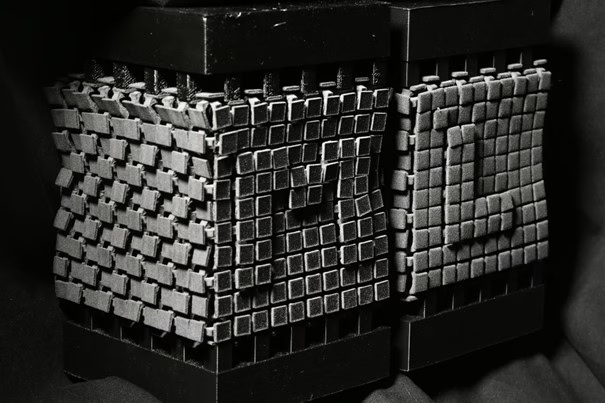
Floppy or not: artificial intelligence predicts properties of complex metamaterials
Given a 3D piece of origami, can you flatten it without damaging it? Just by looking at the design, the answer is hard to predict, because each and every fold in the design has to be compatible with the flattening process. This is an example of a combinatorial problem. New research led by the University of Amsterdam and AMOLF has demonstrated that machine learning algorithms can accurately and efficiently answer these kinds of questions. This is expected to give a boost to the artificial intelligence-assisted design of complex and functional (meta)materials.
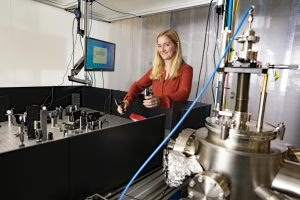
Extreme-ultraviolet light manipulation to unleash unprecedented capabilities
Short-wavelength light sources beyond the color that the human eye can perceive have tremendous application potential, but controlling them is notoriously difficult. First author Sylvianne Roscam Abbing (ARCNL, in a collaboration with AMOLF) is the first one to demonstrate control over extreme-ultraviolet light pulses using nanostructures. This opens the door towards both new ways of generating light, and also sensing nanostructures. The research team, consisting of members of the Resonant Nanophotonics group (PI: Femius Koenderink, AMOLF) and led by the High-harmonic Generation and EUV Science group (PI: Peter Kraus, ARCNL) published their findings in Physical Review Letters 128, 223902 (2022).

ERC Synergy Grant for AMOLF-Heidelberg-ETH team
A prestigious ERC Synergy Grant worth 9.4 million euros has been awarded to the research groups of Sander Tans (AMOLF), Bernd Bukau (Heidelberg University) and Nenad Ban (ETH). The team aims to elucidate a new mechanism to explain how protein complexes are formed – the complex molecules that execute all main biological functions. Sander Tans also holds a professorship at Delft University of Technology.

Erik Garnett wins KNCV Gold Medal
At the annual Dutch chemistry conference Chains, the KNCV announced that AMOLF group leader Erik Garnett (Nanoscale Solar Cells) is the recipient of the KNCV Gold Medal. He receives the award for his groundbreaking, cross-disciplinary research that combines nanomaterials, photochemistry, materials chemistry and nanophotonics.
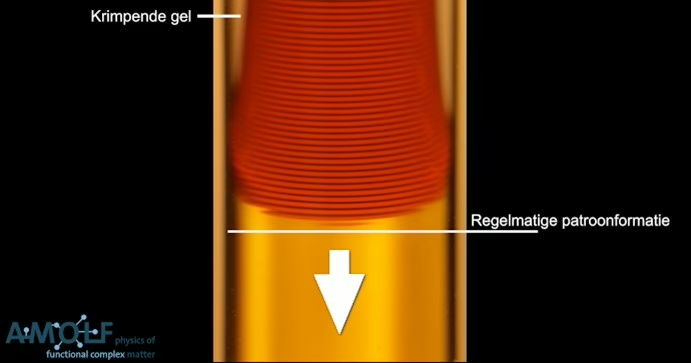
Regular patterns – like those found in nature – now also produced in the lab
AMOLF researchers have found a new method for producing layered materials. Inspired by nature, they developed a physical-chemical process that yields highly regular microstructures. They describe this in a paper that was published this week in the journal PNAS. It offers the prospect of a relatively simple way to manufacture advanced, functional materials. Furthermore, the research can help us to better understand the genesis of natural patterns.
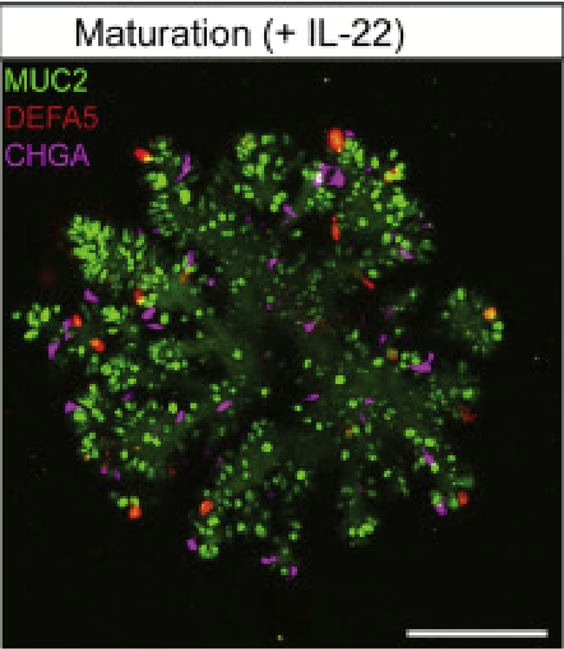
Optimization of human small intestinal organoids
Collaborating scientists have improved human small intestinal organoids – miniature versions of the small intestine. This will help them to better study the functioning of the small intestine. The scientists from the Hubrecht and AMOLF institutes, and various other collaborators developed organoids that contain mature Paneth cells, which were not present in the earlier human small intestinal organoids. The results of the study were published on 23 August in Cell Stem Cell.
Cells: strong at the right place and time
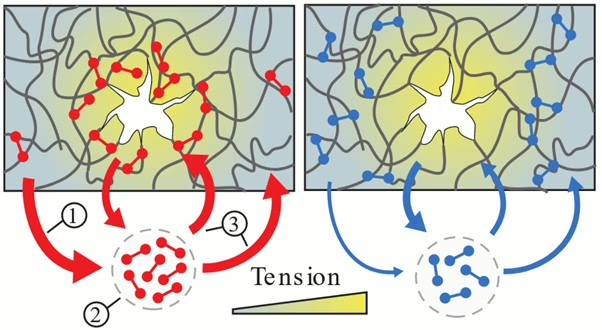
Researchers from TU Delft and AMOLF discovered how certain molecular bonds make living cells both flexible, in order to move, as well as strong, in order to withstand forces. Paradoxically, it turns out that these force-sensitive catch bonds are weak and inactive most of the time, but travel to specific places where and when cells become damaged. This discovery is published in Nature Materials.
Responsive soft robots inspired by sputtering ketchup bottle
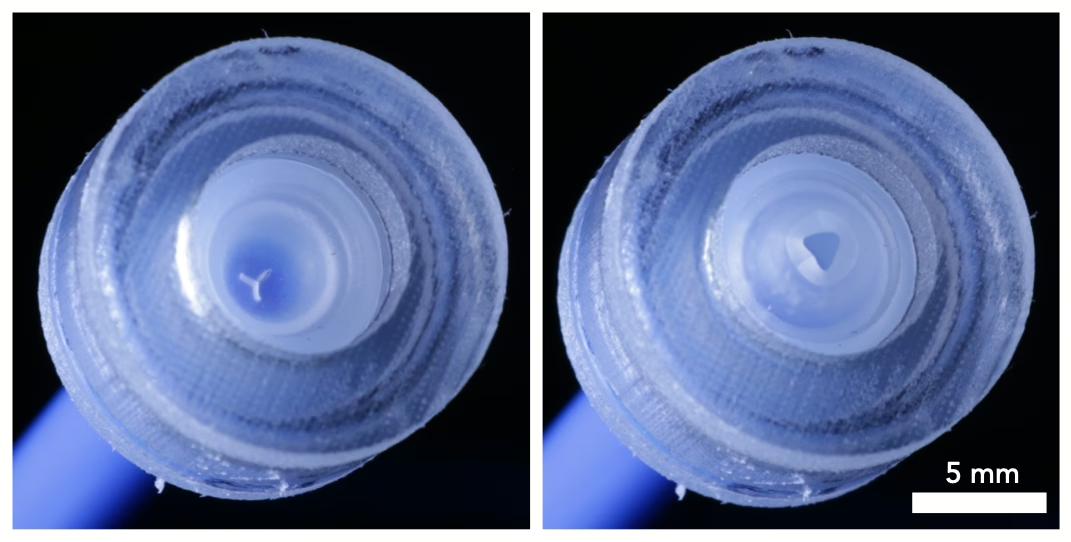
A smartly designed pressure valve allows soft robots to respond to their environment without the need for computer control, reveal AMOLF researchers in their article in the journal Matter. That brings robots with natural movements and tactile responses similar to those of living organisms one step closer to reality. Such developments render soft robots more suitable for exploring rough and unknown terrain or for medical applications.