
News & updates
Latest developments from our institute
Stay informed about new research results, awards, events, and collaborations across our scientific community.
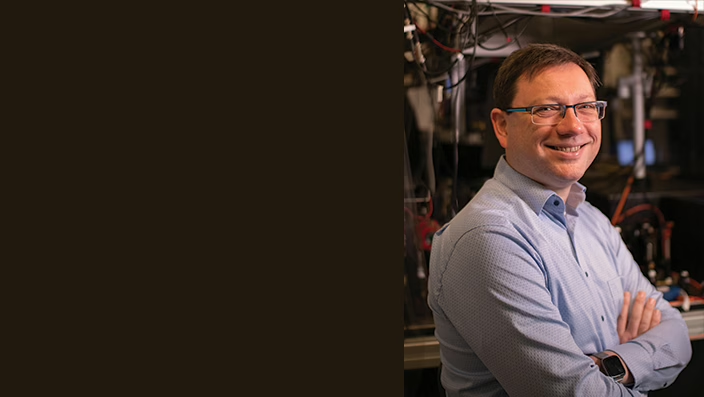
Femius Koenderink elected 2022 Optica Fellow
The Optica (formerly OSA) Board of Directors has elected Femius Koenderink to the 2022 Fellows Class. He is one of the 106 members to be honored this year. Koenderink was elected ‘for fundamental contributions to subwavelength resonant nanophotonics to control scattering, emission, and amplification of light at the nanometer scale’. Koenderink leads the Resonant Nanophotonics group at AMOLF and is head of the Nanophotonics department.

Anne Meeussen wins the Ehrenfest-Afanassjewa thesis prize 2021
Today, the Dutch Physics Council announces that former PhD student Anne Meeussen (Mechanical Metamaterials group at AMOLF and Leiden University) wins the Ehrenfest-Afanassjewa thesis prize 2021. Meeussen defended her thesis in May 2021 at Leiden University, for which she received the cum laude distinction.

Martin van Hecke elected APS fellow
Metamaterials researcher Martin van Hecke has been elected American Physical Society (APS) fellow, an honour exclusive to only half a percent of the society’s members. The Soft Matter Division of the American Physical Society elected Van Hecke ‘For leading work in the field of jammed and disordered systems, and for pioneering the field of programmable mechanical metamaterials.‘

Vidi grant for Kristina Ganzinger
AMOLF group leader Kristina Ganzinger (Physics of Cellular Interactions) is one of the 78 researchers who received a NWO Vidi grant that is worth 800.000 euros. This grant allows Ganzinger to further expand her research on immune cell signaling using advanced microscopy and synthetic biology tools.
Two NWO Rubicon grants for AMOLF researchers
Former PhD students Anne Meeussen (Mechanical Metamaterials group) and Mario Avellaneda Sarrio (Biophysics group) are amongst the 31 researchers who have recently received a Rubicon grant from NWO. The Rubicon program gives young, highly promising researchers the opportunity to gain international research experience. With a Rubicon grant they can spend up to 24 months doing research at a foreign institution.

Marc Serra starts Hyper Smart Matter group
On October 1st Marc Serra will start as tenure track group leader at AMOLF. His Hyper Smart Matter group will be embedded in the Designer Matter research theme at AMOLF. Serra intends to design and build complex materials that manipulate sound waves to process information. These materials will enable a wide variety of new devices, from computers that consume very low power to soft robots that accomplish complex tasks autonomously. Serra aims to simultaneously solve practical problems and understand how physical principles such as the laws of thermodynamics fundamentally limit the energy efficiency of computers.
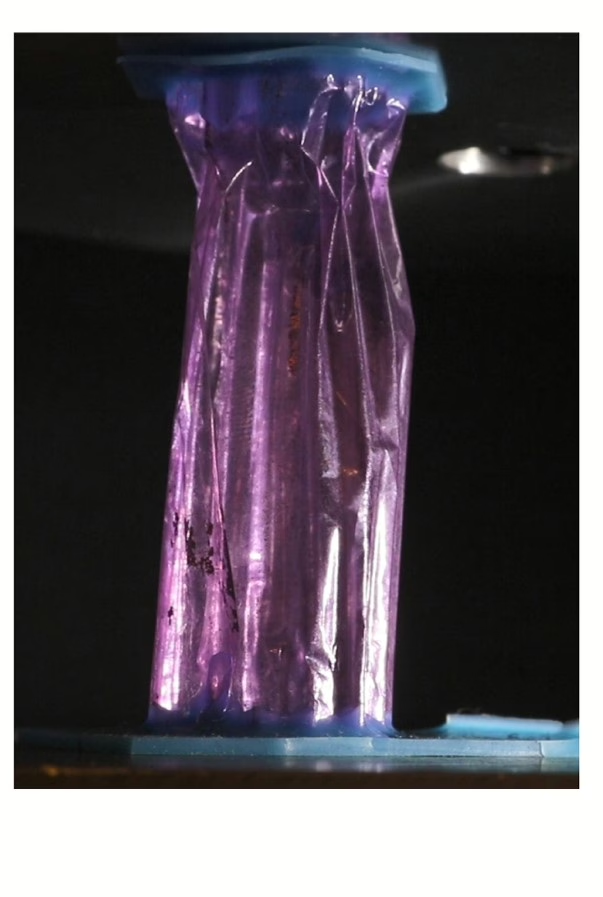
Martin van Hecke receives ERC Advanced Grant
Martin van Hecke (Mechanical Metamaterials group at AMOLF and Leiden University) receives a 2.5 million euro ERC Advanced Grant for research into information processing materials. The European Research Council uses the ERC Advanced grants to allow outstanding research leaders to pursue ground-breaking, high-risk projects in Europe.
Albert Polman receives ERC Advanced Research Grant
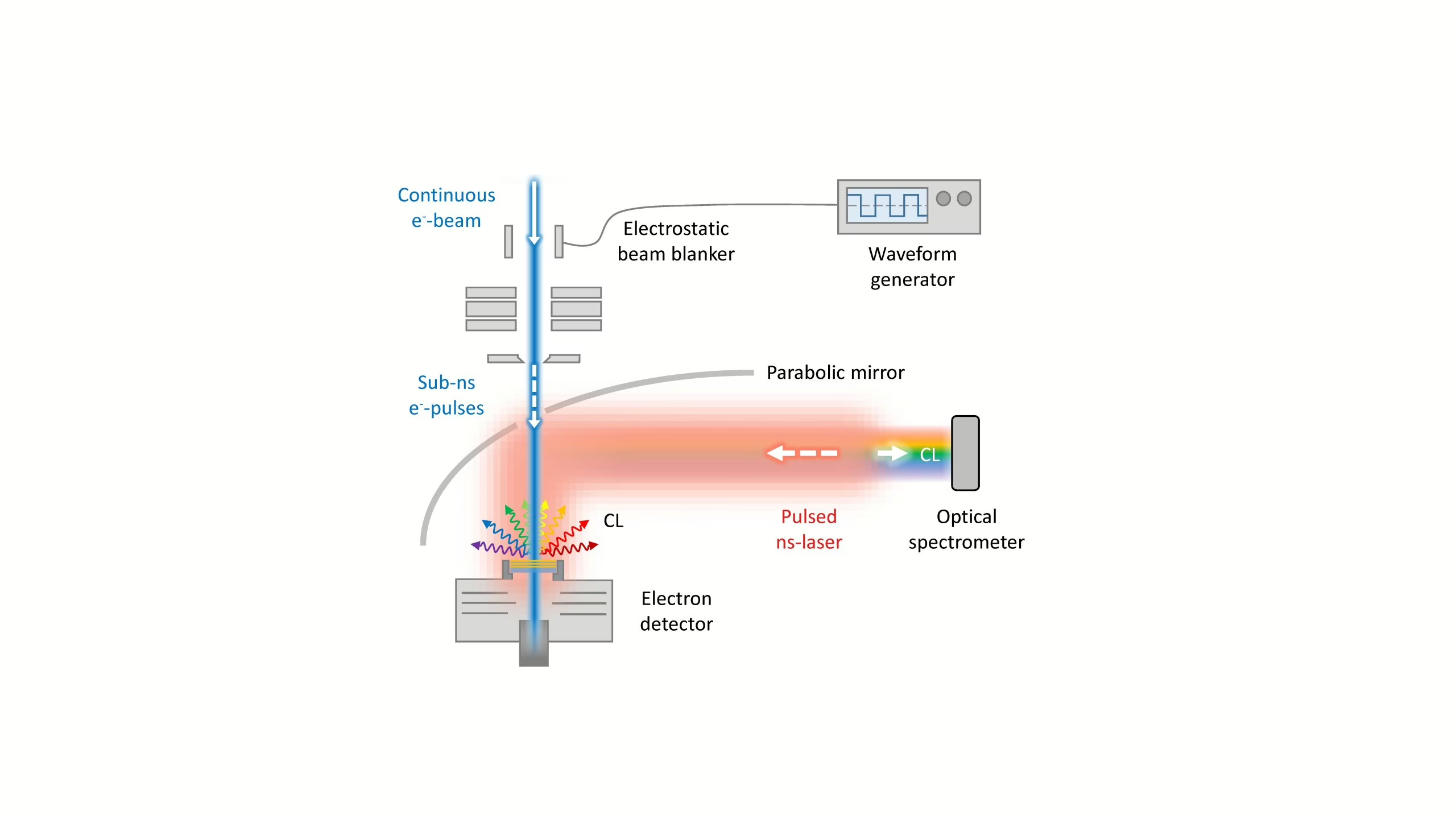
AMOLF program leader Albert Polman receives an Advanced Research Grant of 2.5 million euros from the European Research Council (ERC). He will use the ERC Advanced Grant to develop a new type of quantum electron microscope. He will use intense laser pulses to tailor the energy spectrum of high-energy electrons in a scanning electron microscope. This provides a unique way to control the quantum-mechanical electron wave packet in space and time. By combining materials excitation using these wavepackets and the detection of light that is emitted (cathodoluminescence) this creates an entirely new way of analytical electron microscopy. The new instrument will play a key role in AMOLF’s nanophotonics and nanophotovoltaics research program.