
News & updates
Latest developments from our institute
Stay informed about new research results, awards, events, and collaborations across our scientific community.
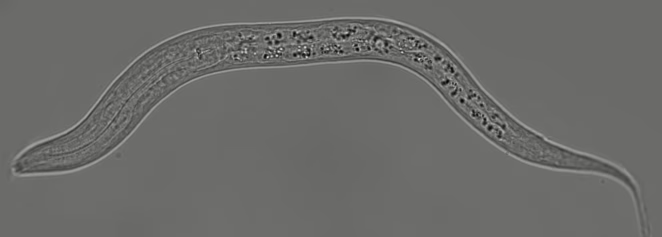
C. elegans does not accidentally switch off its ability to detect salt
AMOLF researchers, collaborating with researchers from the Erasmus MC, have discovered a genetic mechanism that ensures that a nerve cell retains its identity once it has differentiated. This concerns a neuron in the worm C. elegans that can detect salt. Its identity is activated by a genetic switch during the cell’s development. Jeroen van Zon and his colleagues have discovered how it is possible that this switch never spontaneously switches off again. The research was published today in the scientific journal eLife.
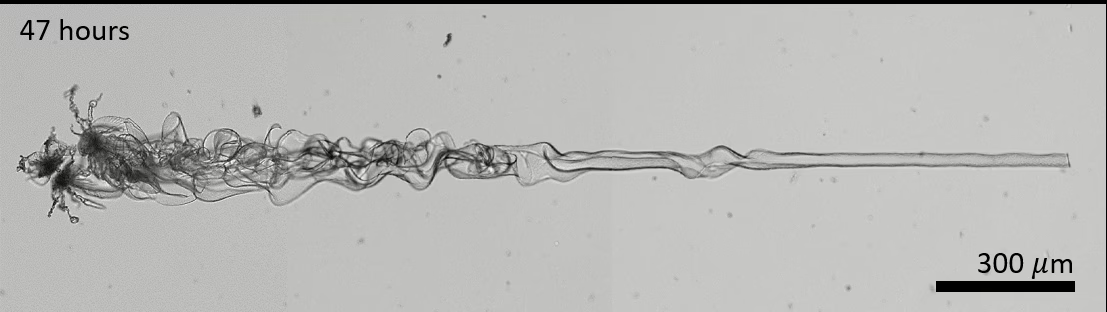
Crystals beneath a sunbed
Light-controlled spontaneous growth of nanostructures PhD student Marloes Bistervels from the Self-Organizing Matter research group at AMOLF has managed to use light to very precisely control the formation of nanocomposites in the shape of corals and vases. By illuminating a solution of the right ingredients with UV light, she can control where, when and which structures arise at the micrometer scale. This week, she published her findings in the scientific journal Advanced Materials.
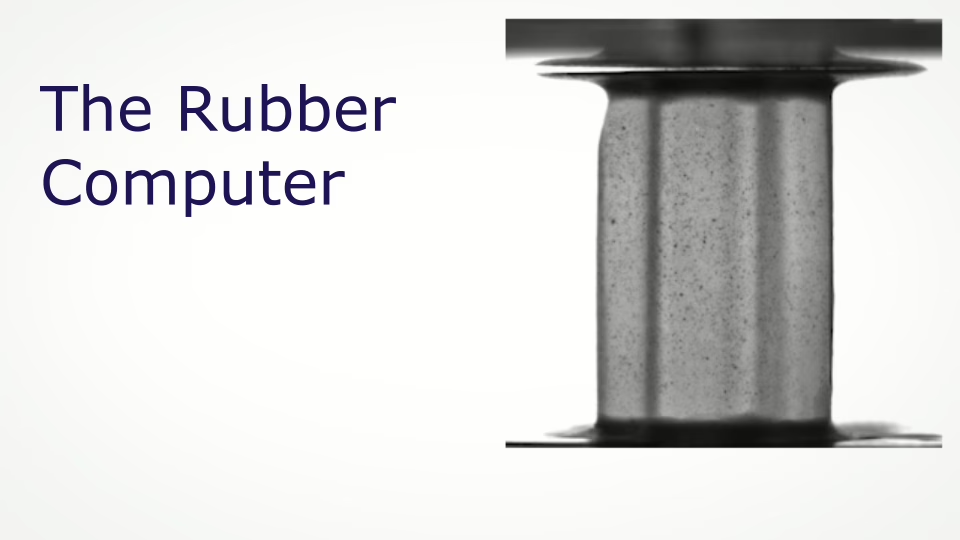
A computer made of rubber
A piece of corrugated rubber can function as a simple computer, displaying memory and dis-playing the ability to count to two. Physicists from Leiden University and AMOLF published about the computing rubber in the journal PNAS. ‘Simple materials can process information, and we want to find the principles behind that.’

Molecular device turns infrared into visible light
Researchers at EPFL, China, Spain and AMOLF have built a micro-device that uses vibrating molecules to transform invisible mid-infrared light into visible light. The breakthrough ushers in a new class of compact sensors for thermal imaging and chemical or biological analysis. The team publishes their findings in Science.
Minerva Prize 2021 goes to Wiebke Albrecht and Natalia Chepiga
Today, the NNV and the Dutch Physics Council (DPC) announced that AMOLF tenure track group leader Wiebke Albrecht is one of the two recipients of the Minerva prize 2021. She shares the prize with Natalia Chepiga (Kavli Institute of Nanoscience Delft). The Minerva Prize is awarded to an outstanding young female or non-binary physicist in the Netherlands with an overall performance that scientifically excels in any subfield of physics. Both experimental and theoretical scientific physics research are taken into account. Albrecht and Chepiga share the prize money of € 5000.

Femius Koenderink elected 2022 Optica Fellow
The Optica (formerly OSA) Board of Directors has elected Femius Koenderink to the 2022 Fellows Class. He is one of the 106 members to be honored this year. Koenderink was elected ‘for fundamental contributions to subwavelength resonant nanophotonics to control scattering, emission, and amplification of light at the nanometer scale’. Koenderink leads the Resonant Nanophotonics group at AMOLF and is head of the Nanophotonics department.

Anne Meeussen wins the Ehrenfest-Afanassjewa thesis prize 2021
Today, the Dutch Physics Council announces that former PhD student Anne Meeussen (Mechanical Metamaterials group at AMOLF and Leiden University) wins the Ehrenfest-Afanassjewa thesis prize 2021. Meeussen defended her thesis in May 2021 at Leiden University, for which she received the cum laude distinction.

Martin van Hecke elected APS fellow
Metamaterials researcher Martin van Hecke has been elected American Physical Society (APS) fellow, an honour exclusive to only half a percent of the society’s members. The Soft Matter Division of the American Physical Society elected Van Hecke ‘For leading work in the field of jammed and disordered systems, and for pioneering the field of programmable mechanical metamaterials.‘