Hyperuniform Disorder
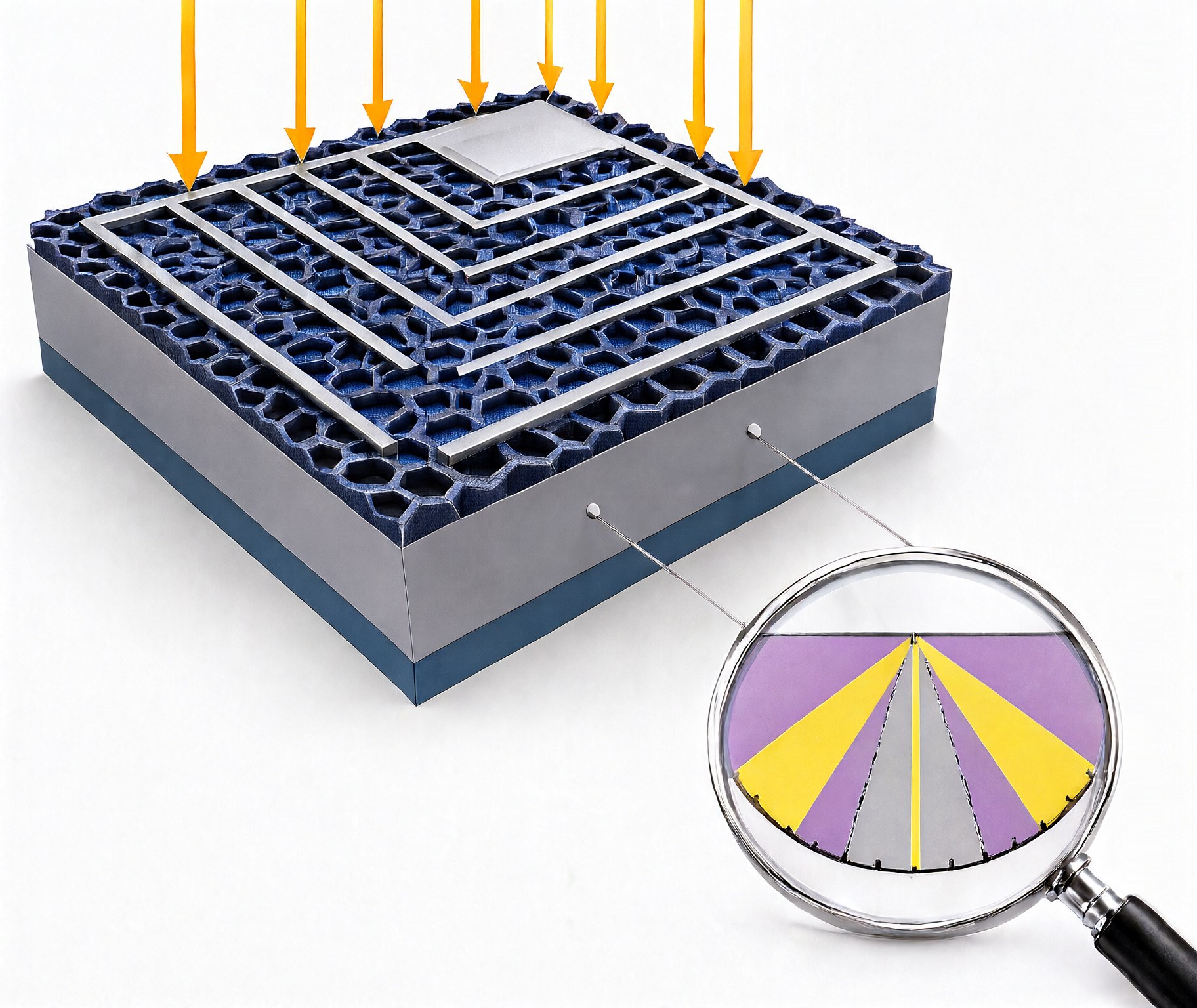
HUD patterns are like people milling around a busy square: nobody stands in a grid, but everyone keeps a comfortable distance from each other. As a result, the crowd spreads out evenly, without clusters or empty spaces. There are many examples in nature that follow HUD order, all the way from the light-sensing cones in a bird’s eye to the structure of the universe.
“We managed to harness nature’s hidden order to make ultra-thin solar cells more efficient.”
Trapping all colors
The researchers used inverse design to create patterns that direct light where they want it to go, regardless of its color. Inverse design is a method that starts with the desired result and works backwards. Thus, it became possible to implement the patterns in the ultra-thin solar cells and effectively trap light across the entire spectrum, which is crucial for making the most of the available sunlight.
Collaboration
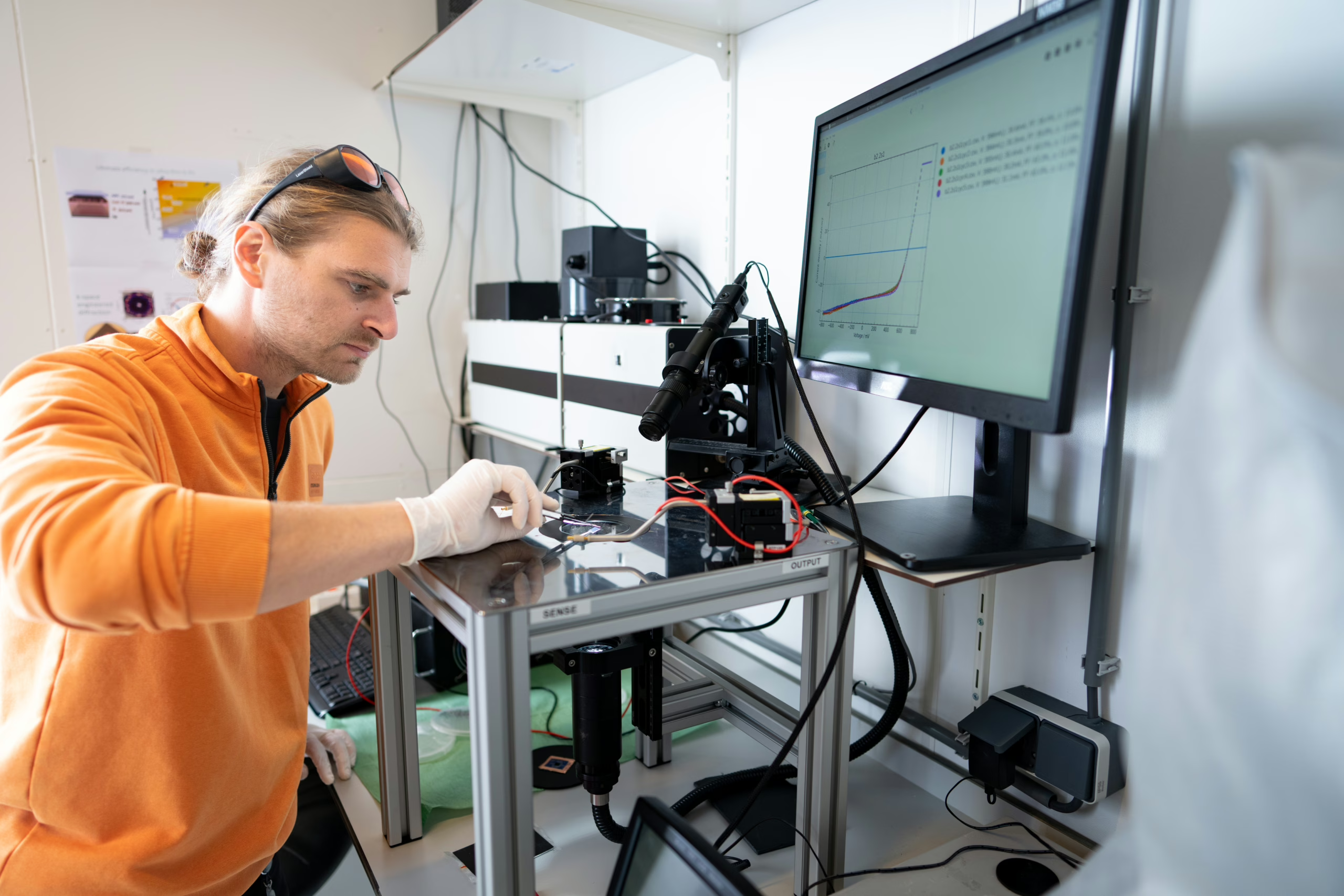
The work was a collaboration between AMOLF, University of Amsterdam, Stanford University and University of Southampton. Esther looks back on a great project: “This was a wonderful collaboration, in which the cells were fabricated in Stanford, the designs were made in Southampton, and the patterning with all of the optical/solar cell analysis was done in Amsterdam.”
Learn more:
– If you have any questions about this research, please contact Esther Alarcón Lladó at e-mail e.alarconllado@amolf.nl
– The paper Integrating hyperuniform disordered light trapping layers in ultrathin c-Si solar cells was published in ACS Photonics on October 12.
– To read full paper go to ACS Photonics