
Our Disciplinary centers
Center for Modern Mechanics
Disciplinary Centers are dedicated hubs for training and scientific exchange. They are designed to foster the development of expertise, train researchers, and stimulate scientific interaction and collaboration. These centers focus on specific areas of expertise, whereas the research themes cover broader research domains.
The Center for Modern Mechanics leverages geometry, vibrations and nonlinearities to probe and design (meta)materials and mechanical systems that reconfigure, sense, and process information.
Area of expertise
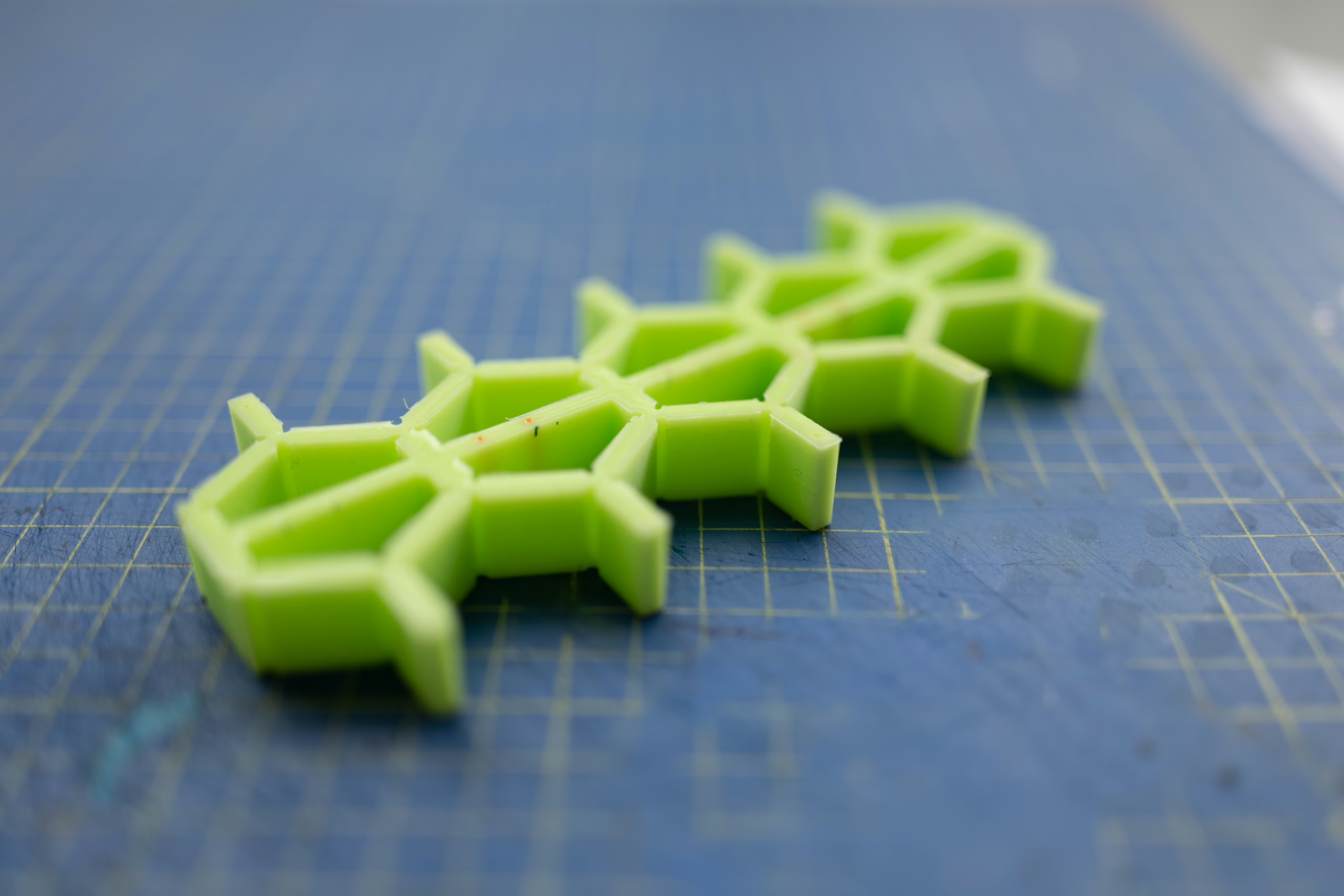
We develop design techniques for complex metamaterials that straddle the boundary between material and machine. For example, we explore how complex materials – from metamaterials to crumpled sheets – store and process information and use elastic stresses and strains as information carriers.
We integrate our work with soft robotics and explore how mechanical nonlinearities and instabilities can be used to incorporate sensing, actuation, autonomy, and feedback in soft systems. Moreover, at smaller scales we develop micro- and nanomechanical resonators with ultralow dissipation and explore new ways to control both thermal and quantum fluctuations in mechanical metamaterials.
Connecting insights with applications
An important aspect of our work is to synergize this fundamental understanding with applications. Our understanding of mechanical nonlinearities yields functional materials and soft robots with embodied intelligent behavior. At the same time, our understanding of the limits and principles that govern information processing in physical systems, addresses the low energy and ubiquitous computing needs of the future and enables new classical and quantum sensors.
To achieve this, our center brings together research groups with expertise in the design, fabrication and characterization of metamaterials, soft robotics and micromechanical resonators, integrating experiments, simulations and theory.
We operate at scales from the nanometer to centimeter, and incorporate knowledge on nonlinearities, instabilities, waves, computing and emergence with technical expertise on 3D printing, nanofabrication and finite element modeling.
Related research themes
The Center for Modern Mechanics is related to our research themes Autonomous Matter and Information in Matter. Autonomous Matter studies how matter can perform complex functions independently, whereas Information in Matter investigates how physical systems gather, process, and utilize information.
Group leaders
Group leaders associated with the Center for Modern Mechanics:
Other Disciplinary Centers
Contact
If you have any questions about the Center for Modern Mechanics, please contact Martin van Hecke at M.v.Hecke@amolf.nl.