
News & updates
Latest developments from our institute
Stay informed about new research results, awards, events, and collaborations across our scientific community.

AMOLF group leaders publish review article in Science on challenges in photovoltaic energy conversion
Analyzing 16 record-efficiency solar cell materials, the paper presents opportunities to improve photovoltaic efficiency using nanoscale light management and to enhance carrier collection with innovative materials science and engineering strategies.
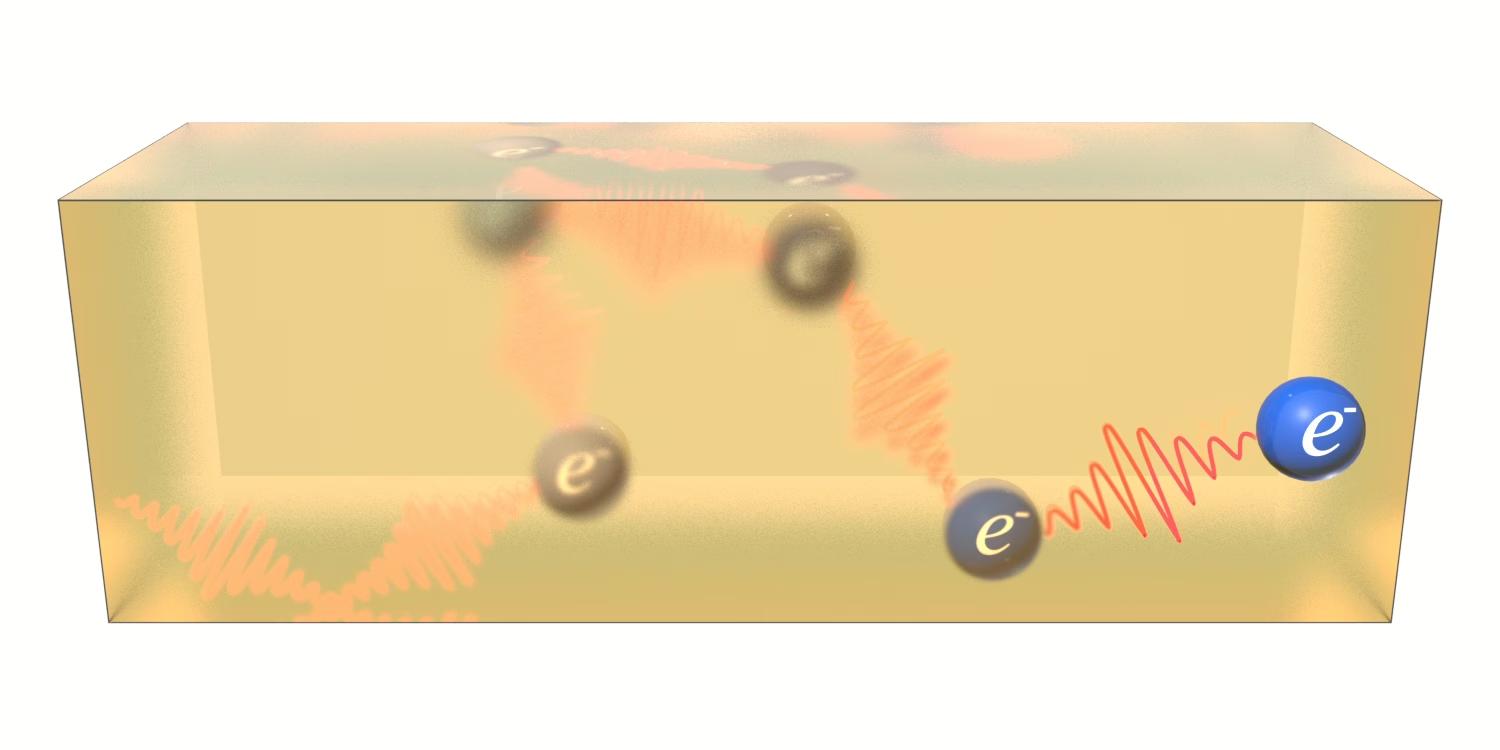
Solar cell material can recycle light to boost efficiency
Perovskite materials can recycle light particles – a finding which could lead to a new generation of affordable, high-performance solar cells.
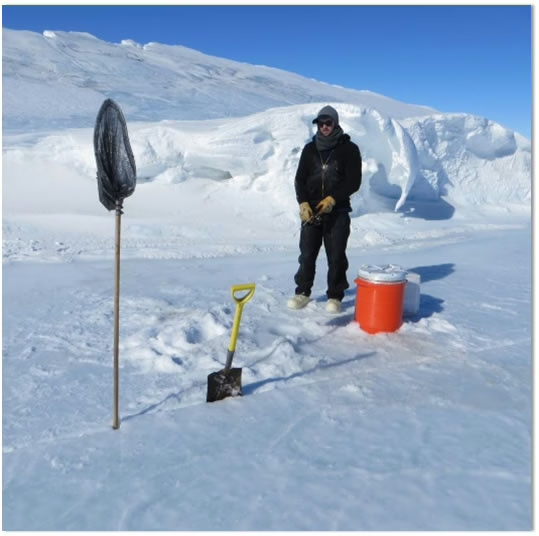
No clear winner when it comes to antifreeze protein efficiency
Ever since biologist Arthur DeVries discovered antifreeze proteins in Antarctic fish in the 1960’s, researchers have tried to unravel the mystery behind these remarkable proteins. Thanks to the proteins in their body fluids these fish, and other extremophiles, do not freeze in the cold environment in which they live. The antifreeze proteins, of which there are several varieties, attach to small ice crystals, thereby hindering their growth. So while ice may form in the blood, the crystals are so small that the blood is not deprived of its functions.

The biological clock in dividing cells: a robust design
Researchers from FOM institute AMOLF and the University of Michigan have discovered how the biological clock of an organism remains stable, even when the cells of that organism grow and divide. Today in the Proceedings of the National Academy of Sciences (PNAS) USA they provide a mathematical model that explains the undisrupted functioning of the biological clock.

AMOLF researchers make transparent conductors by means of stamping and growing
Researchers at AMOLF have discovered a new technique for making transparent conductors used in electronics such as solar cells and smartphones.
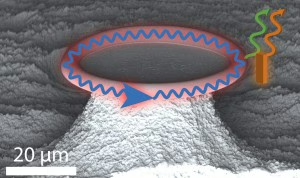
Nanoparticles unexpectedly make light move faster
Researchers at the FOM Institute AMOLF have observed a surprising effect during experiments in which light is ‘trapped’ in a cavity. They established that the presence of nanoparticles close to the cavity could increase the speed of the light running through the cavity. This goes against the 70-year-old expectation that the refractive index of the particles predicts the speed of light. In that case, the nanoparticles ought to slow the light down. Radiation from the particles was found to be responsible for this surprising effect. Furthermore, the particles cause the light to remain trapped in the cavity for a longer period of time. This is an important finding, as the measurement of such changes in the speed of light forms the basis for sensors with extreme sensitivity. The researchers published their findings in Physical Review Letters on 11 November.
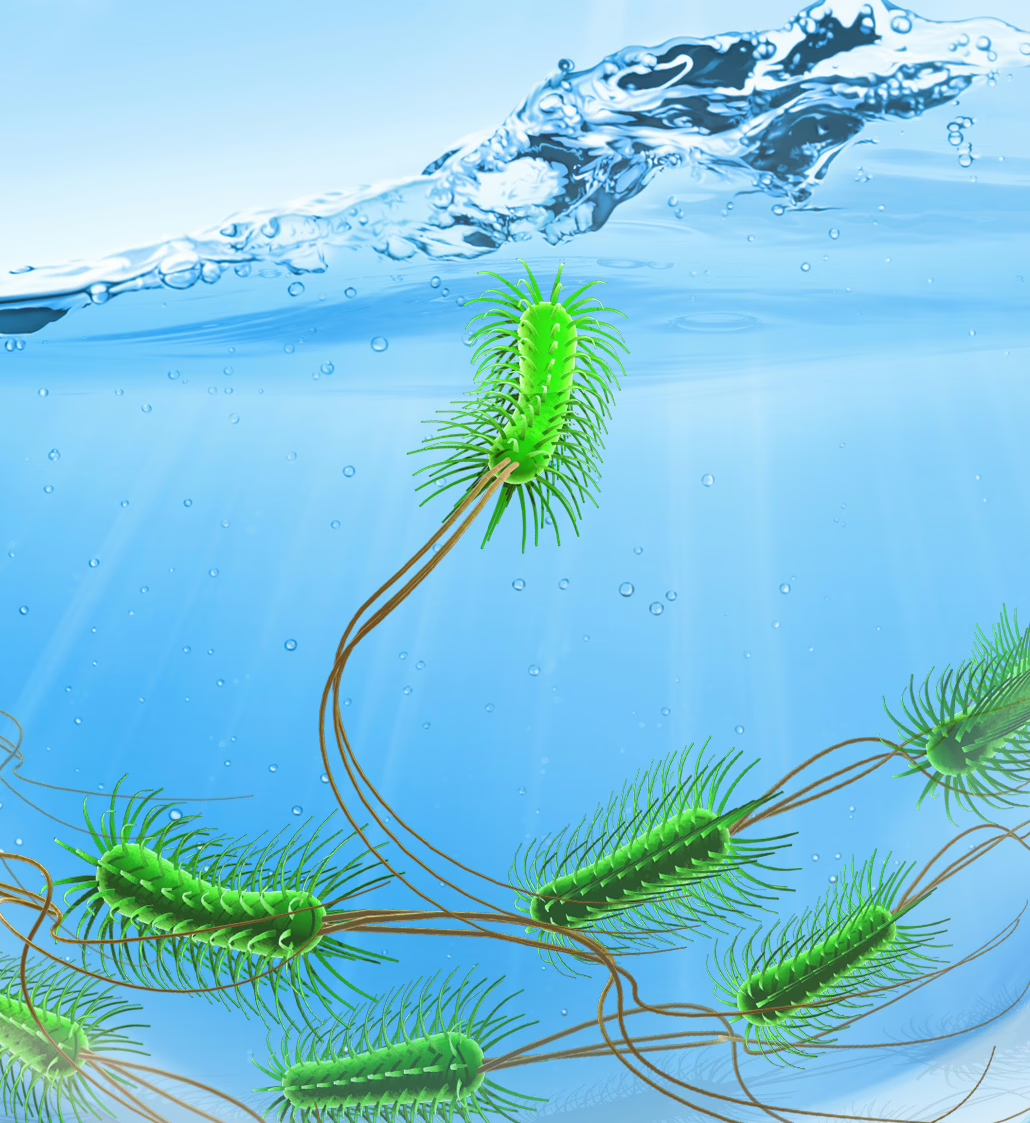
Change accelerates stalled evolution
Researchers of FOM Institute AMOLF and Laboratoire Interdisciplinaire de Physique in Grenoble (France) have shown that the evolution of bacteria can be accelerated when their environment fluctuates in time. The research gives new insights in the evolutionary limitations of organisms and the positive effect of changing conditions, and leads to new suggestions for the evolutionary optimization of biotechnological processes. The work also reveals a flip-side, because evolutionary acceleration can also be detrimental in some cases. For example, the alternating use of antibiotics could increase the risk that bacteria more rapidly evolve resistance against antibiotics. The results will be published Friday, November 13, in PNAS.
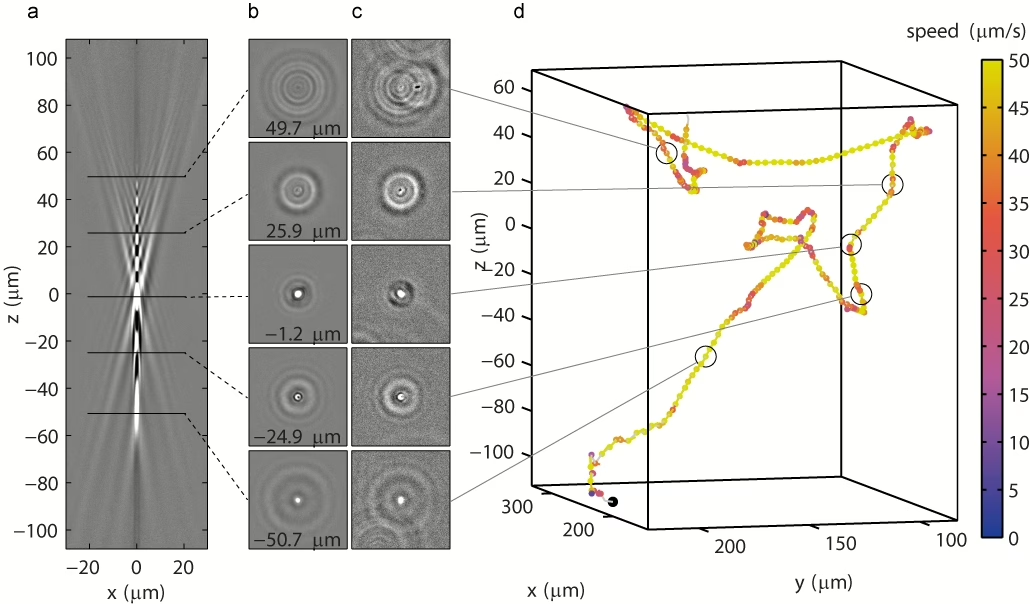
New 3D tracking technique “for the masses” reveals individuality of bacterial behavior
Microscopy techniques used to study the movement of swimming microbes are limited to two dimensions (2D) or require sophisticated devices. In a paper to be published online on 2 November, AMOLF researchers present a new method to track the movement of bacteria swimming in three dimensions (3D) using simple microscopes that are standard in biological laboratories.