
News & updates
Latest developments from our institute
Stay informed about new research results, awards, events, and collaborations across our scientific community.
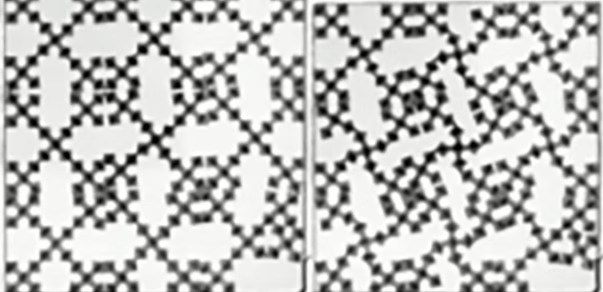
Self-folding metamaterial
The more complex the object, the harder it is to fold up. Space satellites often need many small motors to fold up an instrument, and people have difficulty simply folding up a roadmap. Physicists from Leiden and Amsterdam have now designed a structure that folds itself up in several steps. The results from this research will be published in Nature on September 27, 2018.
Nanoscale solar cells benefit from transistor technique
An international team of scientists has investigated a new type of charge carrier-selective contact for nanowire solar cells based on the surface-gate effect. Those contacts make use of an effect that is ubiquitous in every computer chip. In a field-effect transistor, a surface gate modulates the conductivity of the underlying semiconductor, allowing control over the current flow between the source and drain terminals. Now, the scientists are able to translate this concept to nanowire solar cells by making use of a surface layer to control the conductivity of the nanowire next to a metal point contact. The researchers from AMOLF, the University of Oregon, Eindhoven University of Technology and Delft University of Technology published their results on August 14th, 2018 in the journal Nature Communications.
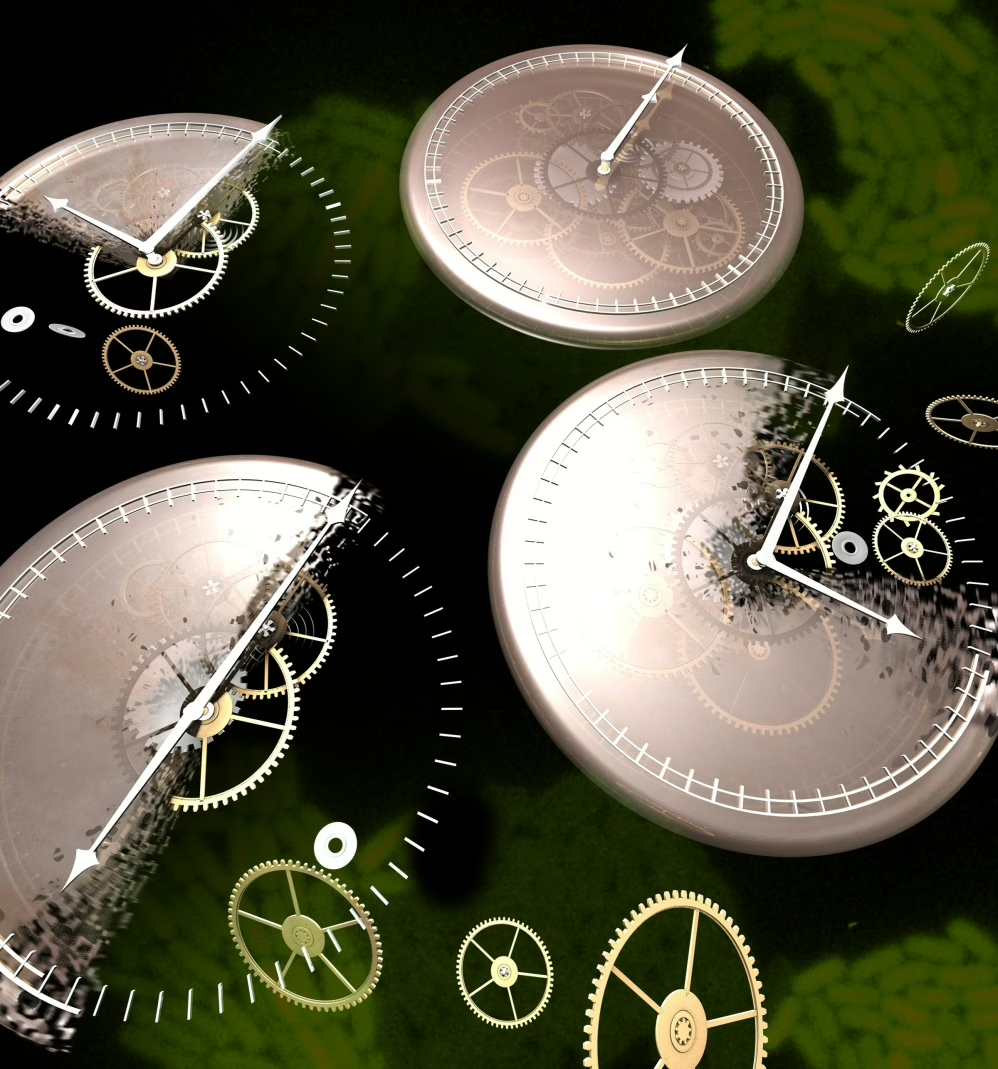
Noise in the biorhythm: biological clocks respond differently to light fluctuations
Anybody who has experienced jet lag knows the power of the biological clock. Almost all organisms, from humans to the smallest of bacteria, have a built-in system that tells them whether it is time to rest or to be active. Most biological clocks ‘tick’ autonomously, but some bacteria depend on light to synchronize their clock every day. Using mathematical calculations, researchers from AMOLF and the University of Michigan have now demonstrated that an autonomous clock suffers far less from noise, such as fluctuations in sunlight due to clouds. The research results were published online on August 14th 2018 in the scientific journal Physical Review Letters.
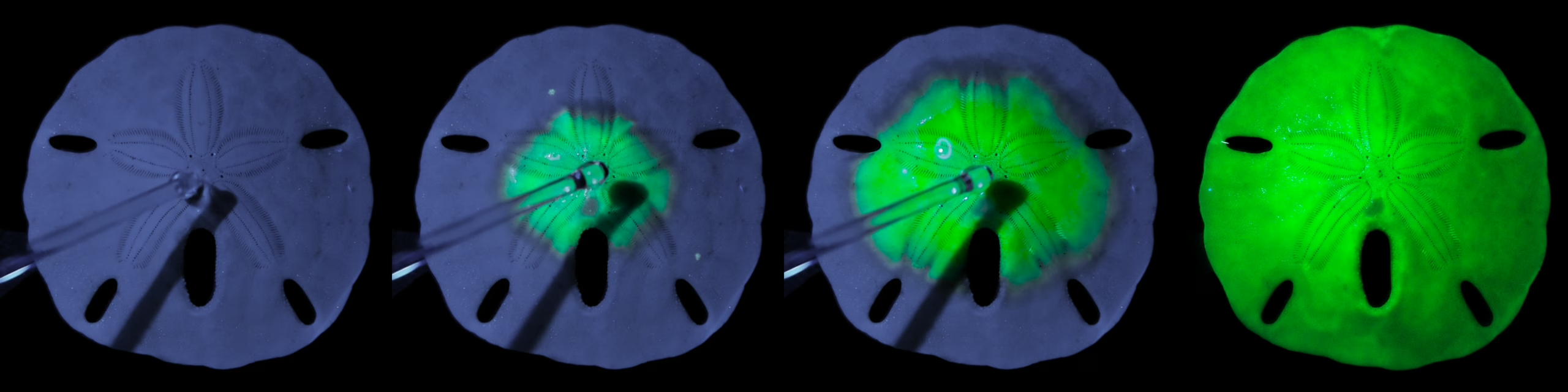
From sea urchin skeleton to semiconductor
Researchers at AMOLF have found a way of making calcium carbonate structures, such as a sea urchin skeleton, suitable for use in electronics. They do this by modifying the composition of the material so that it becomes a semiconductor without losing its shape. This research was published in the journal Nature Chemistry on June 4th 2018.
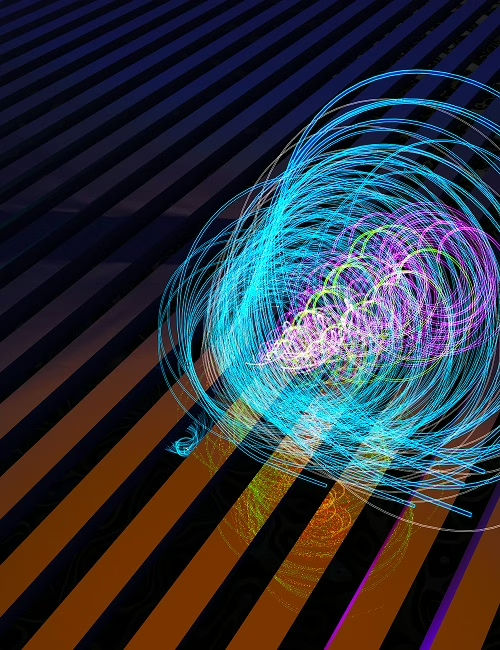
Physicists catch light in the eye of the storm
Stillness rules the eye of a hurricane; without a hurricane no eye, and without an eye no hurricane. In a similar manner, physicists of research institute AMOLF, the University of Amsterdam and the University of Texas at Austin, have captured light in the eye of an optical vortex. “The light could move in any direction but does not do so,” says researcher Hugo Doeleman. The research will be published on June 4th in the top journal Nature Photonics.
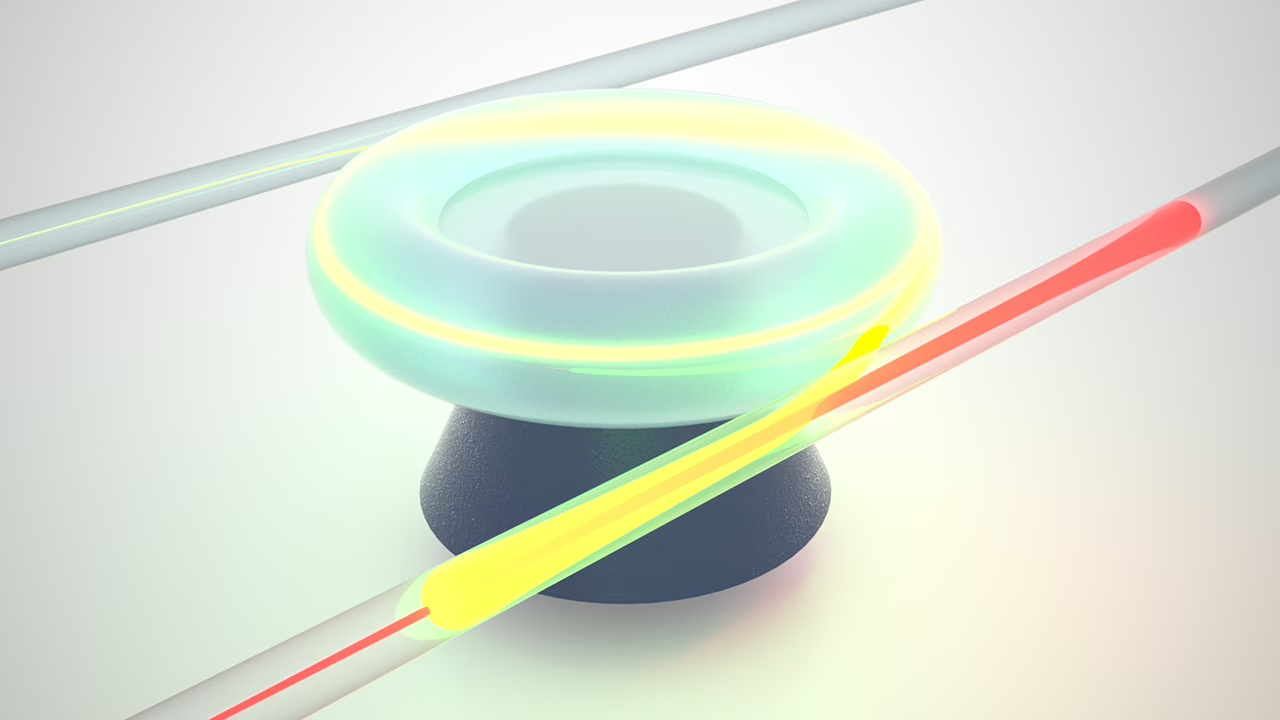
A Microscopic Roundabout for Light
AMOLF develops a magnet-free optical circulator Circulators are important components in communication technology. Their unique way of routing light usually requires centimeter-sized magnets, which are difficult to miniaturize for use on optical chips. Researchers at AMOLF and the University of Texas have circumvented this problem with a vibrating glass ring that interacts with light. They thus created a microscale circulator that directionally routes light on an optical chip without using magnets. The researchers publish their work in Nature Communications on 4 May 2018.

New method predicts evolution
As evolution is driven by chance, predicting it seems impossible. Nevertheless, scientists from AMOLF in Amsterdam and the ESPCI in Paris have succeeded in making predictions about the evolution of a set of genes in E. coli. When and how genes mutate remains random, but it did appear predictable which gene is more likely to evolve first, or if evolutionary deadlock arises. The results have been published on 13 April in the journal Nature Communications.
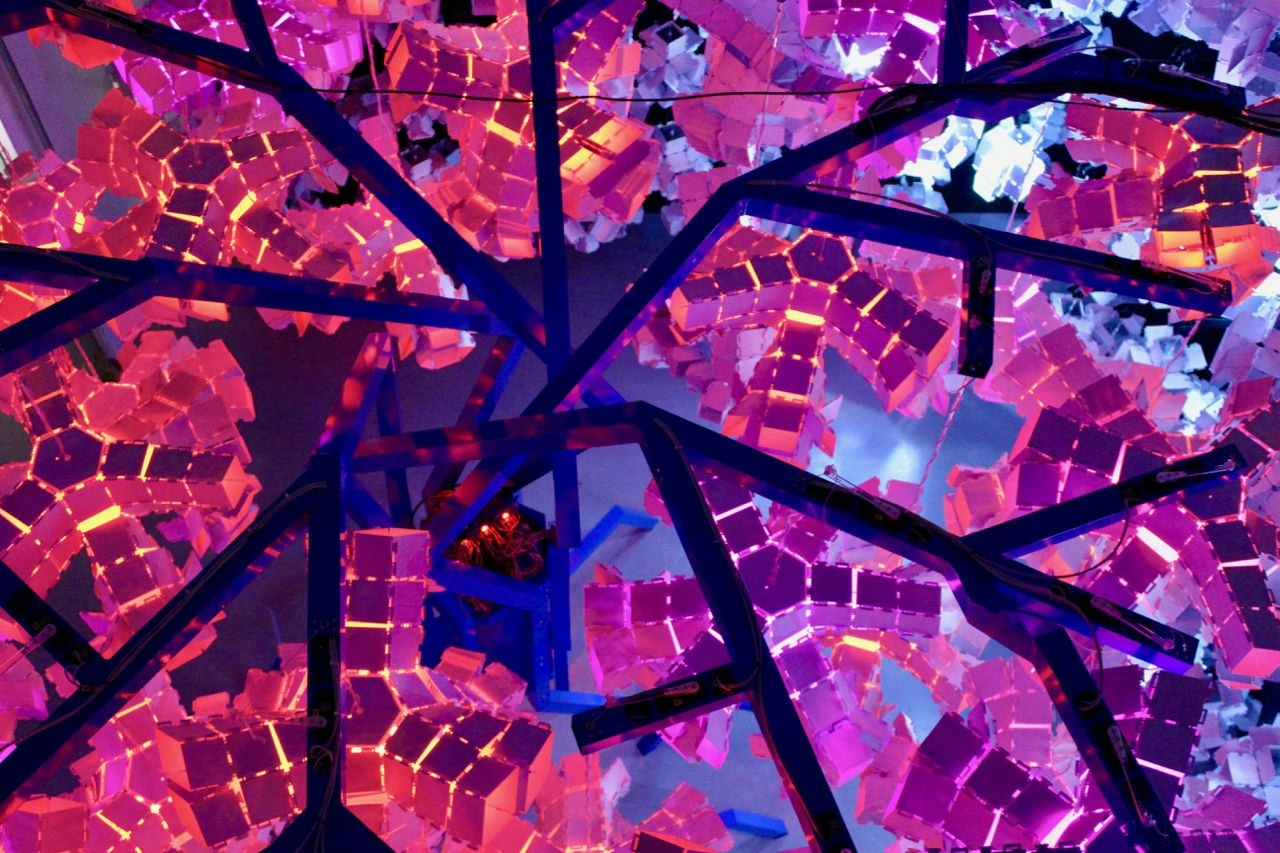
Edge of Chaos – an interactive kinetic installation
Between order and chaos, a mathematical space originally studied to understand the behaviour of avalanches and crystallisation of liquids, scientists are uncovering the rules for the existence of life itself. A small region called the “Edge of Chaos” displays complex behaviour that is both organised and unstable, creating the continuous flux that scientist hypothesise drives the engine of life – evolution – and produces the boundless novelty of the natural world.