
News & updates
Latest developments from our institute
Stay informed about new research results, awards, events, and collaborations across our scientific community.

Bela Mulder appointed at Utrecht University
As of 1 January, Bela Mulder (Theory of Biomolecular Matter) has been appointed Professor by Special Appointment in Theoretical Biophysics at Utrecht University.

ERC Advanced Grant for Pieter Rein ten Wolde
Today the European Research Council (ERC) announced that 185 scientists receive an Advanced Grant of 2.5 million euros. One of them is AMOLF group leader Pieter Rein ten Wolde. He will use the grant to determine how accurately single-celled organisms can predict changes in their environment.
Topology protects light propagation in photonic crystal
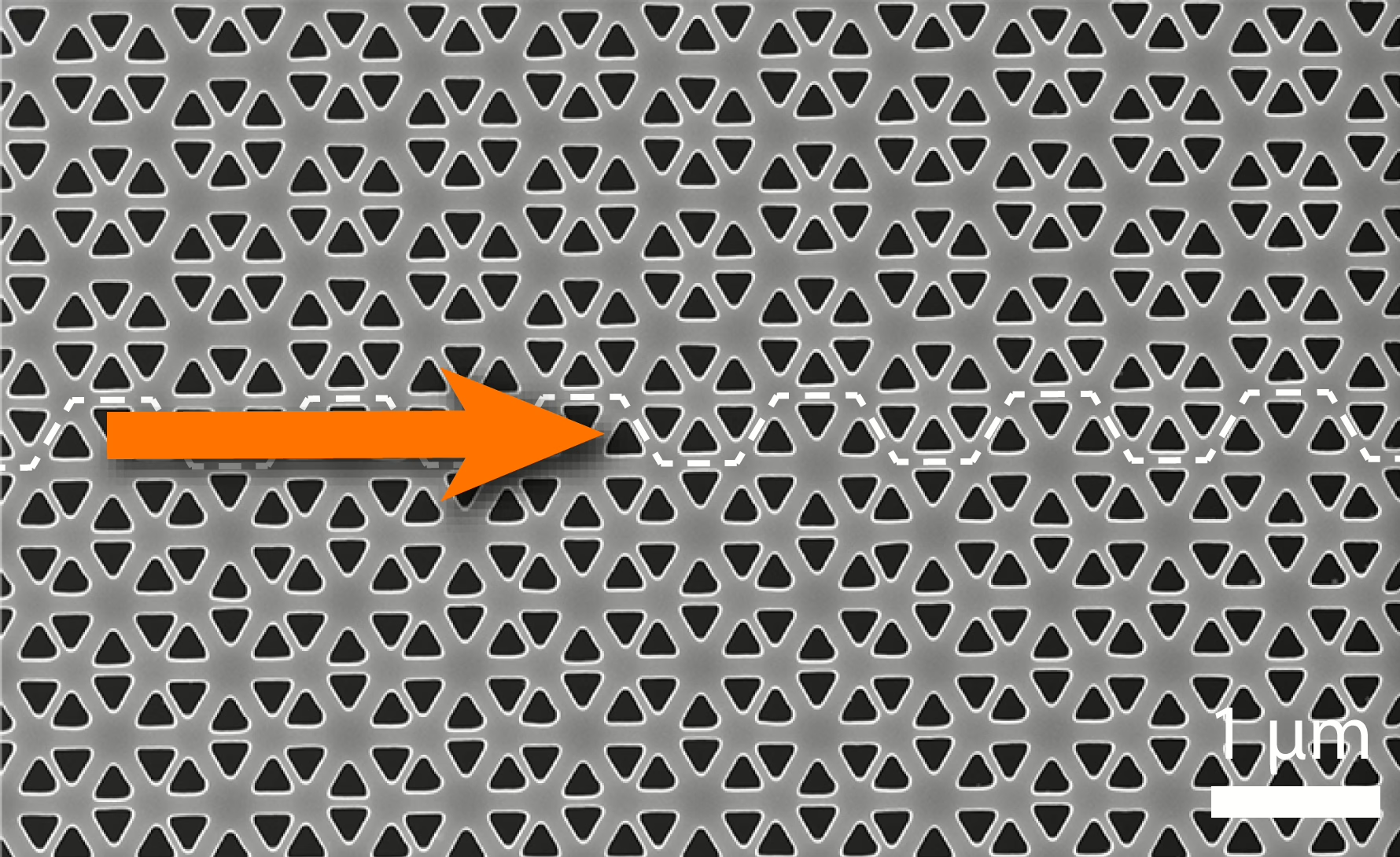
Researchers of AMOLF and TU Delft have seen light propagate in a special material without it suffering from reflections. The material, a photonic crystal, consists of two parts that each have a slightly different pattern of perforations. Light can propagate along the boundary between these two parts in a special way: it is ‘topologically protected’ and, therefore, does not bounce back at imperfections. Even when the boundary forms a sharp corner, the light follows it without a problem. “For the first time, we have seen these fascinating light waves move at the technologically relevant scale of nanophotonics,” says Ewold Verhagen, group leader at AMOLF. The results are published on March 6th in the scientific journal Science Advances.
Organoid project granted in NWO Open Competition Domain Science
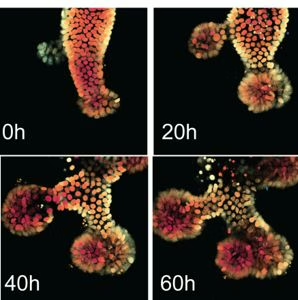
The project ‘Organoids in time’ is one out of twenty new consortia that can start thanks to NWO funding: the Open Competition Domain Science. The grant consists of a total of 2.5 million euros.
Researchers discover new mechanism for the coexistence of species
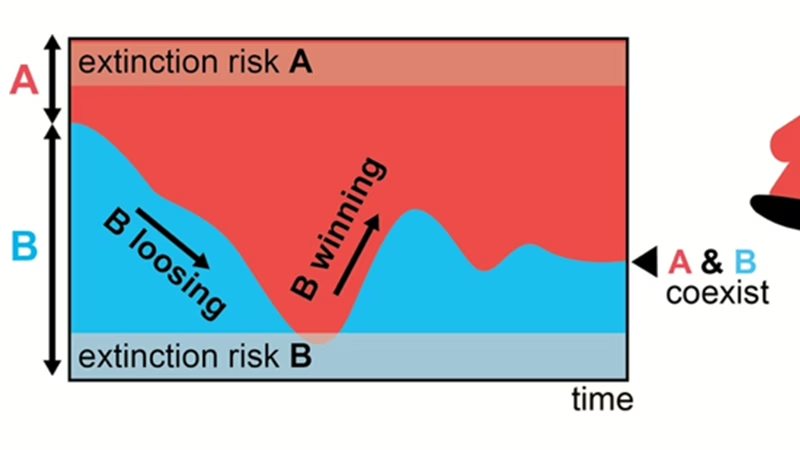
Researchers from AMOLF and Harvard University (USA) show how the ability of organisms to move around plays a role in stabilizing ecosystems. In their paper published 19 February 2020 in Nature, they describe how the competition between ‘movers’ and ‘growers’ leads to a balance in which both types of bacteria can continue to exist alongside each other.
Noise in a sensor? No problem!
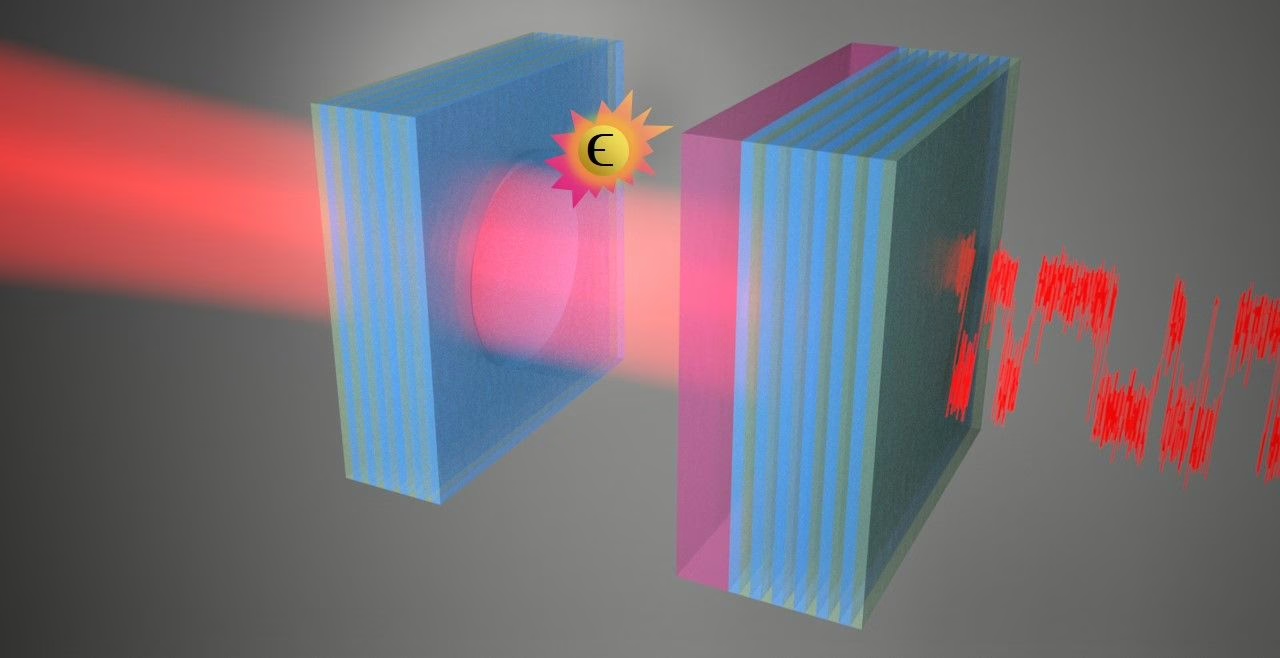
In conventional sensing methods, noise is always a problem, especially in systems that are meant to detect changes in their environment that are hardly bigger or even smaller than the noise in the system. Encountering this problem in his experiments with interacting photons, AMOLF physicist Said Rodriguez thought of a way around it. In an article that will be published in Physical Review Applied on February 13, 2020, he demonstrates how noise can be turned into a resource for optical sensing rather than a problem.
Vibrations on a chip feel a magnetic field
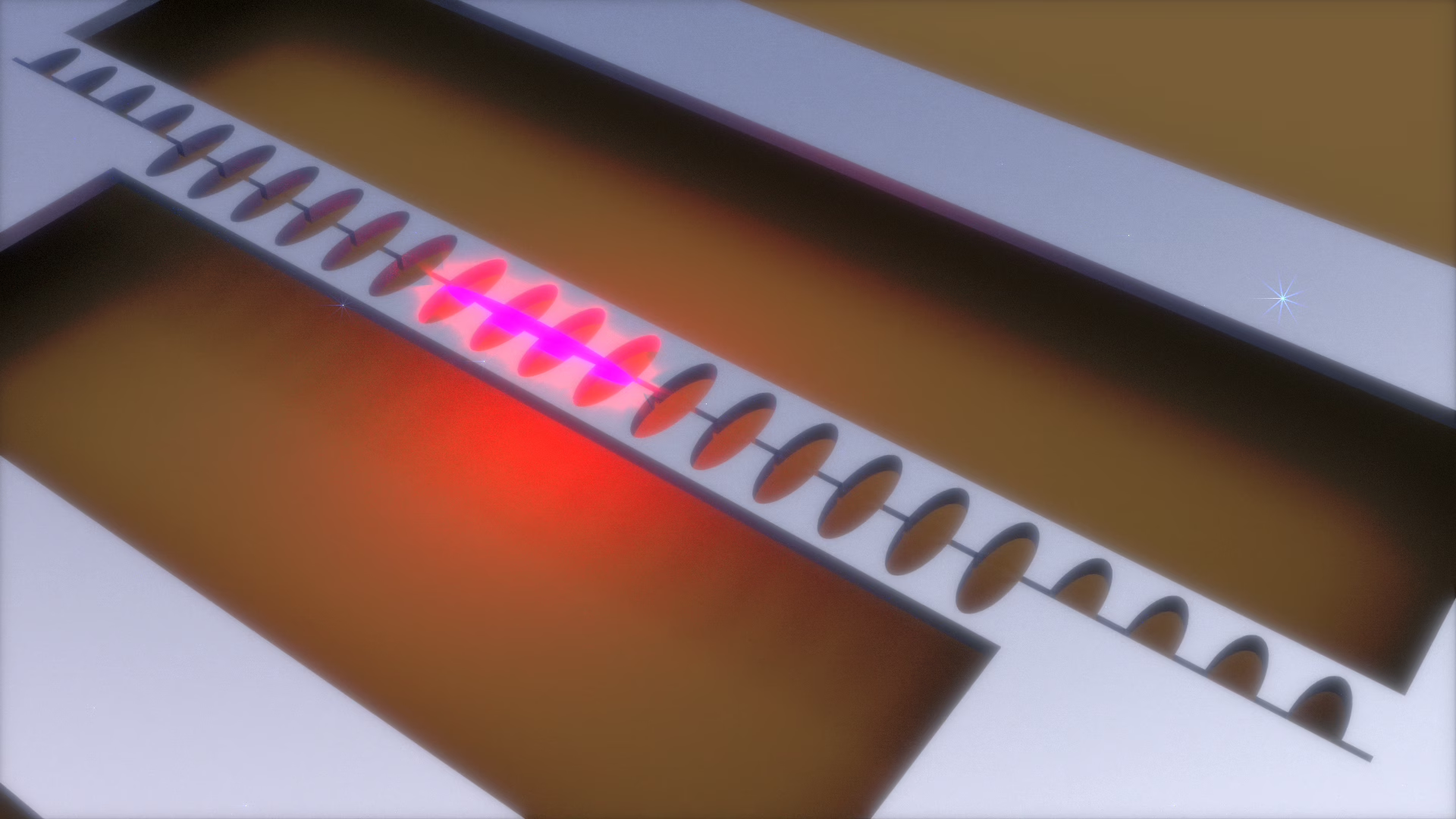
AMOLF physicists have made mechanical vibrations on a chip behave as if they were electrical currents flowing in a magnetic field. Because of their charge, electrons are influenced by magnetic fields, which curve their trajectories. Sound waves or more precisely the propagating mechanical vibrations don’t feel a magnetic field, because they don’t carry charge. By illuminating strings with laser light the researchers have found a way to make mechanical vibrations hop from one nanoscale string to another. Thus, these vibrations behave like electrons in a magnetic field. This unlocks new ways to manipulate sound waves and the information they can carry on chips. They publish their findings in Nature Nanotechnology on 3 February 2020.
Molecular machine tears toxic protein clumps apart
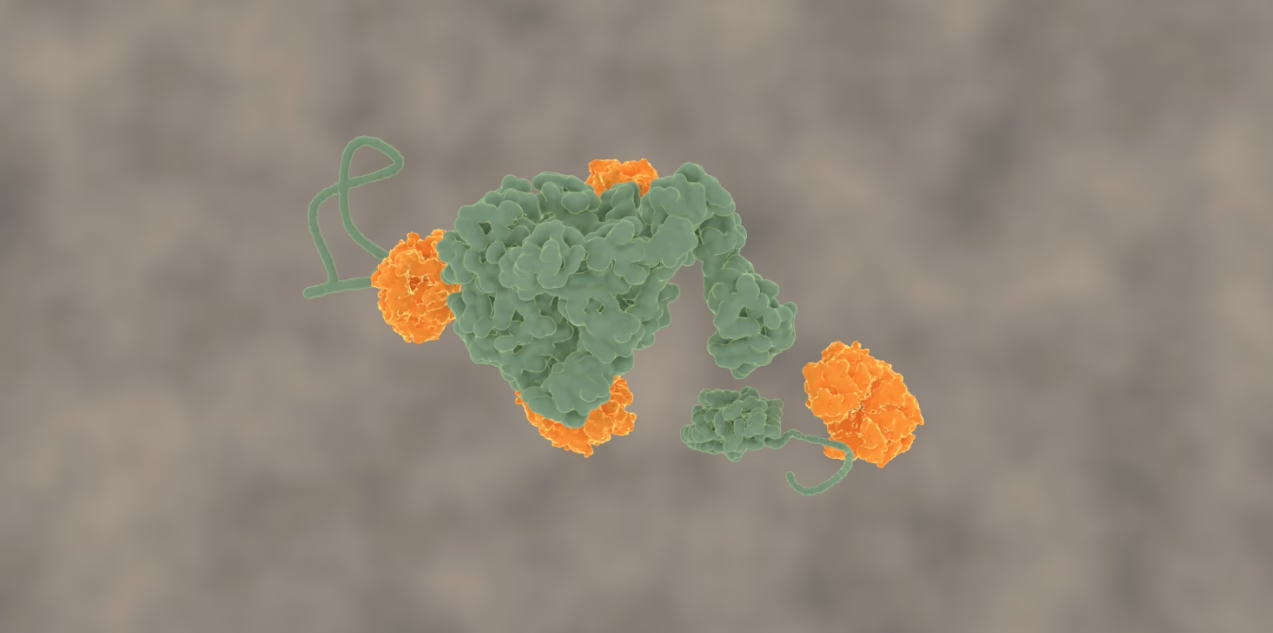
How do cells disentangle proteins that are clumped together? Researchers from AMOLF in Amsterdam and Heidelberg University now show that the molecular chaperone ClpB can forcibly pull on exposed loops of protein chains, and hence extract them from protein clumps. They published their results in Nature today.