
News & updates
Latest developments from our institute
Stay informed about new research results, awards, events, and collaborations across our scientific community.

Nanoscale motion sends light into overdrive
Researchers demonstrate record strong conversion of motion into light AMOLF researchers have developed nanoscale strings whose motion can be converted to light signals with unprecedented strength. This could allow for extremely precise sensors and comes with an important side-effect. “Analogous to a guitar amplifier in overdrive producing distorted sound waves, our strong motion-to-light conversion leads to distorted light signals”, says group leader Ewold Verhagen. “But these signals actually carry information about the motion that may lead to new ways of measuring quantum mechanical motion.” The researchers published their results on 7 July 2017 in Nature Communications.
AMOLF researchers make one-way street for light
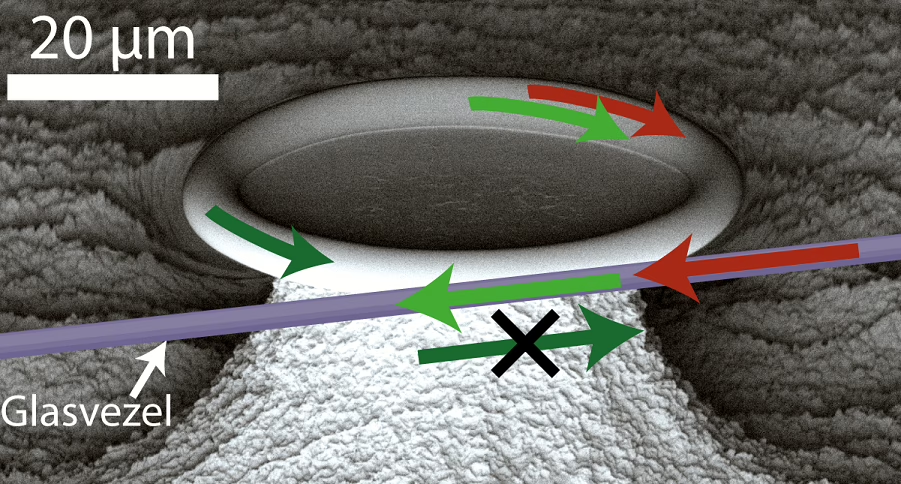
Researchers at FOM institute AMOLF and the University of Texas at Austin have created a compact one-way street for light. That is remarkable because light waves can generally move in both directions inside a material. Optical chips could benefit from the new functionality, as it enables a new way to route data encoded in the light signals. The researchers published their results in Nature Communications on 29 November.
Nanoparticles unexpectedly make light move faster
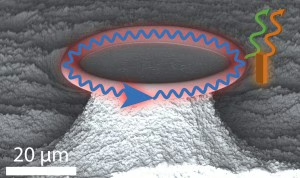
Researchers at the FOM Institute AMOLF have observed a surprising effect during experiments in which light is ‘trapped’ in a cavity. They established that the presence of nanoparticles close to the cavity could increase the speed of the light running through the cavity. This goes against the 70-year-old expectation that the refractive index of the particles predicts the speed of light. In that case, the nanoparticles ought to slow the light down. Radiation from the particles was found to be responsible for this surprising effect. Furthermore, the particles cause the light to remain trapped in the cavity for a longer period of time. This is an important finding, as the measurement of such changes in the speed of light forms the basis for sensors with extreme sensitivity. The researchers published their findings in Physical Review Letters on 11 November.