
News & updates
Latest developments from our institute
Stay informed about new research results, awards, events, and collaborations across our scientific community.

Huib Bakker appointed as new director of FOM Institute AMOLF
Huib Bakker has been appointed as director of FOM Institute AMOLF starting on February 1st, 2016. He succeeds AMOLF director Vinod Subramaniam, who became Rector of VU University on September 1st, 2015. At this date Bakker took over from Subramaniam leading AMOLF as interim director.
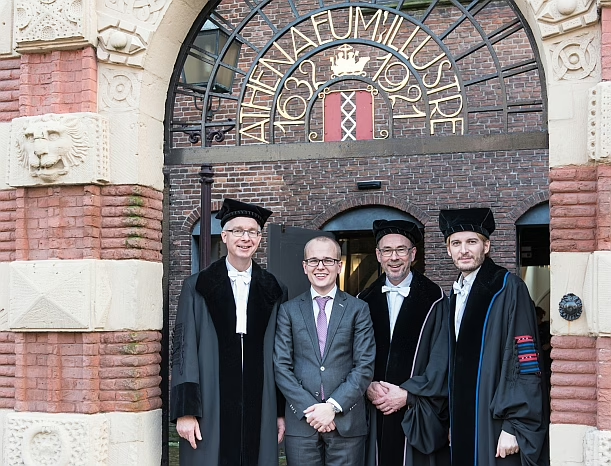
Cum Laude for Jorik van de Groep
On December 15th Jorik van de Groep defended his PhD thesis Resonant Nanophotonic Structures for Photovoltaics at the University of Amsterdam.

AMOLF researchers make transparent conductors by means of stamping and growing
Researchers at AMOLF have discovered a new technique for making transparent conductors used in electronics such as solar cells and smartphones.
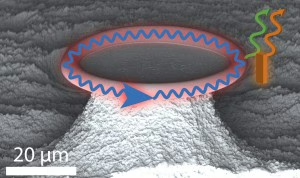
Nanoparticles unexpectedly make light move faster
Researchers at the FOM Institute AMOLF have observed a surprising effect during experiments in which light is ‘trapped’ in a cavity. They established that the presence of nanoparticles close to the cavity could increase the speed of the light running through the cavity. This goes against the 70-year-old expectation that the refractive index of the particles predicts the speed of light. In that case, the nanoparticles ought to slow the light down. Radiation from the particles was found to be responsible for this surprising effect. Furthermore, the particles cause the light to remain trapped in the cavity for a longer period of time. This is an important finding, as the measurement of such changes in the speed of light forms the basis for sensors with extreme sensitivity. The researchers published their findings in Physical Review Letters on 11 November.
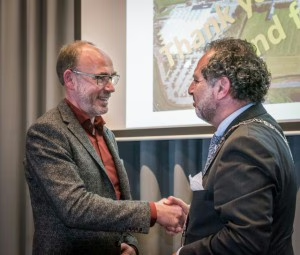
Royal Decoration for Wim Sinke
AMOLF’s visiting scientist Wim Sinke was awarded a royal decoration last Friday, November 13 at the symposium Our solar energy future that was organized at the occasion of Sinke’s 60th birthday. Six (inter-)national speakers gave presentations on state-of-the art photovoltaic energy conversion, honoring the many contributions of Sinke in this field.

Change accelerates stalled evolution
Researchers of FOM Institute AMOLF and Laboratoire Interdisciplinaire de Physique in Grenoble (France) have shown that the evolution of bacteria can be accelerated when their environment fluctuates in time. The research gives new insights in the evolutionary limitations of organisms and the positive effect of changing conditions, and leads to new suggestions for the evolutionary optimization of biotechnological processes. The work also reveals a flip-side, because evolutionary acceleration can also be detrimental in some cases. For example, the alternating use of antibiotics could increase the risk that bacteria more rapidly evolve resistance against antibiotics. The results will be published Friday, November 13, in PNAS.
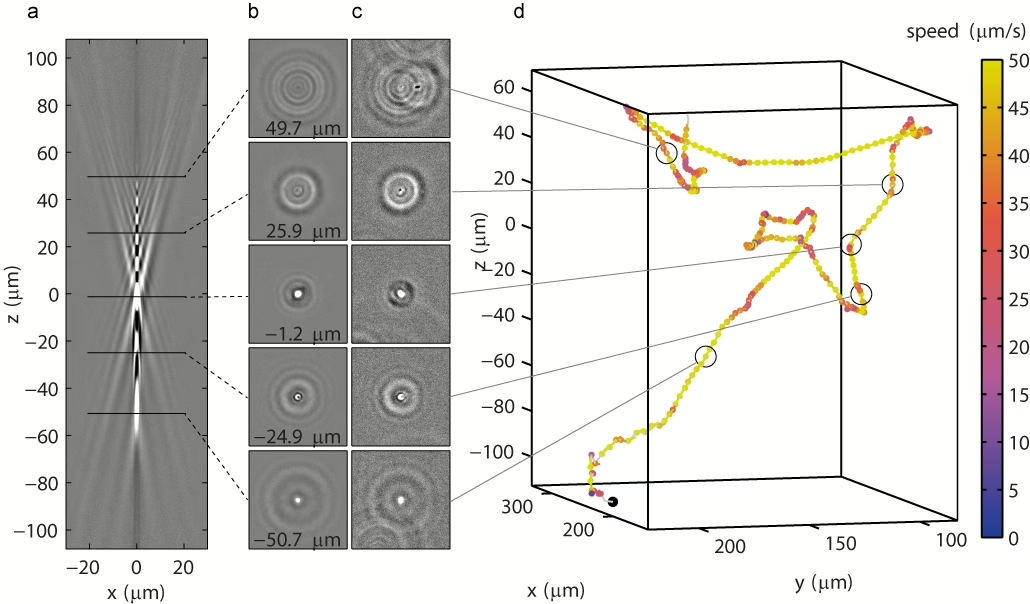
New 3D tracking technique “for the masses” reveals individuality of bacterial behavior
Microscopy techniques used to study the movement of swimming microbes are limited to two dimensions (2D) or require sophisticated devices. In a paper to be published online on 2 November, AMOLF researchers present a new method to track the movement of bacteria swimming in three dimensions (3D) using simple microscopes that are standard in biological laboratories.

Pieter Rein ten Wolde elected as APS Fellow
The American Physical Society (APS) has elected AMOLF group leader Pieter Rein ten Wolde as APS Fellow.