
News & updates
Latest developments from our institute
Stay informed about new research results, awards, events, and collaborations across our scientific community.

Anne Meeussen wins the Ehrenfest-Afanassjewa thesis prize 2021
Today, the Dutch Physics Council announces that former PhD student Anne Meeussen (Mechanical Metamaterials group at AMOLF and Leiden University) wins the Ehrenfest-Afanassjewa thesis prize 2021. Meeussen defended her thesis in May 2021 at Leiden University, for which she received the cum laude distinction.

Martin van Hecke elected APS fellow
Metamaterials researcher Martin van Hecke has been elected American Physical Society (APS) fellow, an honour exclusive to only half a percent of the society’s members. The Soft Matter Division of the American Physical Society elected Van Hecke ‘For leading work in the field of jammed and disordered systems, and for pioneering the field of programmable mechanical metamaterials.‘

Two NWO Rubicon grants for AMOLF researchers
Former PhD students Anne Meeussen (Mechanical Metamaterials group) and Mario Avellaneda Sarrio (Biophysics group) are amongst the 31 researchers who have recently received a Rubicon grant from NWO. The Rubicon program gives young, highly promising researchers the opportunity to gain international research experience. With a Rubicon grant they can spend up to 24 months doing research at a foreign institution.
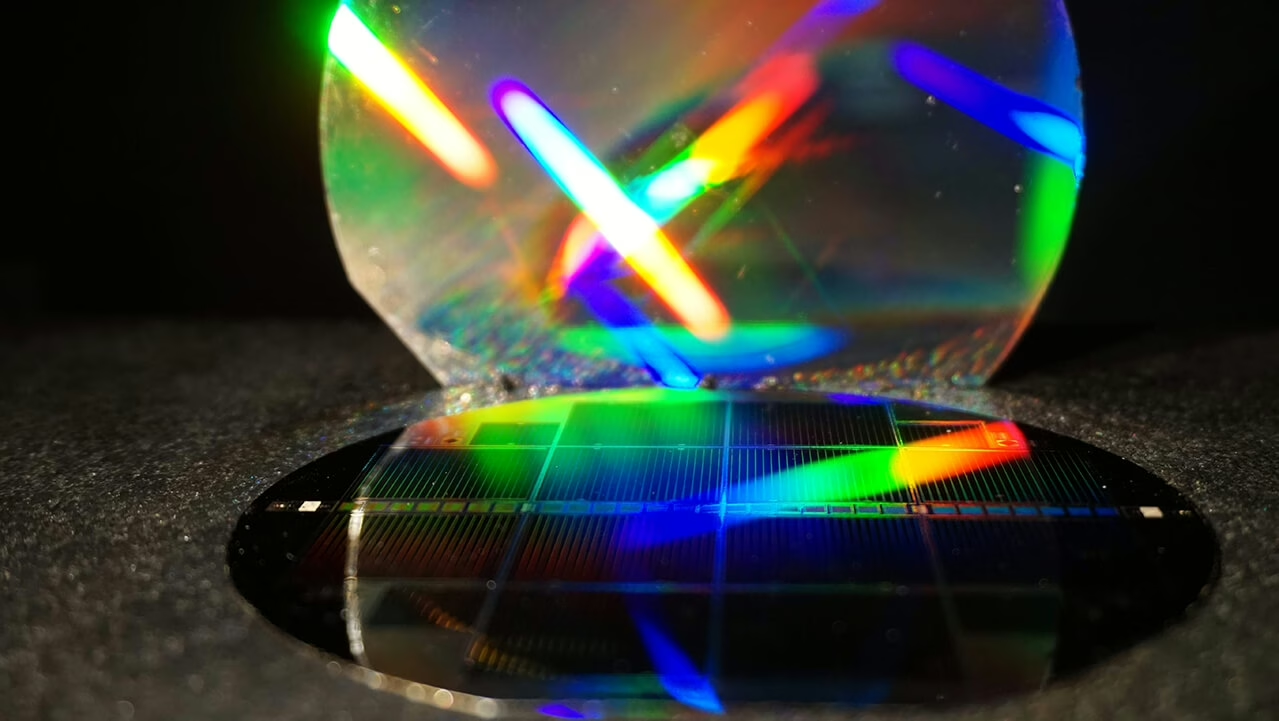
AMOLF and Fraunhofer ISE start cooperation on metamaterials
AMOLF and the Fraunhofer Institute for Solar Energy Systems have started a strategic cooperation in the field of metamaterials for optical applications. In the project “Metasurfaces for Energy Efficient Devices” (MEEt), the partners are developing metamaterials for solar cells, LEDs and optical sensors and the processes for their production. The joint project will run for three years and is funded by the Fraunhofer International Cooperation and Networking (ICON) program.
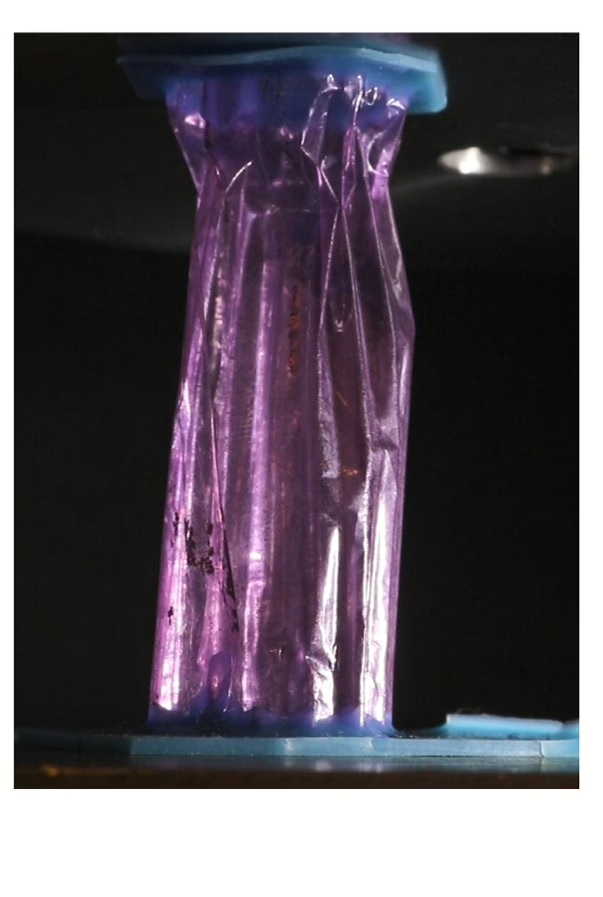
Martin van Hecke receives ERC Advanced Grant
Martin van Hecke (Mechanical Metamaterials group at AMOLF and Leiden University) receives a 2.5 million euro ERC Advanced Grant for research into information processing materials. The European Research Council uses the ERC Advanced grants to allow outstanding research leaders to pursue ground-breaking, high-risk projects in Europe.
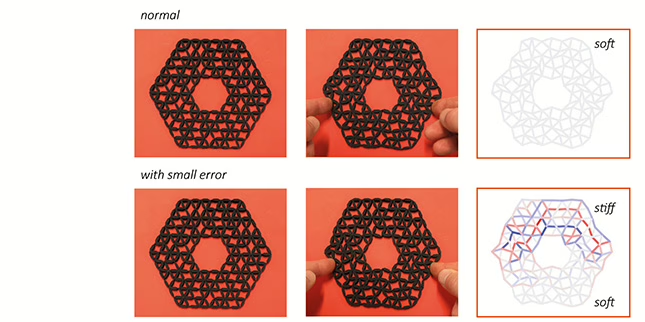
The peculiar effect of a small error
Metamaterials have properties that depend on their shape and architecture. Researchers at AMOLF, Leiden University and Tel Aviv University have found a new way of designing these metamaterials and their properties by deliberately incorporating small errors. They published their results on January 27th in Nature Physics.
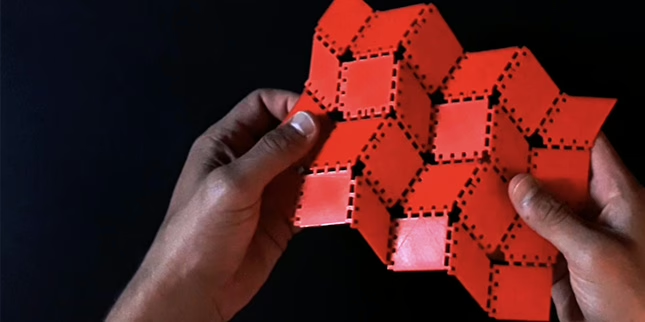
Alphabet of 140 puzzle-pieces programs origami
How can a single origami crease pattern be folded into two precisely defined target shapes? Researchers at AMOLF and Leiden University have created an ‘alphabet’ of 140 origami ‘puzzle-pieces’ that allows them to do just that, as described today in Nature Physics. This discovery could help in the construction of origami robots and towards designing smart programmable materials.
Self-folding metamaterial
The more complex the object, the harder it is to fold up. Space satellites often need many small motors to fold up an instrument, and people have difficulty simply folding up a roadmap. Physicists from Leiden and Amsterdam have now designed a structure that folds itself up in several steps. The results from this research will be published in Nature on September 27, 2018.