
News & updates
Latest developments from our institute
Stay informed about new research results, awards, events, and collaborations across our scientific community.
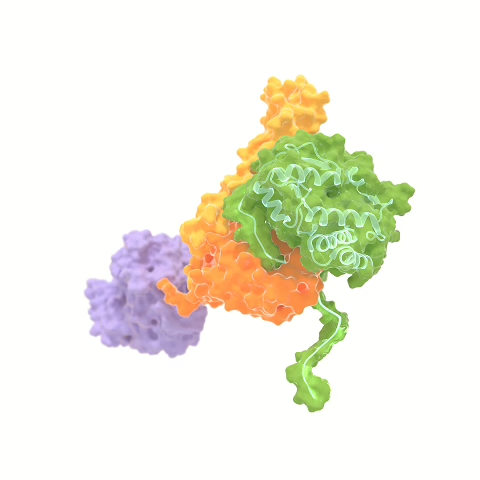
Universal clamping protein stabilizes folded proteins
New insight into how the chaperone protein Hsp70 works On October 26th Nature will publish a study that overturns the decades-old textbook model of action for a protein that is central for many processes in living cells. Researchers at the FOM Institute AMOLF and the University of Heidelberg show that the protein Hsp70 can mechanically stabilize folded proteins using a moveable lid, and thus protect them against stress and damage. This insight into how proteins help each other offers a new perspective on diverse cellular functions and can ultimately lead to a better understanding of diseases like cancer and Parkinson’s, in which failing protein systems are central.

Change accelerates stalled evolution
Researchers of FOM Institute AMOLF and Laboratoire Interdisciplinaire de Physique in Grenoble (France) have shown that the evolution of bacteria can be accelerated when their environment fluctuates in time. The research gives new insights in the evolutionary limitations of organisms and the positive effect of changing conditions, and leads to new suggestions for the evolutionary optimization of biotechnological processes. The work also reveals a flip-side, because evolutionary acceleration can also be detrimental in some cases. For example, the alternating use of antibiotics could increase the risk that bacteria more rapidly evolve resistance against antibiotics. The results will be published Friday, November 13, in PNAS.
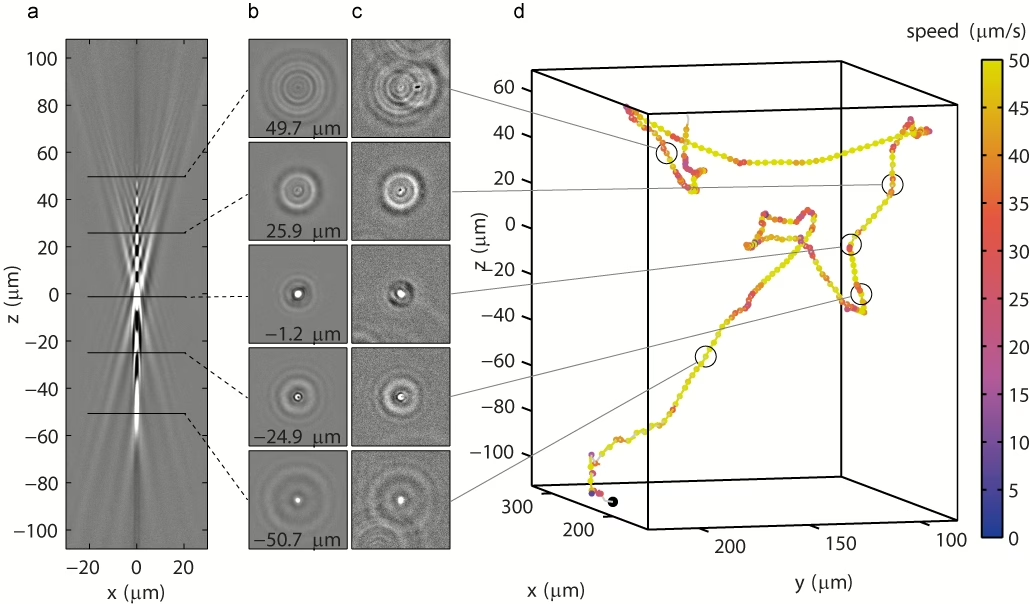
New 3D tracking technique “for the masses” reveals individuality of bacterial behavior
Microscopy techniques used to study the movement of swimming microbes are limited to two dimensions (2D) or require sophisticated devices. In a paper to be published online on 2 November, AMOLF researchers present a new method to track the movement of bacteria swimming in three dimensions (3D) using simple microscopes that are standard in biological laboratories.

Katja Taute wins award for outstanding talk
AMOLF postdoc Katja Taute (Systems Biology and Biophysics research groups) has won the award for outstanding postdoctoral talk at the BLAST XIII conference (13th International Conference on Bacterial Locomotion and Signal Transduction). The award included a cash prize of USD 500. The conference took place in Arizona, USA from January 19th till January 23rd, 2015.
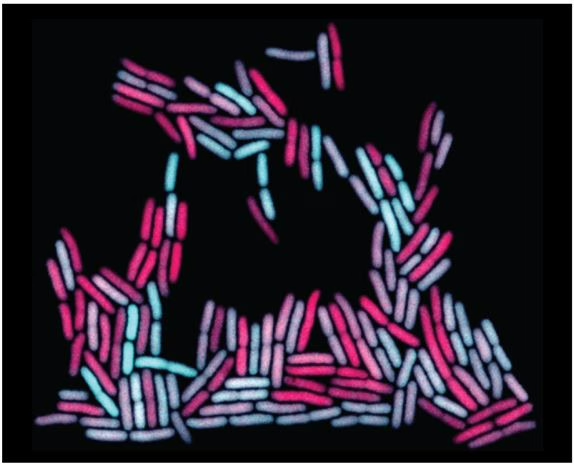
Cell factory runs with fits and starts
Researchers from FOM institute AMOLF have discovered that metabolism, the process that converts molecules in a cell, proceeds irregularly. As metabolism is the motor that drives all biological activity in cells this instability may play a role in diseases such as cancer. The researchers will publish their study on 3 September 2014 in Nature.

Observing the misfolding of a single protein
Researchers from FOM institute AMOLF have directly observed the misfolding of a protein chain. Protein chains are thought to fold into the wrong structure sometimes, and thus cause neurodegenerative diseases. It has now become possible to follow this crucial process directly, by mechanically manipulating single proteins. The paper reporting on this work is published online on 14 August in Angewandte Chemie.