
Solar cell efficiency
Detailed balance charts
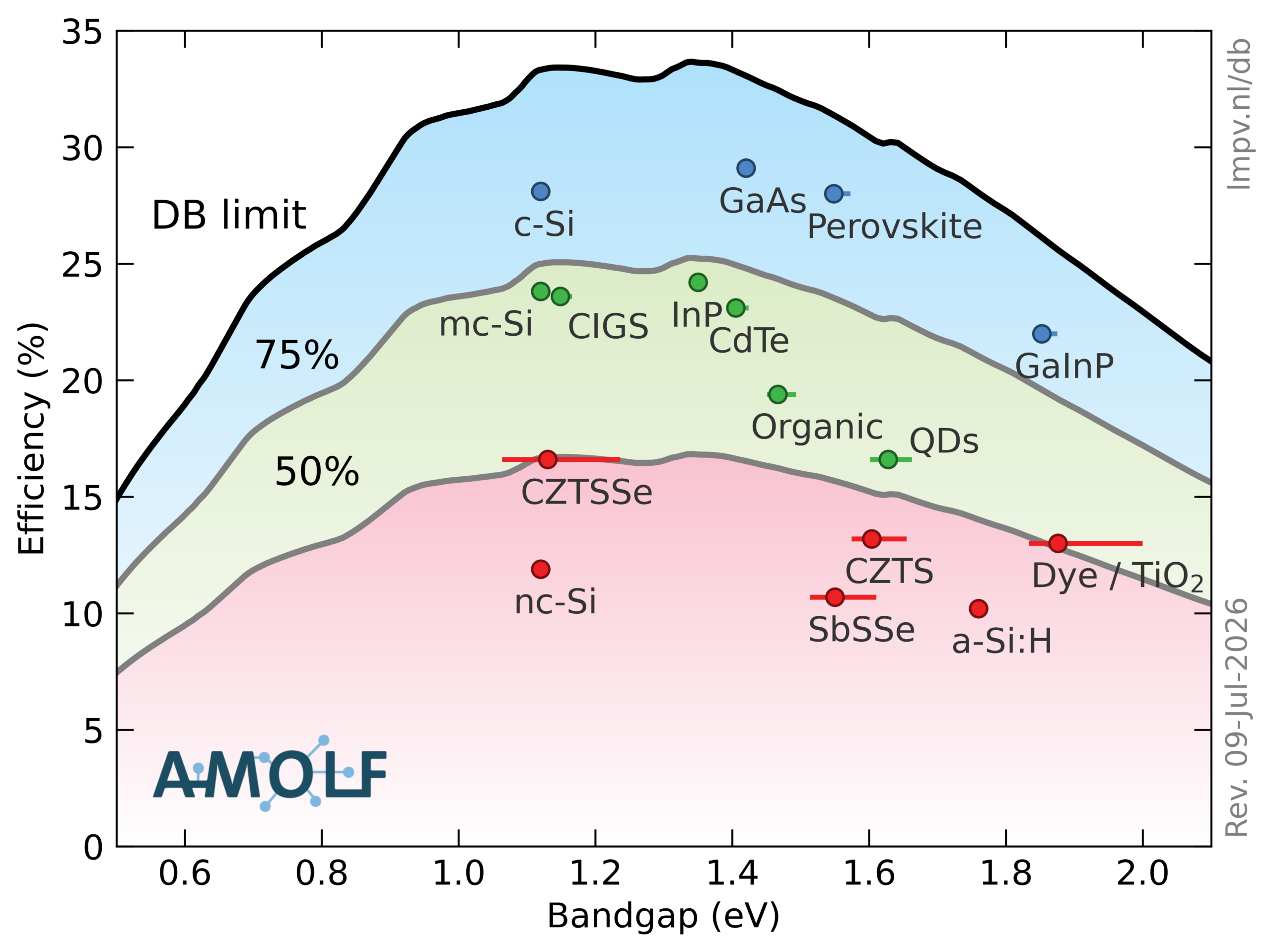
This page contains figures that provide an up-to-date comparison between world-record solar cell efficiencies for different materials and the fundamental detailed balance efficiency limit.
Below you find the following sections:
- Plots for single-junction efficiencies
These plots may be used with attribution to both this website and the following article: Photovoltaic materials – present efficiencies and future challenges, A. Polman, M. Knight, E.G. Garnett, B. Ehrler, and W.C. Sinke, Science 352, 307 (2016); DOI: 10.1126/science.aad4424 - Plots for multi-junction efficiencies
These plots may be used with attribution to both this website and the following article: Photovoltaics reaching for the Shockley-Queisser limit, B. Ehrler, E. Alarcón-Lladó, S.W. Tabernig, T. Veeken, E.C. Garnett, and A. Polman, ACS Energy Letters 5, 9 (2020); DOI: 10.1021/acsenergylett.0c01790 - References for record-efficiency cells shown in the charts
Single-junction solar cell efficiences
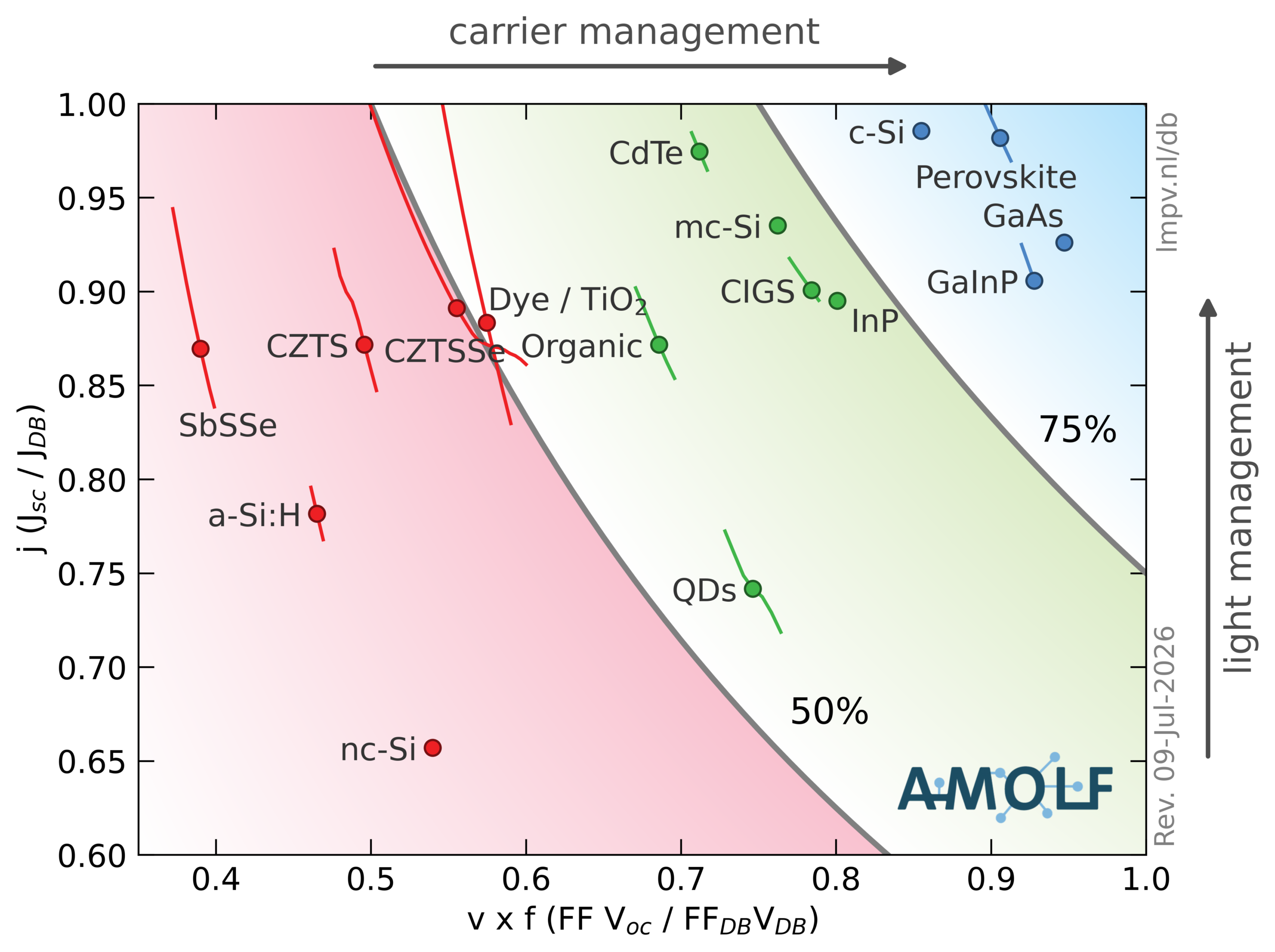
Efficiencies relative to the detailed balance limit
Optical and electrical fractions
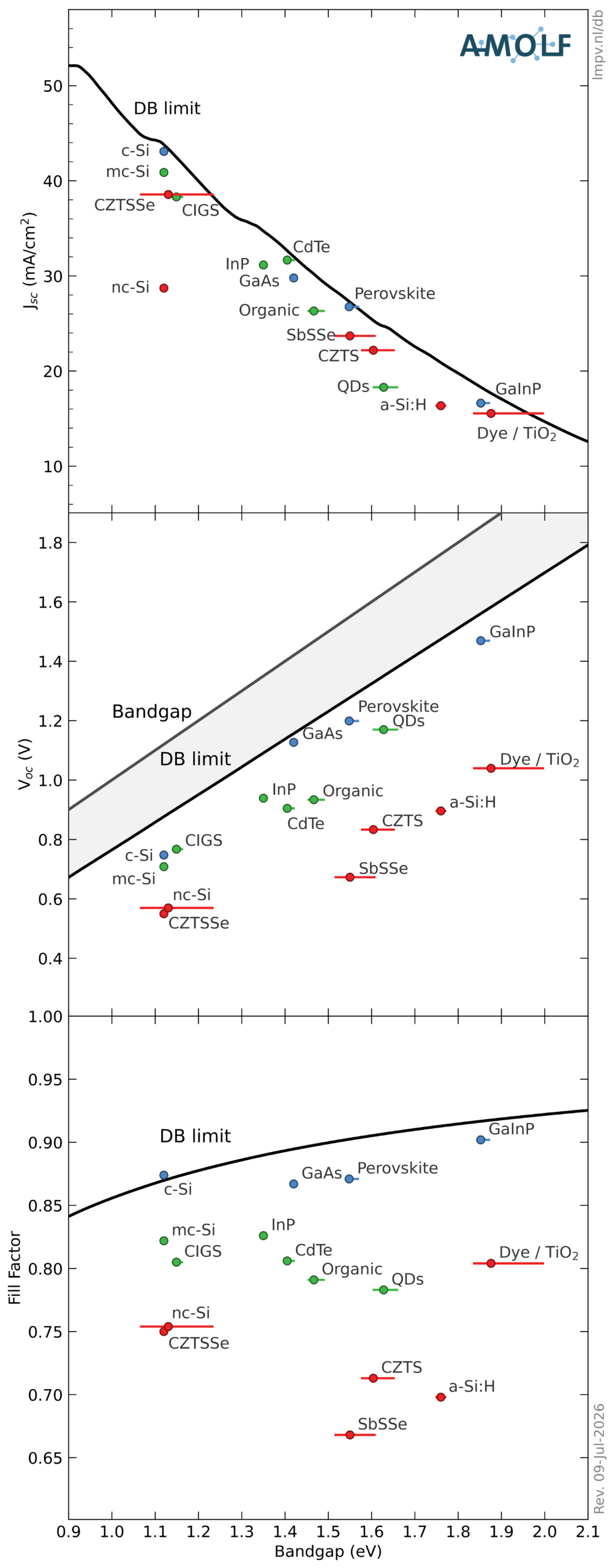
Current, voltage, and fill factor (FF)
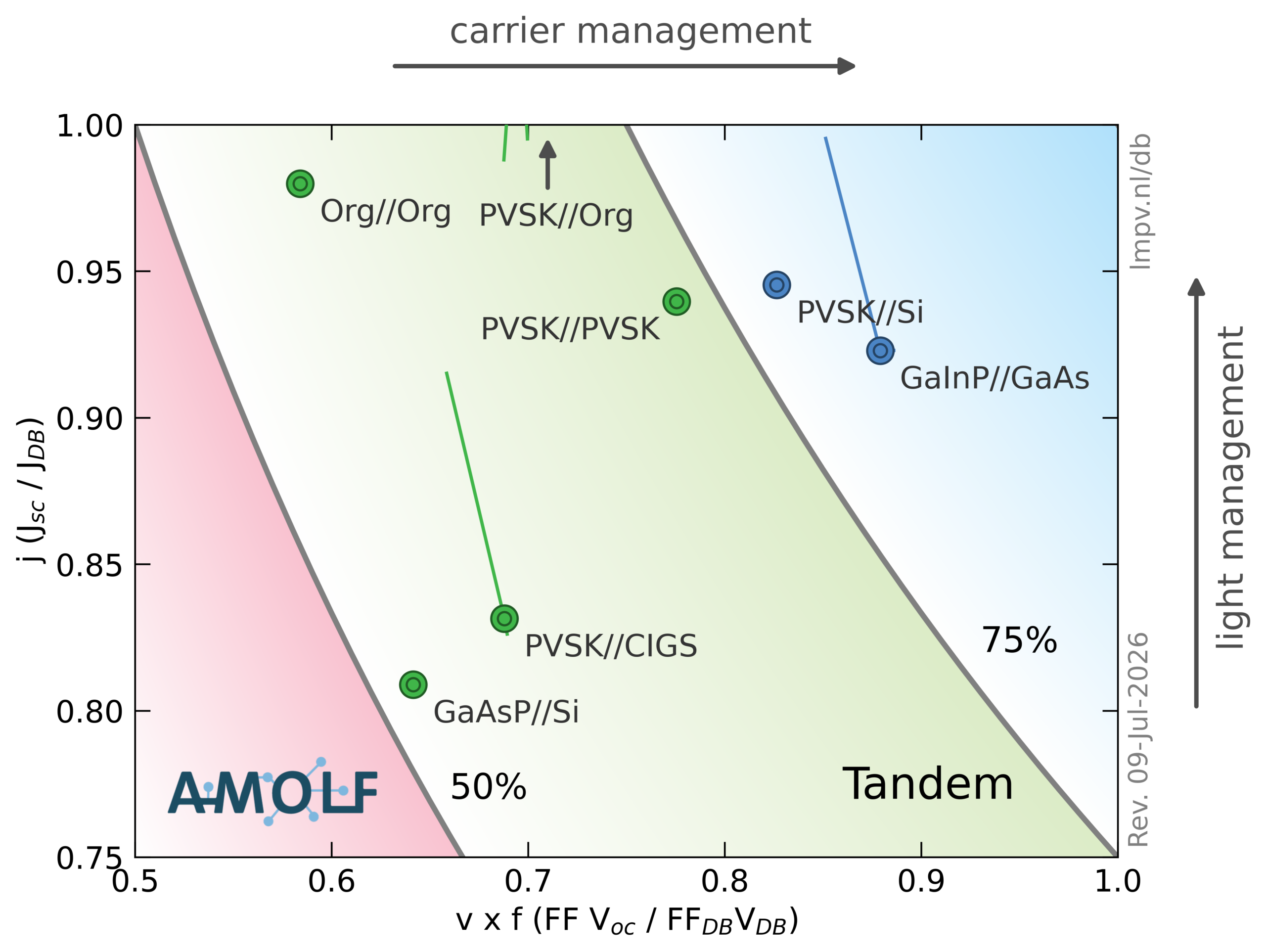
Multi-junction solar cell efficiencies
Optical and electrical fractions for selected tandem solar cells
References for record-efficiency cells in the charts
- Performance parameters (efficiency 27.8%) (updated June 2025):
Solar cell efficiency tables (version 66)
M. A. Green et al., Prog. Photovolt: Res. Appl. (2025). - Cell fabrication:
No information available.
- Performance parameters (efficiency 23.8%) (updated July 2020):
Solar cell efficiency tables (version 56)
M. A. Green et al., Prog. Photovolt: Res. Appl. 28, 629– 638 (2020). - Cell fabrication
Canadian Solar sets a 23.81% conversion efficiency world record for n-type large-area multicrystalline silicon solar cell.
GUELPH, Ontario, Mar. 06, 2020 /PRNewswire/Canadian Solar Inc.
- Performance parameters (efficiency 10.2%) (original, April 2016):
Solar cell efficiency tables (version 45)
M. A. Green et al., Prog. Photovolt: Res. Appl. 23, 1-9 (2014). - Cell fabrication:
Development of Highly Stable and Efficient Amorphous Silicon Based Solar Cells
T. Matsui et al., Proc. 28th European Photovoltaic Solar Energy Conference, 2213–2217 (2013).
- Performance parameters (efficiency 11.9%) (updated September 2017):
Solar cell efficiency tables (version 50)
M. A. Green et al., Prog. Photovolt: Res. Appl. 25, 668-676 (2017). - Cell fabrication:
High-efficiency microcrystalline silicon solar cells on honeycomb textured substrates grown with high-rate VHF plasma-enhanced chemical vapor deposition
H. Sai et al., Jpn. J. Appl. Phys. 54, 08KB05 (2015).
- Performance parameters (efficiency 29.1%) (updated June 2019):
Solar cell efficiency tables (version 53)
M. A. Green et al., Prog. Photovolt: Res. Appl. 27, 3-12 (2019). - Cell fabrication:
Highly efficient GaAs solar cells by limiting light emission angle
E. D. Kosten et al., Light Sci. Appl. 2, e45 (2013).
- Performance parameters (efficiency 24.2%) (updated September 2017):
Solar cell efficiency tables (version 50)
M. A. Green et al., Prog. Photovolt: Res. Appl. 25, 668-676 (2017). - Cell fabrication:
Advanced Ultra High Performance InP Solar Cells
NREL Technology (23 June 2016).
- Performance parameters (efficiency 22.0%) (updated October 2019):
Solar cell efficiency tables (version 54)
M. A. Green et al., Prog. Photovolt: Res. Appl. 27, 565-575 (2019). - Cell fabrication:
NREL, private communication, 22 May 2019. (according to M. A. Green et al., Prog. Photovolt: Res. Appl. 27, 565-575 (2019)
- Performance parameters (efficiency 23.1%) (updated November 2024):
Solar cell efficiency tables (version 65)
M. A. Green et al., Prog. Photovolt: Res. Appl. (2024). - Cell fabrication:
No specifics available yet.
- Performance parameters (efficiency 23.6%) (updated July 2023):
Solar cell efficiency tables (version 62)
M. A. Green et al., Prog. Photovolt: Res. Appl. 31, 651-663 (2023). - Cell fabrication:
State of the art and future prospects of thin film CIGS solar cells
University of Luxembourg Physics Colloquium (10 May 2023).
- Performance parameters (efficiency 15.8%) (updated June 2025):
Solar cell efficiency tables (version 66)
M. A. Green et al., Prog. Photovolt: Res. Appl. (2025). - Cell fabrication
Control of the phase evolution of kesterite by tuning of the selenium partial pressure for solar cells with 13.8% certified efficiency
J. Zhou et al., Nat. Ener. 8, 526-535 (2023)
- Performance parameters (efficiency 13.0%) (updated July 2023):
Solar cell efficiency tables (version 62)
M. A. Green et al., Prog. Photovolt: Res. Appl. 31, 651-663 (2023). - Cell fabrication:
Hydroxamic acid pre-adsorption raises the efficiency of cosensitized solar cells
Y. Ren et al., Nature 613, 60-65 (2023).
- Performance parameters (efficiency 19.2%) (updated July 2023):
Solar cell efficiency tables (version 62)
M. A. Green et al., Prog. Photovolt. Res. Appl. 31, 651-663 (2023). - Cell fabrication:
Single-junction organic solar cells with over 19% efficiency enabled by a refined double-fibril network morphology
L. Zhu et al., Nat. Mater. 21, 656-663 (2022).
- Performance parameters and cell fabrication (efficiency 16.6%) (updated July 2020):
Ligand-assisted cation-exchange engineering for high-efficiency colloidal Cs1−xFAxPbI3 quantum dot solar cells with reduced phase segregation
Hao, M., Bai, Y., Zeiske, S. et al., Nat. Energy 5, 79–88 (2020).
- Performance parameters (efficiency 27.3%) (updated June 2025):
Solar cell efficiency tables (version 66)
M. A. Green et al., Prog. Photovolt: Res. Appl. (2025). - Cell fabrication:
No specifics available yet.
- Performance parameters (efficiency 10.7%) and cell fabrication (updated November 2024):
Regulating Energy Band Alignment via Alkaline Metal Fluoride Assisted Solution Post-Treatment Enabling Sb2(S,Se)3 Solar Cells with 10.7% Efficiency
Y. Zhao et al., Adv. Energy Mater. 12, 2103015 (2022).
Tandem solar cells
- Performance parameters (efficiency 34.9%) (updated June 2025):
Solar cell efficiency tables (version 66)
M. A. Green et al., Prog. Photovolt: Res. Appl. (2025). - Cell fabrication
No specifics available yet.
- Performance parameters (efficiency 24.6%) (included June 2025):
Solar cell efficiency tables (version 66)
A. Green et al., Prog. Photovolt. Res. Appl. (2025).
- Performance parameters (efficiency 30.1%) (updated July 2024):
Solar cell efficiency tables (version 64)
M. A. Green et al., Prog. Photovolt: Res. Appl. 32, 425-441 (2024). - Cell fabrication:
All-perovskite tandem solar cells with improved grain surface passivation
R. Lin et al., Nature 603, 73-78 (2022).
- Performance parameters (efficiency 23.4%) (included July 2020):
Solar cell efficiency tables (version 57)
A. Green et al., Prog. Photovolt. Res. Appl. 28, 1-13 (2020). - Cell fabrication:
GaAs75P0.25/Si Dual-Junction Solar Cells Grown by MBE and MOCVD
T. Grassman, IEEE Journal of Photovoltaics 6, 326 (2020).
- Performance parameters (efficiency 32.8%) (included July 2020):
Solar cell efficiency tables (version 57)
A. Green et al., Prog. Photovolt. Res. Appl. 28, 1-13 (2020).
- Performance parameters (efficiency 25.1%) (updated November 2024):
Solar cell efficiency tables (version 65)
M. A. Green et al., Prog. Photovolt: Res. Appl. (2024). - Cell fabrication
Highly Efficient Perovskite/Organic Tandem Solar Cells Enabled by Mixed-Cation Surface Modulation
X. Wang et al., Adv. Mater., 35, 2305946 (2023).
- Performance parameters (efficiency 19.5%) (included August 2022):
A Tandem Organic Photovoltaic Cell with 19.6% Efficiency Enabled by Light Distribution Control
J. Wang et al., Adv. Matter 33, 2102787 (2021). - Cell fabrication
A Tandem Organic Photovoltaic Cell with 19.6% Efficiency Enabled by Light Distribution Control
J. Wang et al., Adv. Matter 33, 2102787 (2021).
Share your new record-efficiency solar cell data
Please contact us with your new record-efficiency solar cell data at d.dekker@amolf.nl.