
Our Disciplinary centers
Center for Nanophotonics
Disciplinary Centers are dedicated hubs for training and scientific exchange. They are designed to foster the development of expertise, train researchers, and stimulate scientific interaction and collaboration. These centers focus on specific areas of expertise, whereas the research themes cover broader research domains.
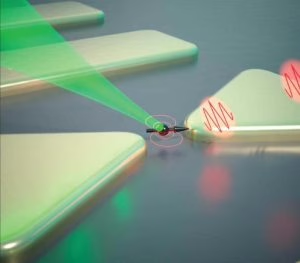
The Center for Nanophotonics explores new physical phenomena and functionalities emerging from the interaction between light and nanoscale matter. By designing advanced materials and optical systems and developing cutting edge measurement techniques, we seek control over light and various material excitations to address challenges in energy, information processing and sensing.
Area of expertise
The Center for Nanophotonics investigates new physical phenomena and functionalities, emerging from the interaction of light and nanoscale matter.
We strive for spatial and temporal control of various degrees of freedom of light and matter, down to the atomic scale and the quantum regime. We do so through combining nanoscale design and materials in novel optical systems. We exploit nonlinearity, non-Hermiticity, fluctuations, quantum correlations, and nonreciprocity, as resources enabling unique functionalities. Moreover, we develop advanced measurement techniques to gain deep insight into light-matter interactions.
With these, we aim to address important problems relevant to the acquisition, transport, conversion, and processing of energy and information.
Research questions
Relevant scientific questions include:
- How can photonic metamaterials process information in a massively parallel fashion?
- How can photons be transduced to material degrees of freedom and vice versa, with ultimate efficiency and quantum coherence?
- How can strong light-matter coupling enable frictionless energy flow, like superfluid light or superconducting materials?
- What advances can topological protection and nonreciprocity give to the on-chip routing of light?
- What are the fundamental limits to optical sensor performance, and how can we evade these to enhance classical and quantum sensing?
- How are material structure and optical response correlated, and can we probe these correlations at the single-atom and femtosecond scale?
Techniques and materials
The activities make extensive use of nanofabrication and nanocharacterization techniques. In fact, the development of new experimental techniques and new materials for nanophotonic devices is an important focus.
Related research themes
The Center for Nanophotonics is closely linked to our Information in Matter research theme, that studies how physical systems gather, process, and utilize information.
Group leaders
Group leaders directly associated with the Center for Nanophotonics:
Other group leaders involved are Erik Garnett, Wiebke Albrecht, Albert Polman, and Esther Alarcón Llado.
Other Disciplinary Centers
Contact
If you have any questions about the Center for Nanophotonics, please contact Ewold Verhagen at E.Verhagen@amolf.nl.