
Our Disciplinary centers
Center for Living Systems
Disciplinary Centers are dedicated hubs for training and scientific exchange. They are designed to foster the development of expertise, train researchers, and stimulate scientific interaction and collaboration. These centers focus on specific areas of expertise, whereas the research themes cover broader research domains.
The Center for Living Systems uses physics based experimental, theoretical and computational approaches to study living systems across scales, combining advanced microscopy, microfluidics, biochemical reconstitutions and quantitative modeling to reveal principles of biological organization and dynamics.
Area of expertise
The Center for Living Systems develops and applies a broad range of physics-based approaches – experimental, theoretical and computational – to enable innovative studies of living systems. From the folding of single protein molecules to organism-scale processes such as development, immunity, and behavior, we explore the design principles of living systems across multiple levels of biological complexity and physical scales.
We develop and apply high-resolution microscopy, microfluidics, and in vitro reconstitutions of complex biological processes to quantify dynamics and organization across scales. We leverage methods and concepts of statistical physics to develop theoretical models of diverse biological phenomena, including information processing by biochemical networks and cellular mechanics, and computational methods for simulation of stochastic and spatial biochemical processes.
Equipment
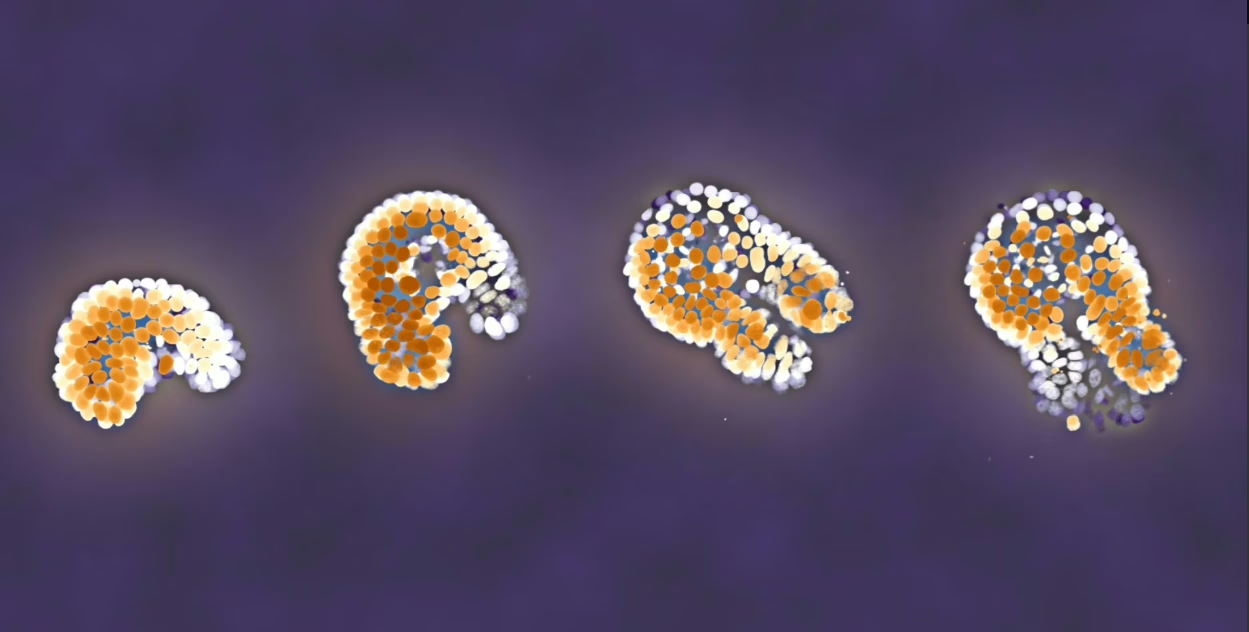
Our experimental labs feature state-of-the-art optical microscopes (often bespoke setups fabricated at AMOLF) for single-molecule imaging and optical tweezers / force spectroscopy, super-resolution imaging, FRET microscopy, stroboscopic widefield imaging (2-D and 3-D) and multiphoton confocal imaging.
Our biochemical labs are equipped for both in vitro work with purified DNA and proteins, as well as in vivo work with cells (both ML-I and ML-II), organoids, and select model organisms such as the nematode C. elegans, and specialist technicians for molecular biology, genetics, as well as purified protein work.
Related research themes
The Center for Living Systems is closely linked to our research themes Autonomous Matter and Information in Matter. Autonomous Matter studies how matter can perform complex functions independently, whereas Information in Matter investigates how physical systems gather, process, and utilize information.
Group leaders
Group leaders associated with the Center for Living Systems:
Other Disciplinary Centers
Contact
If you have questions the Center for Living Systems, please contact Tom Shimizu at T.Shimizu@amolf.nl.