Autonomous Matter
Learning Machines

The Learning Machines group explores how learning works in both natural and artificial systems. By applying ideas from neuroscience and machine learning to physical materials, this work connects biology and technology and opens the door to smart materials that can adapt themselves to real-world environments and users’ needs.
Research focus
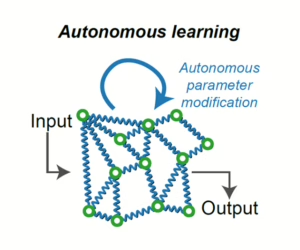
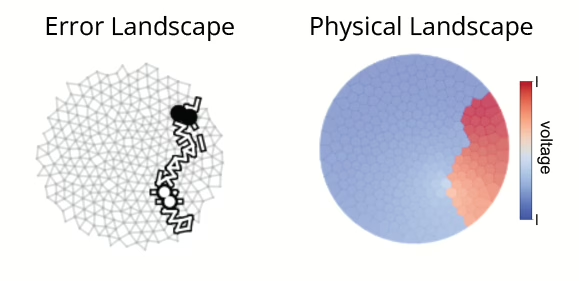
The Learning Machines group explores how physical systems can learn and adapt in the real world. Physical learning is an emerging discipline that bridges between digital learning by neural networks and learning in living systems. Because physical systems must satisfy physical constraints as they learn, learning creates imprints in the physical properties of the system. Being able to unravel these imprints is one of the challenges of the group.
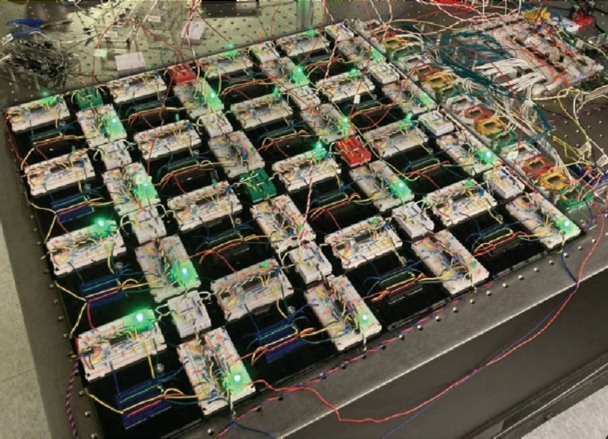
Another research topic the group focuses on is neuromorphic computing. Neuromorphic computers are gaining significant attention due to their numerous advantages. Unlike traditional computers, which separate computation from memory, neuromorphic systems mimic the way the brain operates. As a result, they consume considerably less energy – an important benefit given the anticipated increase in global electricity demand.
We develop theoretical and experimental foundations for physical learning, where materials adapt their properties through local rules without external computation. By embedding learning into the physics of networks, we aim to create systems that self-organize and optimize functionality, bridging concepts from machine learning, statistical physics, and biological adaptation.
Our group designs adaptive metamaterials that reconfigure themselves in response to mechanical or flow stimuli. These materials learn from repeated use, enabling programmable stiffness, conduction, shape morphing, and energy routing. Applications range from resilient infrastructure to aerospace components, where real-time adaptation enhances performance and durability without electronics.
We explore AI without computers by embedding learning directly into physical substrates. Using local update rules, networks of beams, bonds, or conductive paths classify patterns and perform optimization tasks with minimal energy. This approach promises ultra-low-power intelligence for edge devices, sensors, and autonomous systems, bypassing energy-hungry digital computation.