Research highlights

Studying individual molecules to understand how a cell’s inner life makes cells function

To understand the fundamental processes of life we need to understand the language that cells use to communicate with each other and to orchestrate their joint behavior. This is important for vital processes such as DNA replication, protein synthesis and signal transmission. Since cells communicate through interactions of molecules, researchers at AMOLF and the Max-Planck Institute of Biochemistry in Munich developed a technique to study individual molecules in model membranes. They first published the results in 2021 (see reference below). Using self-renewing DNA-based fluorescent labels, they were able to observe them for extended times. Overcoming the constraints of conventional fading fluorescent markers, the new technique enables unprecedented quantitative studies of molecular interactions in living systems. Now, their latest advancements on this DNA-PAINT based single-particle tracking method (DNA-PAINT-SPT) also enables them to see individual molecules binding to each other in live cells. This study was published in Nature Communications on July 19th (see reference below).

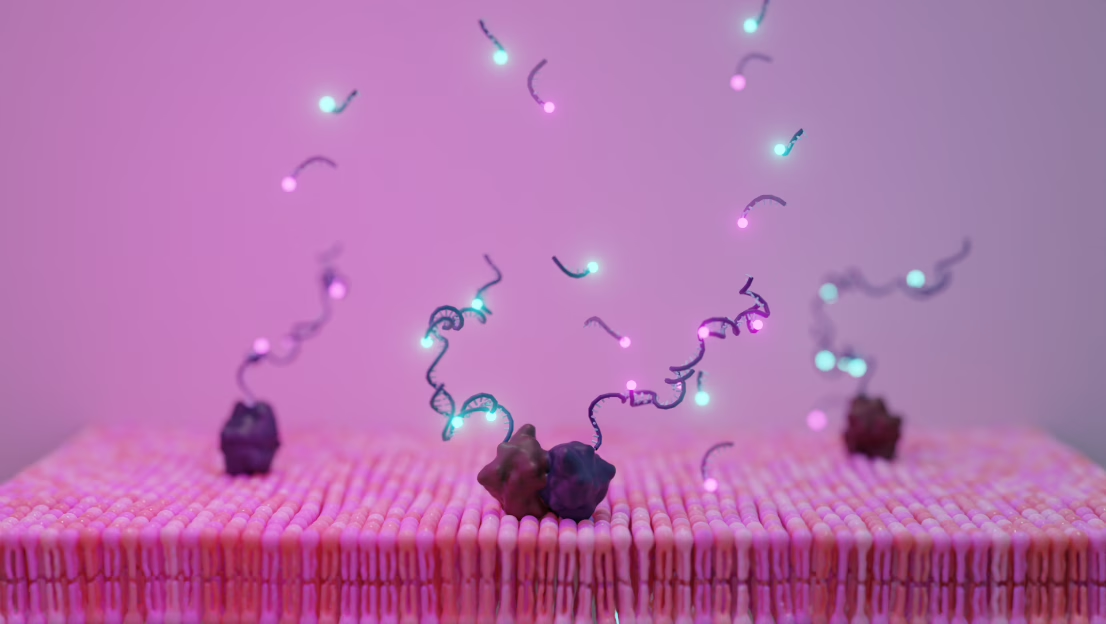
Fluorescent-labelled DNA molecules bind to complementary DNA attached to membrane-bound proteins; the two proteins shown are marked with a different DNA sequence and therefore color (artistic impression).

Self-renewing DNA-based fluorescent labels
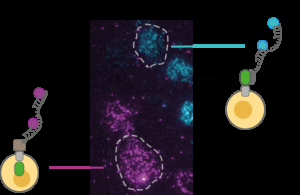
The researchers developed a fluorescent label that continuously exchanges fluorophores. To establish this, they use a method called DNA-PAINT, in which fluorescently-labeled oligonucleotides reversibly bind to a single-stranded DNA handle attached to the target molecule. The researchers engineered sets of DNA strands that incorporate multiple binding sites for fluorescently-labeled oligonucleotides. They optimized the turnover kinetics and provided two sets of orthogonal sequences for dual-color labelling, an essential requirement for interaction studies. As a result, individual proteins in reconstituted systems and live cell membranes can now be tracked for several minutes with 20-30 nanometer precision, a leap forward in observational precision and temporal dynamic range.
Control experiments
The researchers demonstrated that this improvement in performance allows the detailed quantification of two-dimensional binding constants of a model membrane protein. To rule out artifacts introduced by the DNA label, they conducted meticulous control experiments. These experiments involved measurements of the diffusion constants of proteins labelled with various methods and conducting additional controls with non-interacting proteins. The absence of these unwanted effects, combined with the straightforward one-to-one molecular targeting achievable through standard tagging methods, positions DNA-PAINT-SPT as a notably superior labelling approach. The new technique paves the way for more extensive studies of membrane protein interactions, a crucial yet challenging area of research.
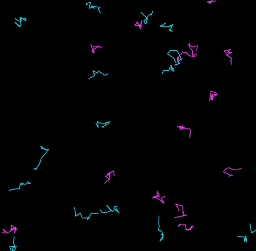
Movement of molecules in a lipid membrane as detected by the DNA-PAINT-SPT method. Where two molecules are found to interact and therefore show synchronized movement, this is marked by a yellow circle.

References
Christian Niederauer, Chikim Nguyen, Miles Wang-Henderson, Johannes Stein, Sebastian Strauss, Alexander Cumberworth, Florian Stehr, Ralf Jungmann, Petra Schwille & Kristina A. Ganzinger, Dual-color DNA-PAINT single-particle tracking enables extended studies of membrane protein interactions, Nature Communications, 2023, https://doi.org/10.1038/s41467-023-40065-8

Florian Stehr, Johannes Stein, Julian Bauer, Christian Niederauer, Ralf Jungmann, Kristina Ganzinger & Petra Schwille, Tracking single particles for hours via continuous DNA-mediated fluorophore exchange, Nature Communications, 2021, https://doi.org/10.1038/s41467-021-24223-4

Share article
What's happening

Most recent news items

All news items
Collaboration

Successful outcomes of international EBEAM program led by AMOLF

The EU Pathfinder project Electron Beams Enhancing Analytical Microscopy (EBEAM) that was recently completed has received a highly positive review of the European Innovation Council (EIC). EBEAM brought together eight European research institutions and companies, including AMOLF, that develop new concepts and instruments combining spectroscopic analysis with electron microscopy.

Read news item
Research highlights

Everything you need to know about organoids

Organoids are instrumental in improving our understanding of processes that are otherwise hidden inside the body. For instance, these small 3D organs can be used to test medicines on tissue grown from a patient’s own cells. AMOLF researchers carry out unique and complex experiments to follow organoids in time. In order to enable other researchers to benefit from their experiences, they now publish their methods in the prestigious journal Nature Protocols.

Read news item
Events and outreach

Minister Rianne Letschert wears hat and shoulder ornament inspired by Wim Noorduin’s research

This year at the opening of the parliamentary year (Prinsjesdag) Minister of Education, Culture and Science Rianne Letschert wears a spectacular hat and shoulder ornament. Both of them are inspired by the microscopic structures studied by group leader Wim Noorduin (AMOLF/UvA), which look remarkably like tiny flowers under a microscope. Artist and designer Malou Beemer translated these shapes, normally invisible to the naked eye, into wearable art.

Read news item
Nachi Stern, Group Leader Learning Machines at AMOLF
People and recognition

Nachi Stern awarded ERC Starting Grant to explore how matter learns

Why do brains learn, but rocks do not? Could a material one day adapt to its environment the way a living organism does? AMOLF group leader Dr. Nachi Stern has been awarded an ERC Starting Grant to investigate the physical laws of learning, in a project called, “Physical Learning in Dynamical Systems.”

Read news item
Stay informed

Get the latest research highlights, events, and news from our institute delivered to your inbox