Research highlights

A new view on state switching in materials

AMOLF researchers in the group of Martin van Hecke working on theoretical models for disordered materials, discovered how these systems can start switching between states in unexpected ways. The results open new ways to model materials that show memory effects and could influence fields ranging from soft robotics to biophysics. They published their findings in the journal Physical Review Letters on November 13.

A surprising discovery about self-loops
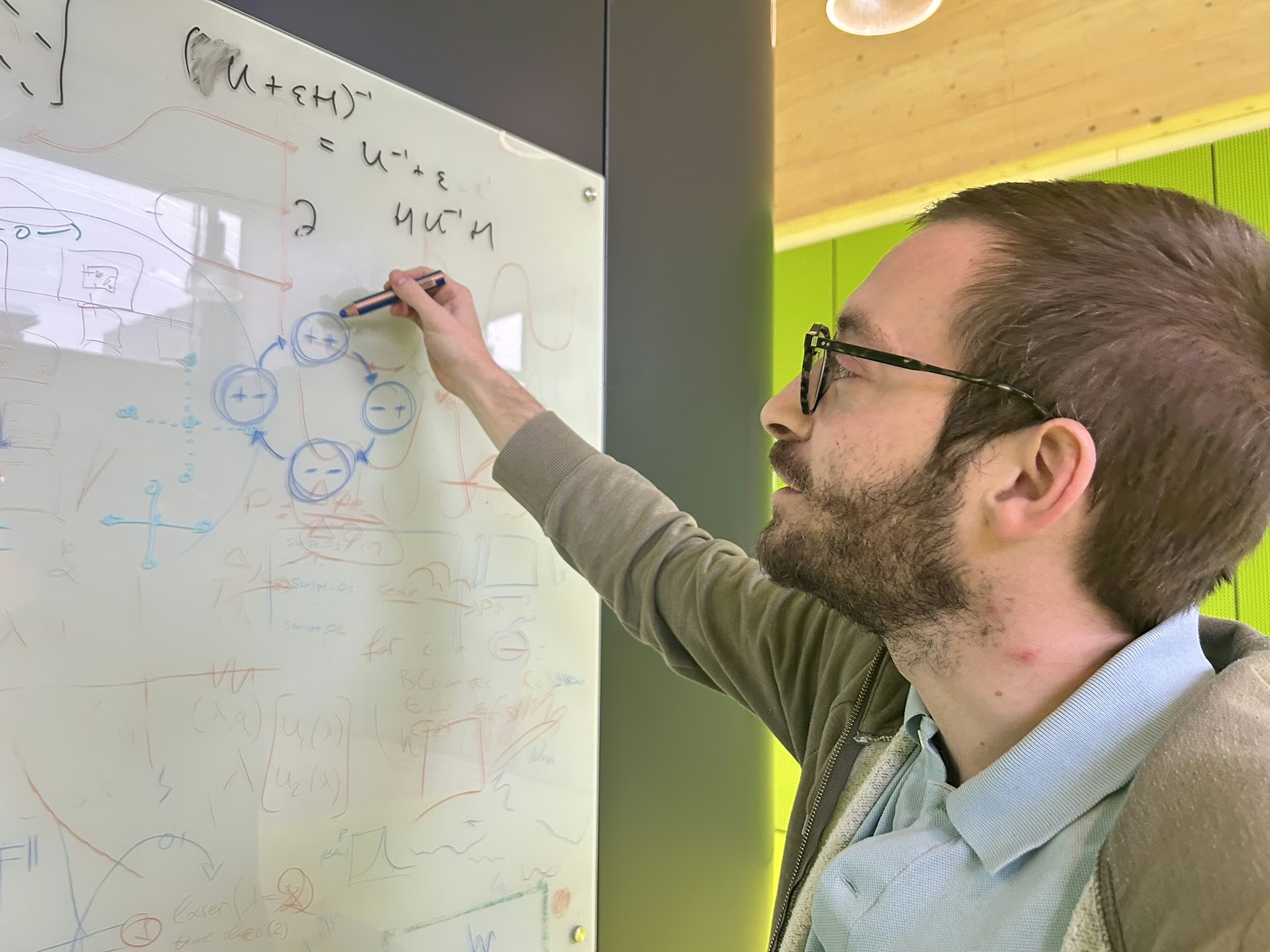
First author Paul Baconnier at AMOLF

The researchers found that networks of simple two-state units, called hysterons, can spontaneously start cycling between states. These cycles, known as self-loops, were long thought to be unphysical because they suggest motion that should not appear in passive materials like crumpled paper or magnetic systems. Instead of dismissing these loops as simulation errors, the team discovered that they point to something deeper and more interesting. The loops arise because energy is effectively injected into the network. This means hysteron models can describe both passive and active materials, including systems that move or oscillate because they consume energy.

Why hysterons matter

Hysteron models are used to simulate many kinds of disordered materials. They help scientists understand how such materials store memories of past events. However, the appearance of self-loops makes it hard to use these models to study materials that do not display active behavior. First author Paul Baconnier set out to understand why the loops are so common and how to control them. He discovered that as the number of hysterons in the network increases the number of possible loop structures grows extremely fast. This makes the loops almost unavoidable, unless their structure is fully understood.
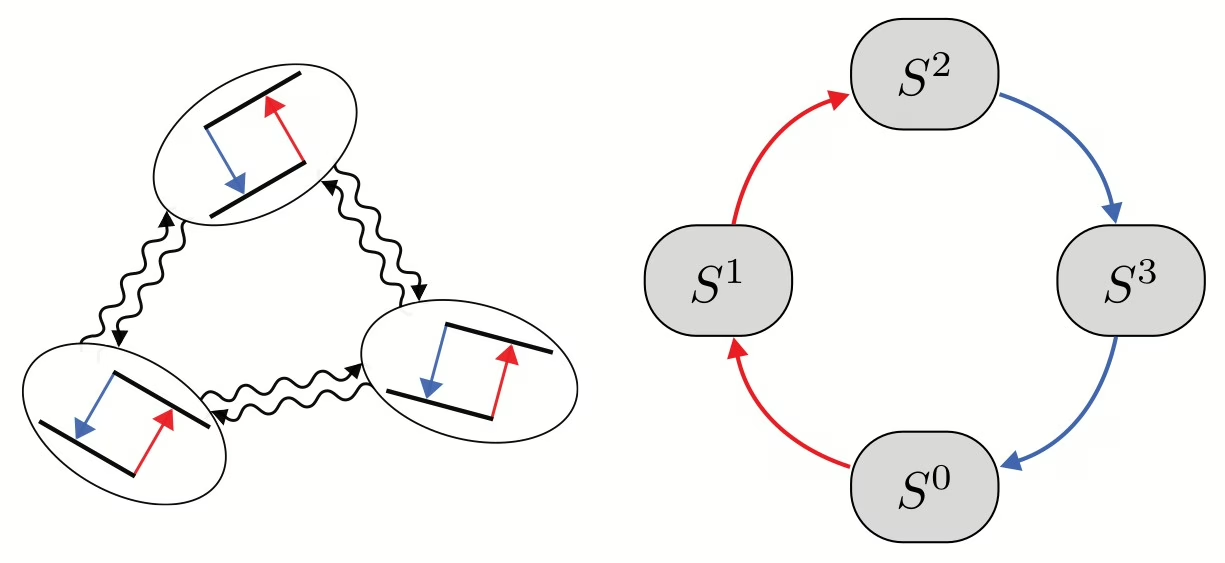
Left: Network of hysterons: binary elements which can be in one of two states, denoted 0 or 1. The wavy arrows represent interactions between the hysterons. Right: When the interactions correspond to a system with energy injection, the network can oscillate spontaneously along a cyclic trajectory of states (S0→S1→S2→S3→S0→...) called a self-loop.

Developing new tools to overcome the challenge

To tackle this, fellow researcher Margot Teunisse developed a full classification of all possible self-loop structures. This provided the insight needed to design new ensembles of hysterons that are completely free of such loops. With these new ensembles, researchers can now reliably simulate purely passive disordered materials without unwanted oscillations. At the same time, they can deliberately include active behavior when they want to study systems that inject or consume energy.

Broader importance and future possibilities

The results open new ways to model materials that show memory effects and could influence fields ranging from soft robotics to biophysics. Because the findings link hysteron networks to active and living systems, they may also offer clues to how complex oscillations arise in nature. The team is now exploring experimental platforms capable of reproducing the active oscillations predicted in this work – an effort that could ultimately guide the design of autonomous materials or mechanical information-processing devices.

Learn more

If you have questions about this research, please contact Martin van Hecke (email: m.v.hecke@amolf.nl).

This paper was published in Physical Review Letters: Dynamic Self-loops in Networks of Passive and Active Binary Elements by Paul Baconnier, Margot H. Teunisse and Martin van Hecke.

Read the full paper.

Share article
What's happening

Most recent news items

All news items
Collaboration

Successful outcomes of international EBEAM program led by AMOLF

The EU Pathfinder project Electron Beams Enhancing Analytical Microscopy (EBEAM) that was recently completed has received a highly positive review of the European Innovation Council (EIC). EBEAM brought together eight European research institutions and companies, including AMOLF, that develop new concepts and instruments combining spectroscopic analysis with electron microscopy.

Read news item
Research highlights

Everything you need to know about organoids

Organoids are instrumental in improving our understanding of processes that are otherwise hidden inside the body. For instance, these small 3D organs can be used to test medicines on tissue grown from a patient’s own cells. AMOLF researchers carry out unique and complex experiments to follow organoids in time. In order to enable other researchers to benefit from their experiences, they now publish their methods in the prestigious journal Nature Protocols.

Read news item
Events and outreach

Minister Rianne Letschert wears hat and shoulder ornament inspired by Wim Noorduin’s research

This year at the opening of the parliamentary year (Prinsjesdag) Minister of Education, Culture and Science Rianne Letschert wears a spectacular hat and shoulder ornament. Both of them are inspired by the microscopic structures studied by group leader Wim Noorduin (AMOLF/UvA), which look remarkably like tiny flowers under a microscope. Artist and designer Malou Beemer translated these shapes, normally invisible to the naked eye, into wearable art.

Read news item
Nachi Stern, Group Leader Learning Machines at AMOLF
People and recognition

Nachi Stern awarded ERC Starting Grant to explore how matter learns

Why do brains learn, but rocks do not? Could a material one day adapt to its environment the way a living organism does? AMOLF group leader Dr. Nachi Stern has been awarded an ERC Starting Grant to investigate the physical laws of learning, in a project called, “Physical Learning in Dynamical Systems.”

Read news item
Stay informed

Get the latest research highlights, events, and news from our institute delivered to your inbox