
News & updates
Latest developments from our institute
Stay informed about new research results, awards, events, and collaborations across our scientific community.
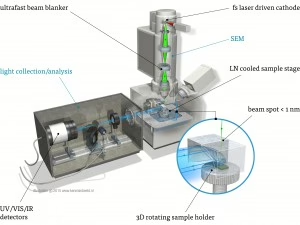
ERC Advanced Research Grants for Huib Bakker and Albert Polman
AMOLF director Huib Bakker and program leader Albert Polman both received an Advanced Research Grant of 2.5 million euros from the European Research Council (ERC). The European Research Council uses the ERC Advanced grants to allow outstanding research leaders to pursue ground-breaking, high-risk projects in Europe.

The biological clock in dividing cells: a robust design
Researchers from FOM institute AMOLF and the University of Michigan have discovered how the biological clock of an organism remains stable, even when the cells of that organism grow and divide. Today in the Proceedings of the National Academy of Sciences (PNAS) USA they provide a mathematical model that explains the undisrupted functioning of the biological clock.
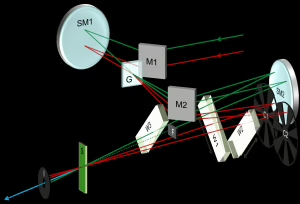
Observation of quantum molecular motions at work in next-generation solar cells
Researchers from AMOLF, Cambridge, Lund and Kiel have revealed that molecular vibrations drive the process known as singlet fission.

Huib Bakker elected as KNAW member
AMOLF group leader Huib Bakker has been elected as a member of the Royal Netherlands Academy of Arts and Sciences (KNAW). Today, the Academy announced the election of 16 new members from various disciplines. The election was based upon nominations from peers. On Monday, September 28th 2015 the new Academy members will be officially installed in the Amsterdam Trippenhuis building of the KNAW.
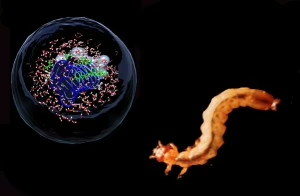
Marie Sklodowska-Curie fellowship for antifreeze protein research
AMOLF postdoc Konrad Meister from the research group of Huib Bakker was honoured with a Marie Sklodowska-Curie Individual Fellowship amounting 165 k€ for his proposal Hydration Dynamics of Antifreeze Proteins.
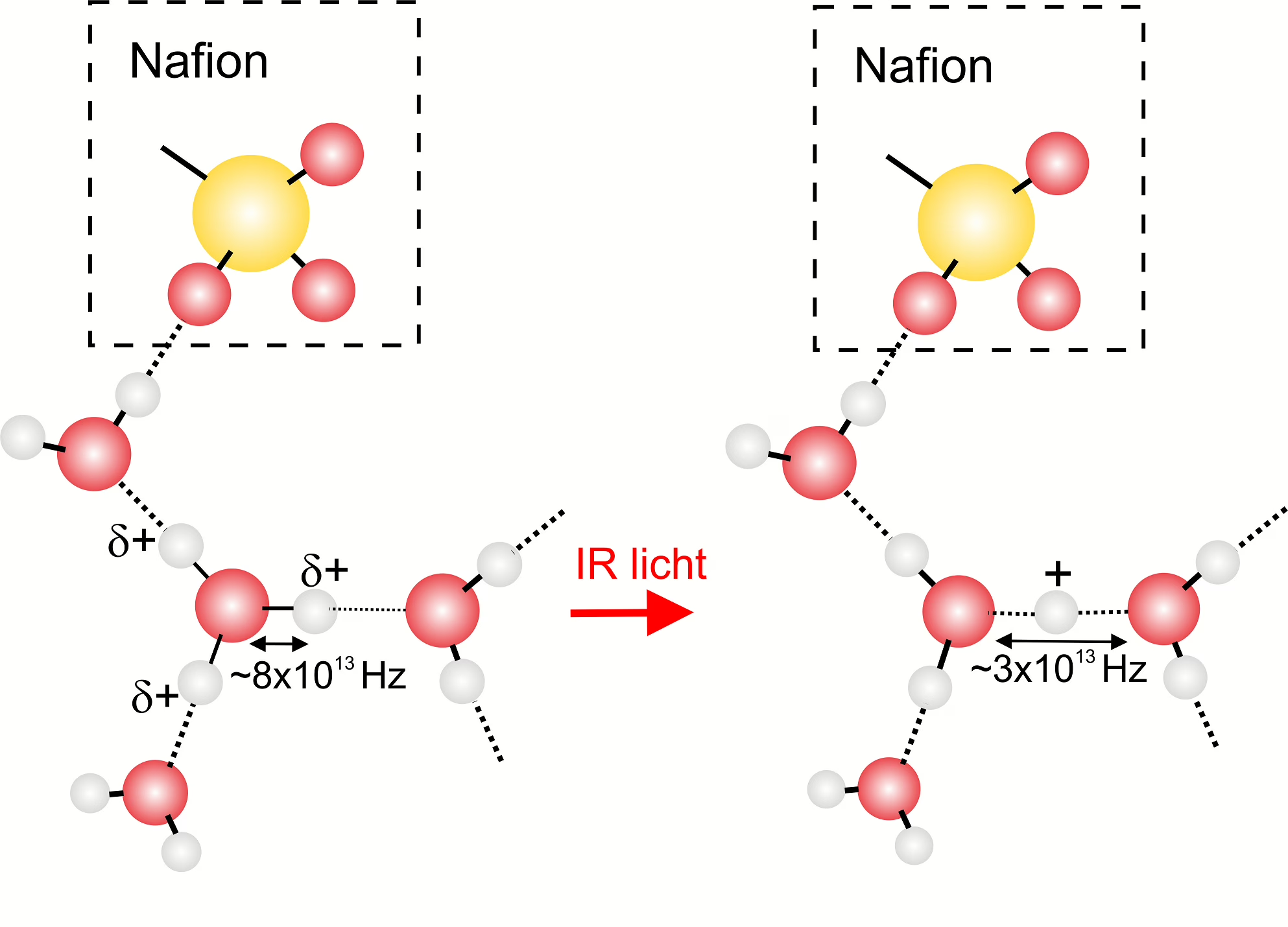
Infrared-activated fuel cells
Researchers from FOM Institute AMOLF have discovered that infrared light strongly stimulates the transport of protons (H+ ions) in hydrogen fuel cells. Hydrogen fuel cells are an alternative, clean source of energy: hydrogen and oxygen are directly converted into electricity with clean water as the sole waste product. A good proton conduction increases the efficiency and yield of these cells. The researchers published their results online on June 26, 2014 in Physical Review Letters.