
News & updates
Latest developments from our institute
Stay informed about new research results, awards, events, and collaborations across our scientific community.

OTP project Femius Koenderink receives funding
AMOLF group leader and UvA professor Femius Koenderink has received funding from the NWO Domain Applied and Engineering Sciences for the OTP project entitled ‘Integrated nanophotonic and extreme-ultraviolet access to semiconductor metrology’ (NANOXUV). Koenderink is thrilled to start his research project together with Peter Kraus (ARCNL) and industrial partner ASML. NWO has assigned 1 million euro to the NANOXUV project.
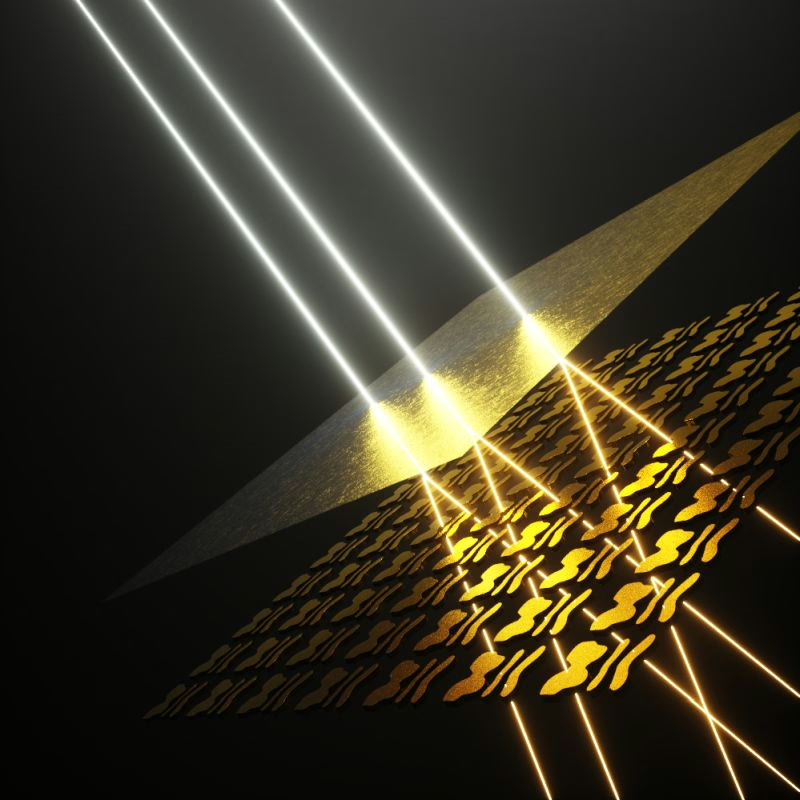
Mathematics at the speed of light
Researchers at AMOLF, University of Pennsylvania, and City University of New York (CUNY) created a nanostructured surface capable of solving equations using light. This discovery opens exciting new opportunities in the field of analog processing based on optical metasurfaces. AMOLF PhD student Andrea Cordaro and his co-authors publish their findings in Nature Nanotechnology on January 12th 2023.
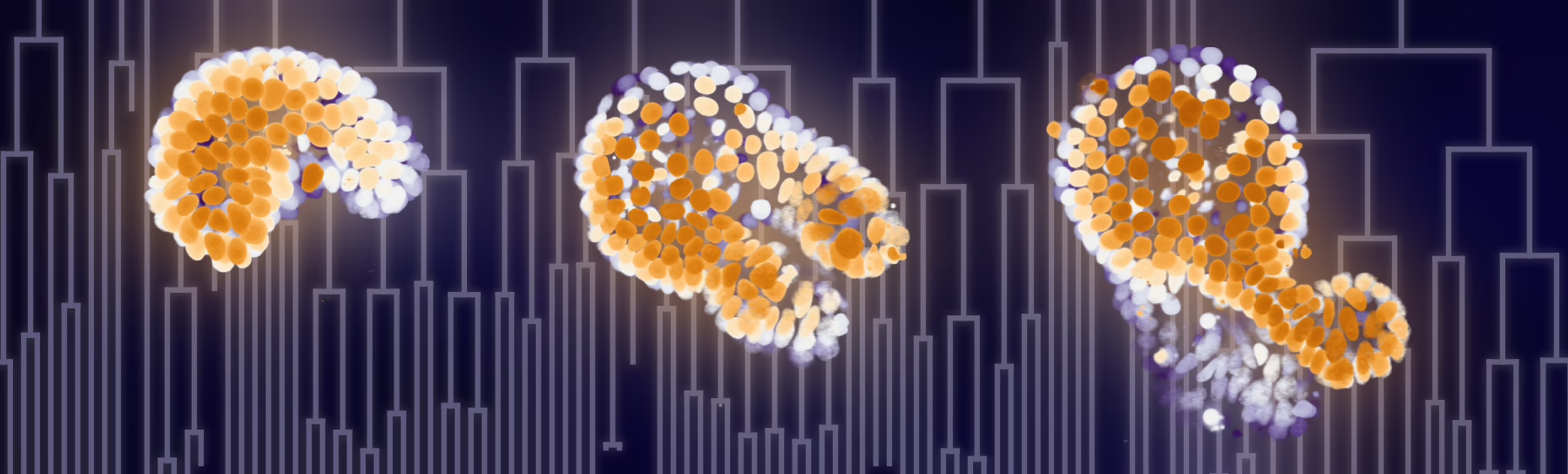
Daughter cells in the intestine do what their mother tells them
AMOLF researchers have discovered what prevents cells in the intestine from dividing rampantly. One hypothesis was that this happens because, on average, for each cell that divides, another cell stops dividing. However, this model failed to provide a good answer to the question as to why cell growth fluctuates so little. Jeroen van Zon and his colleagues have now discovered how that mechanism works by making time-lapse videos of the cells. They noted that two daughter cells from the mother cell always do the same. Either they both divide, or neither divides. As a result of this, cell growth is constant with less chance of cancer and other diseases.
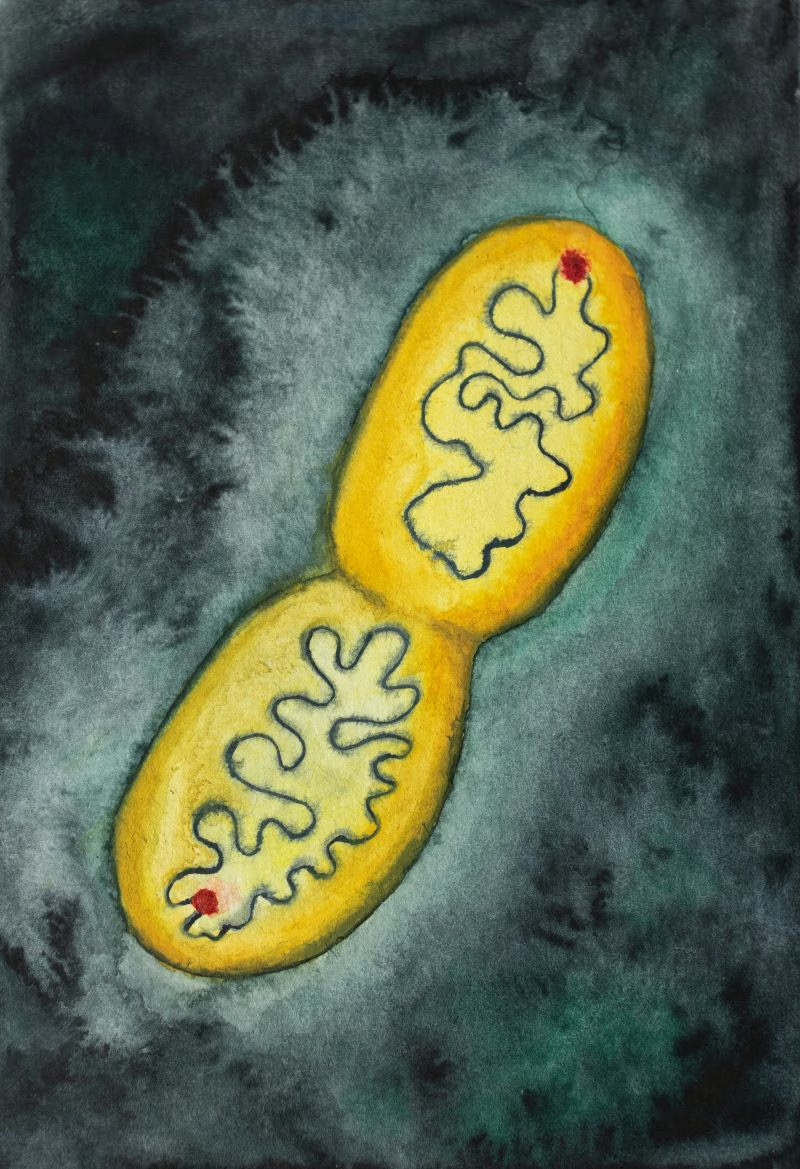
New model for reproduction of E. coli bacteria
With a new model, AMOLF researchers reveal how single celled organisms like bacteria coordinate growth, cell division and DNA replication. Bacteria reproduce via growth and cell division. During each cycle of growth and division, the so-called cell cycle, the cell needs to copy all cellular components exactly once. How the cell achieves this has been a long-standing question in the field. PhD student Mareike Berger and professor Pieter Rein ten Wolde have now developed a mathematical model that offers an explanation. They publish their findings on November 7 in Nature Communications.
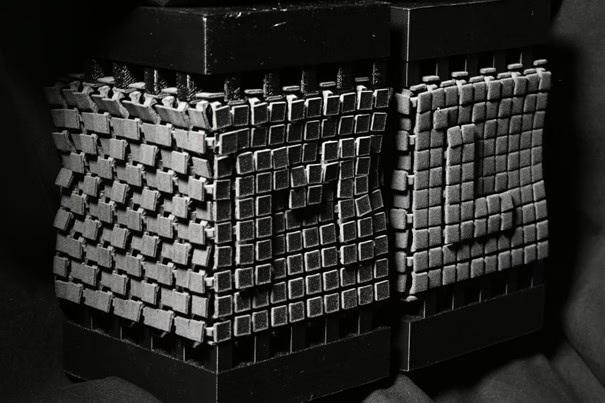
Floppy or not: artificial intelligence predicts properties of complex metamaterials
Given a 3D piece of origami, can you flatten it without damaging it? Just by looking at the design, the answer is hard to predict, because each and every fold in the design has to be compatible with the flattening process. This is an example of a combinatorial problem. New research led by the University of Amsterdam and AMOLF has demonstrated that machine learning algorithms can accurately and efficiently answer these kinds of questions. This is expected to give a boost to the artificial intelligence-assisted design of complex and functional (meta)materials.
Extreme-ultraviolet light manipulation to unleash unprecedented capabilities
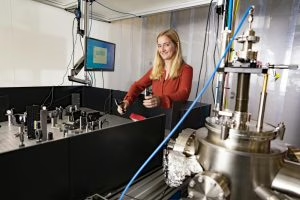
Short-wavelength light sources beyond the color that the human eye can perceive have tremendous application potential, but controlling them is notoriously difficult. First author Sylvianne Roscam Abbing (ARCNL, in a collaboration with AMOLF) is the first one to demonstrate control over extreme-ultraviolet light pulses using nanostructures. This opens the door towards both new ways of generating light, and also sensing nanostructures. The research team, consisting of members of the Resonant Nanophotonics group (PI: Femius Koenderink, AMOLF) and led by the High-harmonic Generation and EUV Science group (PI: Peter Kraus, ARCNL) published their findings in Physical Review Letters 128, 223902 (2022).
Regular patterns – like those found in nature – now also produced in the lab
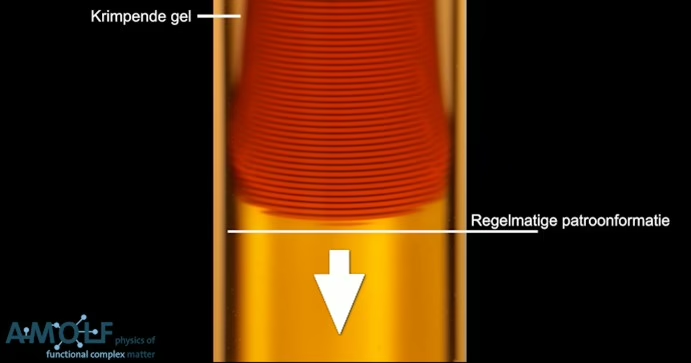
AMOLF researchers have found a new method for producing layered materials. Inspired by nature, they developed a physical-chemical process that yields highly regular microstructures. They describe this in a paper that was published this week in the journal PNAS. It offers the prospect of a relatively simple way to manufacture advanced, functional materials. Furthermore, the research can help us to better understand the genesis of natural patterns.
Optimization of human small intestinal organoids
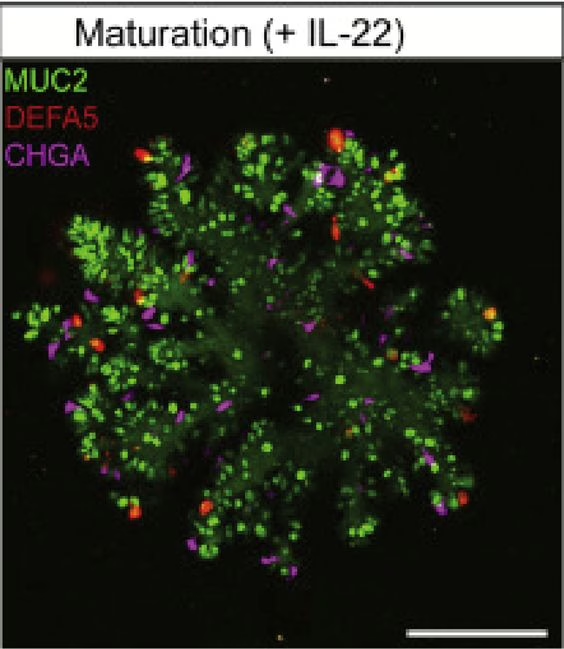
Collaborating scientists have improved human small intestinal organoids – miniature versions of the small intestine. This will help them to better study the functioning of the small intestine. The scientists from the Hubrecht and AMOLF institutes, and various other collaborators developed organoids that contain mature Paneth cells, which were not present in the earlier human small intestinal organoids. The results of the study were published on 23 August in Cell Stem Cell.