
News & updates
Latest developments from our institute
Stay informed about new research results, awards, events, and collaborations across our scientific community.
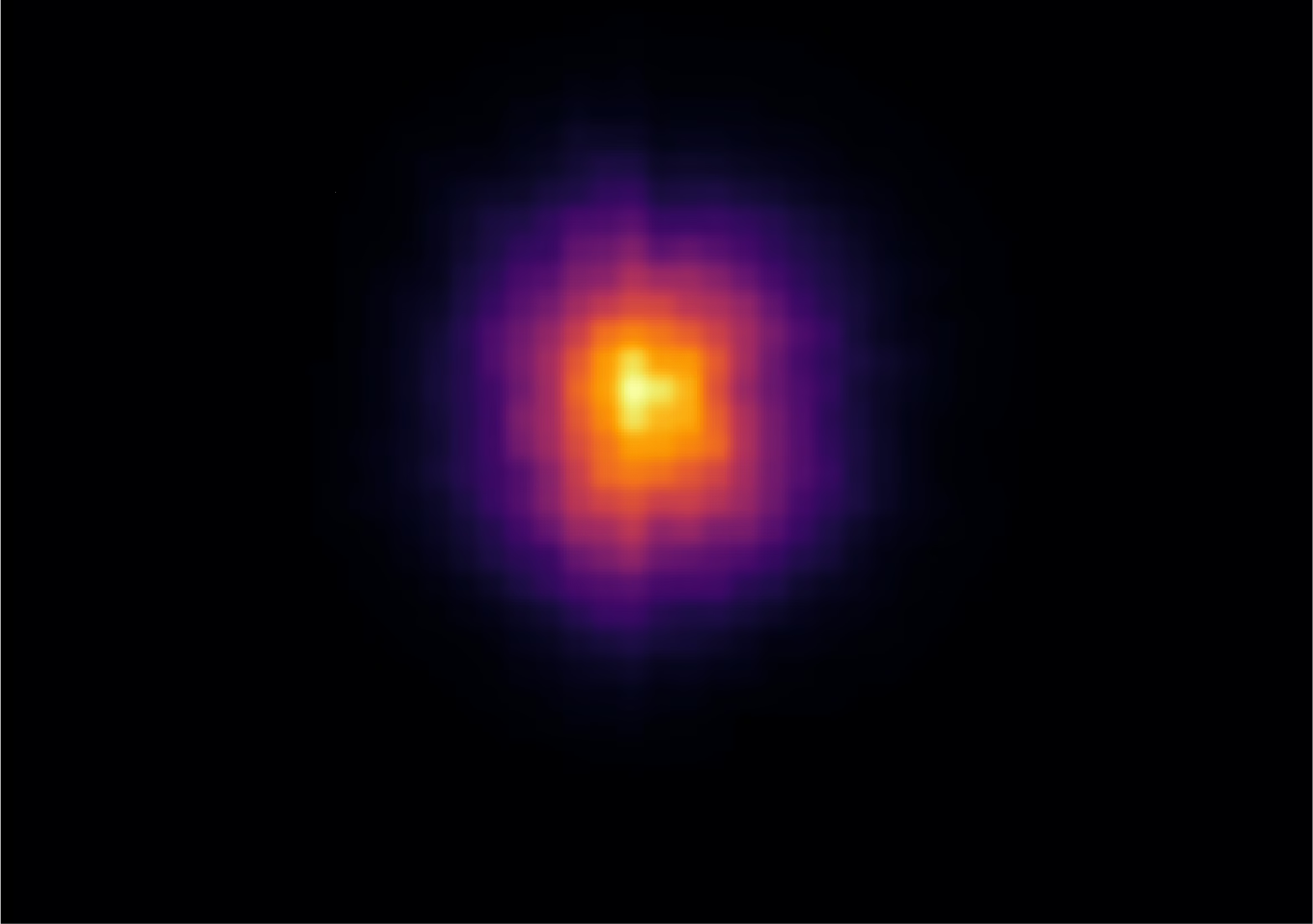
Snapshots freezing a nanoswing : Accurate position measurement overcomes thermal fluctuations
Physicists at AMOLF have managed to cool a swinging nanosized string to near-zero temperature without using external refrigeration. In their experiment, the cooling is an intrinsic result of the ‘snapshot’ position measurement they did on a specially designed nanostructure. The snapshot method, developed in AMOLF’s Photonic Forces group, offers opportunities for new applications in quantum sensing with unprecedented sensitivity.

ERC Starting Grant for Said Rodriguez
AMOLF group leader Said Rodriguez (Interacting Photons) has received a Starting Grant of 1.5 million Euros from the European Research Council (ERC). The project is entitled “Strongly CORrelated Polaritons In Optoelectronic Nanostructures” (SCORPION), and it will last 5 years. The ERC uses this grant to support talented early-career scientists who have already produced excellent research, and show potential to be a research leader. Rodriguez will use the grant to study phase transitions of strongly coupled light and matter. Conventional phase transitions of matter, such as boiling, freezing, and condensation, display some of the most fascinating collective behavior found in nature. Rodriguez aims to achieve similar effects for light and matter simultaneously, by making matter strongly interact with light confined between two mirrors.

Veni grants for Eline Hutter and Sven Askes
The Dutch Research Council (NWO) awarded Veni grants to AMOLF postdocs Eline Hutter (Hybrid Solar Cells group) and Sven Askes (Nanoscale Solar Cells group).

Phys.org: Engineers design nanostructured diamond metalens for compact quantum technologies
The practical challenge of collecting information from a single atom deep inside a crystal is a daunting one, however. Penn Engineers addressed this problem in a recent study in which they devised a way to pattern the surface of a diamond that makes it easier to collect light from the defects inside. Called a metalens, this surface structure contains nanoscale features that bend and focus the light emitted by the defects, despite being effectively flat. Source: Phys.org
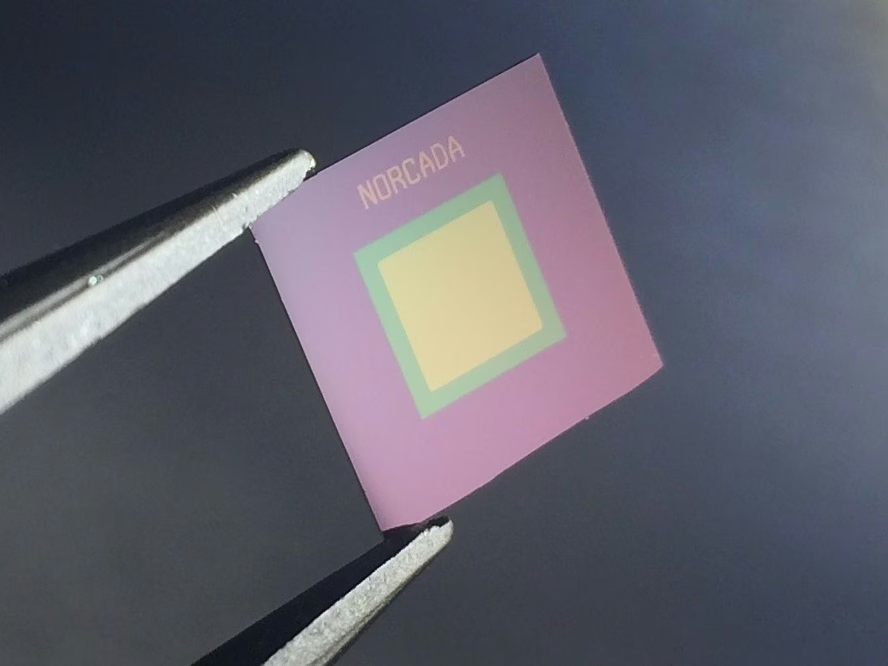
Less can be more: semiconductor nanowires for flexible photovoltaics
Capturing and manipulating light at nanoscale is a key factor to build high efficiency solar cells. Researchers in the 3D Photovoltaics group have recently presented a promising new design. Their simulations show that vertically stacked nanowires on top of ultrathin silicon films reduces the total amount of material needed by 90% while increasing the efficiency of the solar cell. These promising simulation results are an important step towards new generation solar cells that are used in myriad ways in our buildings and landscape. The results have been published on May 23rd in Optics Express.
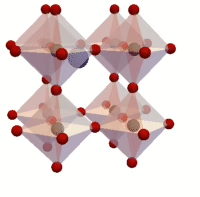
How an old method helps to understand new solar cells
Together with researchers from the University of Konstanz in Germany, researchers at AMOLF rejuvenated an old technique for measuring mobile ions in a promising new group of solar cell materials known as halide perovskites. The results have been published on April 24th in the journal Materials Horizons.
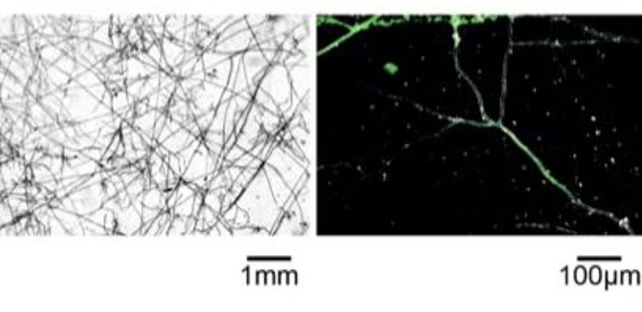
International award for research on symbiotic networks
AMOLF group leader Tom Shimizu (Systems Biology) and colleagues from the Netherlands, USA and Japan have received a 1.2 million dollar research grant from the Human Frontier Science Program (HFSP).
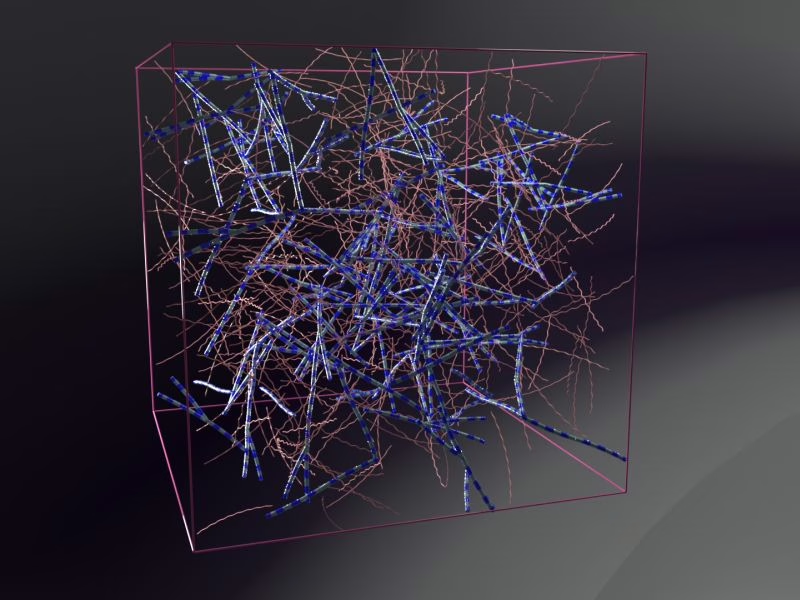
Under our skin: how hyaluronan regulates the stiffness of tissue
Our skin can switch from being soft to stiff if necessary. Other tissues, such as muscle tissue and cartilage, can likewise change their stiffness in a way that is tailored to their function in the body. Scientists from AMOLF and Wageningen University recently discovered that these stiffness changes are regulated by a crucial biomolecule known as hyaluronan. The researchers published their findings on 25 February in the prestigious journal Nature Physics.