
News & updates
Latest developments from our institute
Stay informed about new research results, awards, events, and collaborations across our scientific community.
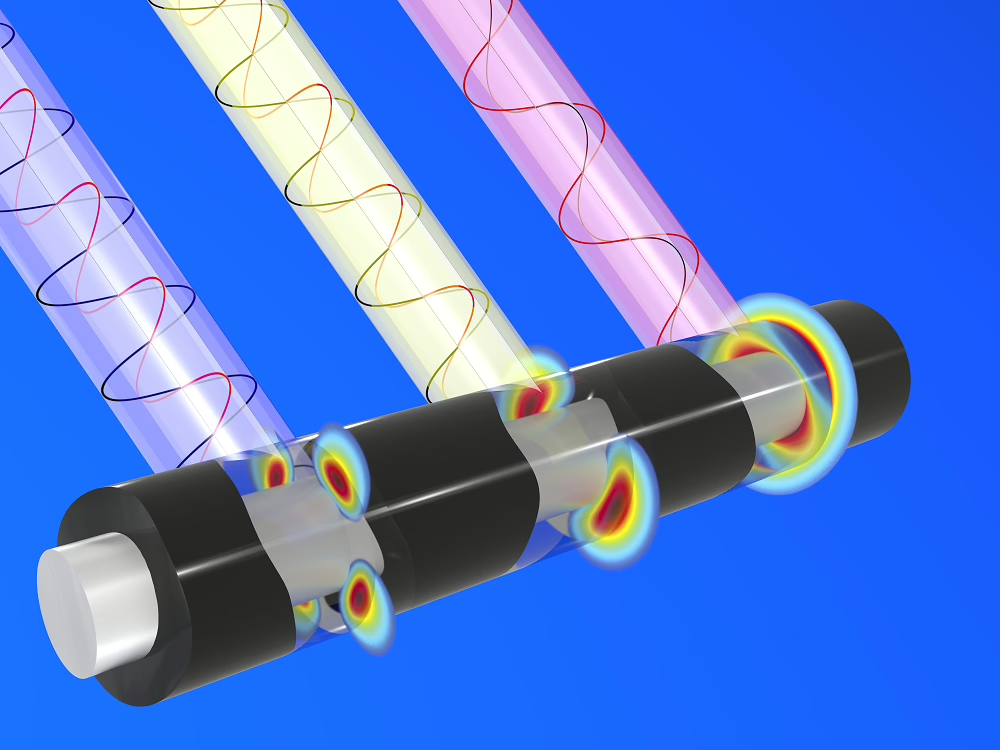
Rubicon award for Sander Mann
Former AMOLF PhD student Sander Mann has received an NWO Rubicon award to do research at the CUNY Advanced Science Research Center in New York. Mann obtained the cum laude degree for his doctorate research in the Nanoscale Solar Cells group led by Erik Garnett.
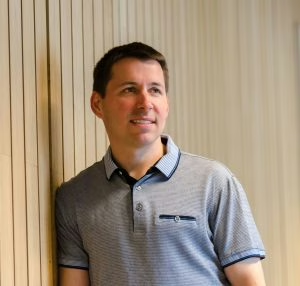
Erik Garnett appointed professor of Nanoscale Photovoltaics at the UvA
Erik Garnett has been named professor by special appointment of Nanoscale Photovoltaics at the University of Amsterdam’s (UvA) Faculty of Science. The chair was established on behalf of the Foundation for the Promotion of Atomic and Molecular Physics. Garnett will continue working at AMOLF as group leader of the Nanoscale Solar Cells group.
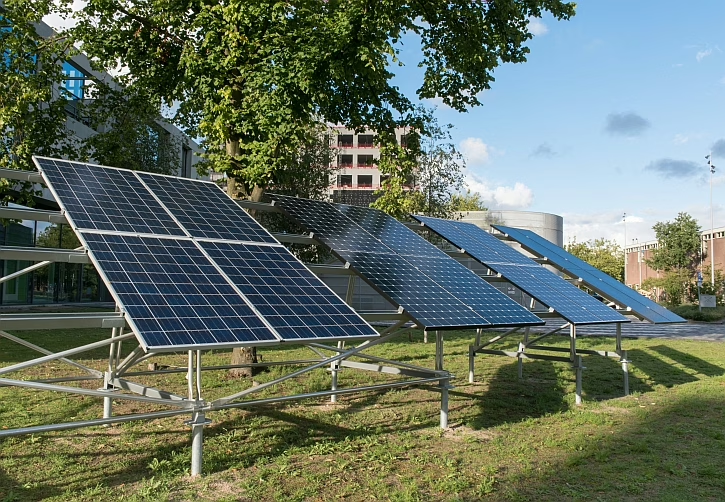
Nature Energy highlights three terminal configuration publication
On November 9th the journal Nature Energy highlighted a Nano Letters publication of the Nanoscale Solar Cells group in which they present a new type of tandem solar cell: the three terminal configuration. In the highlight with the ominous title ‘Dawn of the three-legged beast’, the author Elsa Couderc explains the purpose of introducing a third configuration, in addition to the two existing ones. She also touches on the design of the new device and its accomplishments, such as reaching an efficiency of up to 32,9%.

Dick Stufkens Prize 2017 awarded to Sven Askes
The Dick Stufkens Prize 2017 for the best PhD thesis of the Holland Research School of Molecular Chemistry (HRSMC) is awarded to AMOLF postdoc Sven Askes. In his thesis ‘Upconverting Nanovesicles for the Activation of Ruthenium Anti-Cancer Prodrugs with Red Light’, Askes describes a clever combination of materials and techniques for a new approach in photochemical cancer therapy. The jury was impressed by the quality, the originality and the interdisciplinary character of Sven Askes’s PhD thesis and expects that the work will have considerable impact on future development of photochemical cancer therapy.
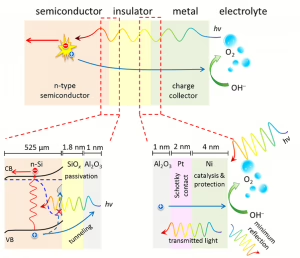
Cheap, efficient and stable photoelectrode could improve water splitting with solar energy
Water splitting with solar energy could provide an efficient route for large scale renewable energy conversion and storage. Scientists from TU Delft and AMOLF have now engineered a very efficient and stable photoelectrode, a material that absorbs light and directly splits water into hydrogen and oxygen. Furthermore, they use silicon wafers as the light absorbing material, so the system is also cheap. They report on their findings in Nature Communications on Thursday, June 29th.
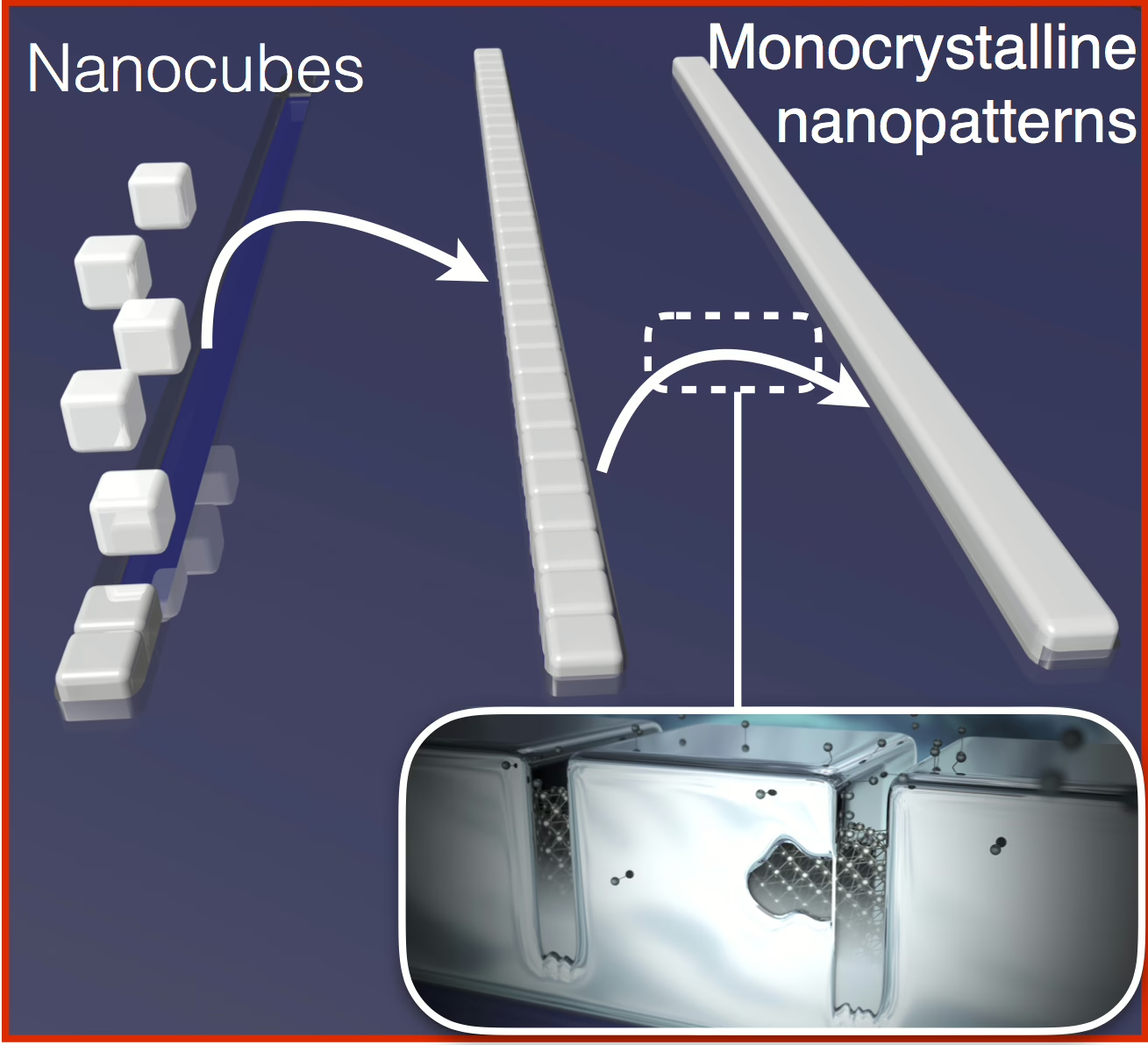
A crucial step towards better performing solar cells
Solar cells need monocrystalline materials to work optimally. But the traditional way to build monocrystalline materials is highly time consuming. AMOLF physicists in the Nanoscale Solar Cells group have found a new way of building them, which is at least a hundred times more efficient. This research has been published in the journal Advanced Materials on 3 May 2017.
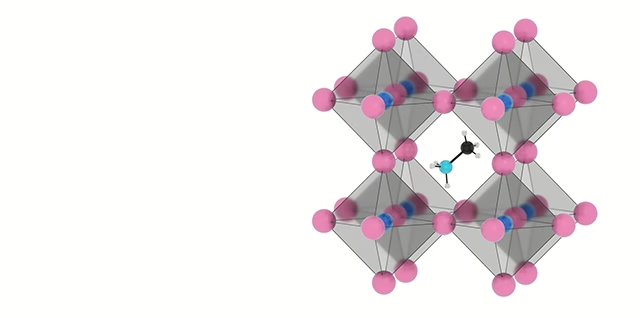
Solar cell wonder material surprises researchers : Unexpected experimental results lead to a better understanding of promising perovskite
Physicists at AMOLF have unraveled the mysterious working mechanism of a promising new class of materials for solar cells. Their pressure experiments with perovskite semiconductors had very counter-intuitive results, which could not be explained by the theory for conventional semiconductors. However, the results matched surprisingly well with a novel theory developed at Imperial College in London, predicting a peculiar band structure in perovskite materials. “Theory and experiments came together perfectly and helped us solve an important part of the perovskite puzzle”, says AMOLF group leader Bruno Ehrler, who published the results in Energy & Environmental Science on 23 December 2016.
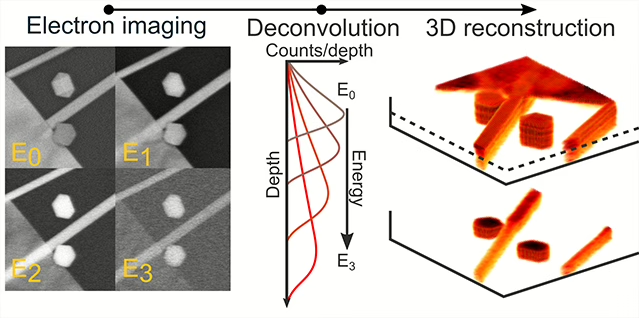
New imaging techniques
Researchers in the Nanoscale Solar Cells group at AMOLF have recently published two papers, one in Nature Communications and one in Nanoscale, demonstrating new imaging techniques for investigating the nanoscale properties of materials.